Type Single seat trainer glider
Dimensions Length 5,00 m, height 1,60 m, span 13,20 m, wing area 17,2 m2, aspect ratio 10,13
Weights Empty 130 kg, max. 210 kg, wing loading 11,1 kg/m2
Performance Max..gliding ratio ca 15, min. sink ca 0,9 m/sec
Type Werk.Nr Registration History
Designed by Alexander Lippisch and Fritz Stamer in 1923
The facilities of one and the same company could not have been further apart climatically than those of Weltensegler GmbH with its locations in Baden-Baden and Wasserkuppe. When the crocuses bloomed in Baden-Baden in March 1922, and for a cup since mocka was almost at seasonal prices, Fritz Stamer and two other Weltensegler employees renounced the pleasant life in this spa town, characterized by a genteel crowd strolling along Lichtentaler Allee and in the spa gardens. They set off with a three-wheeled Phänomobil and a trailer.- the two newly built training gliders carried - on the way towards the Rhön Mountains.
They drove straight into winter, wearing straw hats, and got stuck in the snow between Gersfeld and the World Glider buildings. The white splendor lingered on the
Wasserkuppe until the end of May; only then could the aircraft, painstakingly hauled up the mountain, be fully tested. One of the machines was an improved and reinforced
modification of the tailless Fetdberg- Types of Wenk, which Stamer was able to fly successfully several times before he crashed it in a sharp turn in front of his mother – lack of roll stability.
The physicist, meteorologist, aerodynamicist, and later PhD Friedrich Wenk (1893–1966) had already before the war a novel, M-shaped, curved gull wing design for a self-supporting, tailless construction was sought. Models he created brought the field meteorologist together with the aviator, engineer, and then airfield commander Fritz Peschkes (1896-1970) at Grodno airfield in 1916. Together, they began construction of a full-size version at the end of 1918. Inexperience in construction and other problems constantly delayed completion, but on August 17, 1920, the final design, reinforced by a strut bridge under the wing based on the model of old gliders, took off from Feldberg, the highest peak in the Black Forest, with Peschkes at the controls. The two-minute flight went down in history as the first true glider flight, because Peschkes impressively flew a closed figure eight with a takeoff altitude of up to ten meters. When aviation pioneer Dr.-Ing. Edmund Rumpler specially praised the flight in a lecture, the aviation enthusiast-Metz hopefully christened it "Frohe Welt" (Happy World), and primarily trained a number of young Swedes, whose crowns, as a stable currency, greatly helped the world-traveling enterprise during the rampant inflation in Germany. He became a specialist and at no time a tedious proponent of solo training on single-seaters.
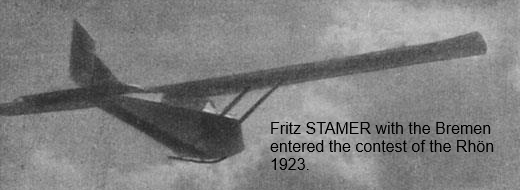
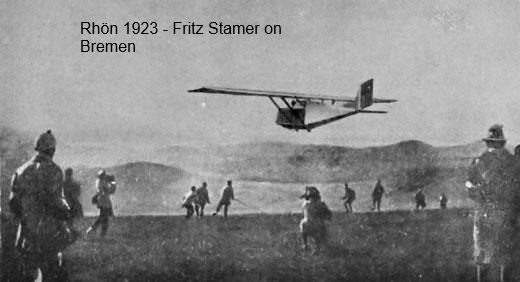
In the waning days of 1922, he designed a training aircraft for advanced pilots in Baden-Baden, which he named after his favorite for the Hanseatic city of Bremen. Although Stamer was an absolute advocate of the biplane for training purposes, he conceived this design—probably influenced by the Edith single-seater training aircraft of the Darmstadt academy pilots as a stylized high-wing aircraft. The design of the originally 13-meter wingspan wing, which later received additional small, trapezoidal wingtips, was undertaken by Alexander Lippisch. The entire aircraft was conventionally designed and constructed. It appeared very spacious. However, the fuselage was so short that the pilot could only operate the rudder pedals while wearing socks – there was no room for shoes.
On August 29, 1923, a crowd of thousands of visitors, including Prince Henry of Prussia and General Ludendorff, witnessed the dedication of the aviation memorial on the Wasserkuppe mountain amidst stormy winds. After several crashes by other pilots, they saw an impressive flight by Stamer in the Bremen. A day later, in still stormy weather, the pilot and aircraft completed a landing approach to Gersfeld.
With the same design and a similar appearance, Stamer and Lippisch developed the two-seater Nimm from the Bremen. me with, which then received the catchy sales name German Eagle, but with its wingspan of 21 meters proved difficult to handle.
When Stamer at the school opened at the end of August 1924 in competition with the World Sailing School When he saw greater opportunities at "Martens Flying School," he switched. Here he trained with several examples of the Pegasus, developed by Lippisch at Weltensegler – the progenitor of all training gliders. The facilities, abandoned due to unprofitability, were acquired in October 1925 by the Rhön-Rossitten-
Society and hired Stamer as headmaster. He was able to remain in that position until 1933, when he was transferred to Berlin as gliding officer of the German Air Sports Association at the Reich Air Sports Leader's office.
The early SA man Stamer, who in the 1930s often appeared in uniform on while residing at the Wasserkuppe, he became head of the German Research Institute for Gliding in 1943 and remained so until the end of the war.
After the war, the German Aero Club elected him vice president and, in 1962, honorary president.
In contrast to the loyalty shown to Stamer, the commercial World Gliding Society was always viewed with suspicion by the then idealistically minded gliding community. treated with a certain reserve, even to the point of complete disregard. In addition, the trend towards buying ready-made aircraft only began years later. In 1926, after significant financial losses, Alexander Steinmetz had to close the chapter on aircraft construction. Ten years later, on February 21, 1936, he died.
Technical Description
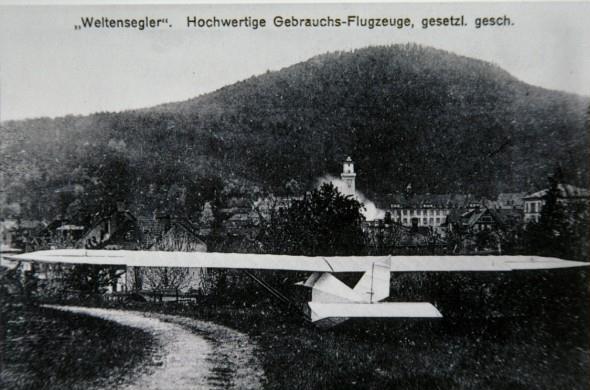
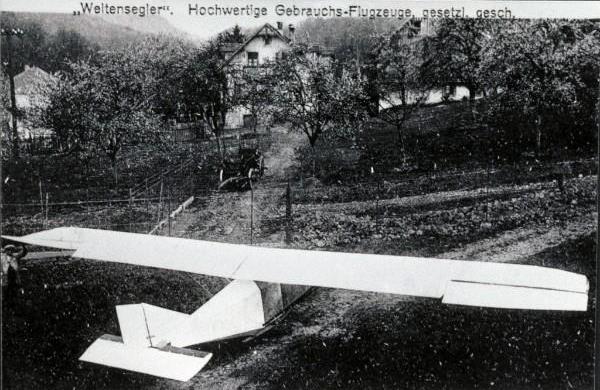
Wings: Two-part, each supported by two streamlined struts made of wood,
towards the fuselage lower chords. Two-spar construction with plywood-covered leading edge up to the front spar,
otherwise fabric-covered. Wooden structure with box spars, truss ribs and truss diagonal bracing. Rectangular outline with slightly trapezoidal wing- one made of plywood. Profile Göttingen 422. Unbalanced ailerons with strong warping.
Fuselage: Hexagonal cross-section. Superstructure made of wood, forward fuselage section with plywood frames and plywood skinning, rear fuselage section in truss construction of stringers and rods with fabric covering. Maximum width 600 mm.
Elevator: Undamped, balanced elevator in single-spar wooden construction with torsionally rigid plywood leading edge, otherwise fabric-covered. Wingspan 2.60 m. Triangular vertical stabilizer, as well as the enlarged rudder, constructed of wood and fabric-covered.
Landing gear: Central skid under the nose of the fuselage, designed as a "scatter skid" with a straight trailing edge, thus lifting the tail.
Coating: Completely impregnated with clear varnish.