Designed by the B.S.V. (Berliner Segelflugverein eV.), Berlin
Totally 3 built
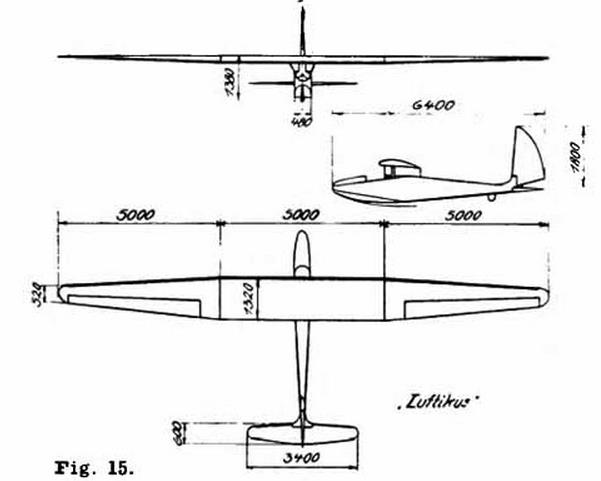
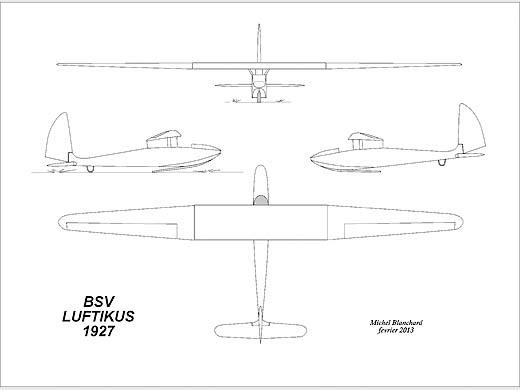
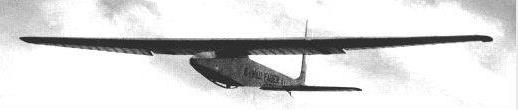
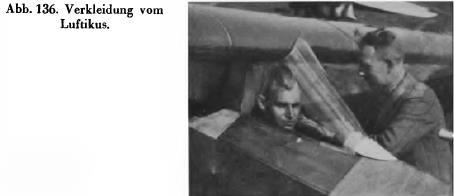
The form of the machine as a whole conforms to the earlier "Vampyr" design with improved and finer lines. The wing, of Gottingen 535 section, is in three parts and of singlespar construction, with a straight middle portion and trapeziform outer portions. An additional spar running inwards from the thrust point towards the rear further stiffens the middle portion. The wing lies upon a straight and somewhat high projection from the body and is further supported at a short distance from this by two short hollow steel struts, which are attached to the upper edge of the body. The body is surfaced with plywood, and is of hexagonal section in front and rectangular behind, like that of the "Vampyr." The greatest width of the body, 0.48 metres in the neighbourhood of the pilot, is astonishingly narrow, so that during a long flight the pilot is allowed little freedom of movement. The body terminated at the rear in a horizontal edge, which was broadened by a small horizontal stabilising fin. The high, pointed rudder was attached to a small fixed stabilising fin on the upper surface of the body in front of the elevator control mechanism. In fact this arrangement of the controls was formerly the general custom. The control surfaces were extraordinarily light but at the same time strongly built.

This glider was designed and built by O. HOHMUTH, president of the BSV (Berliner Segelflug-Verein e.V., Berlin gliding association), helped by the members of the club. He participated in the 1929 Rhön competition.
Despite its very angular shapes, this glider surpassed most of the other performance machines of the time, and allowed its young pilot Otto BEDAU to obtain his C diploma at the start of the competition.
Type Single seat glider
Dimensions Length 6,4 m , height 1,8 m ,  span 15 m , wing area  15,4 m2 , aspect ratio 14,6, wing profile Göttingen 535
Weights Empty 143 kg, loaded 214 kg , max. take off weight   wing loading 13,9 kg/m2
Performance Max.. speed  ,  sink 0,74 m/sec. at 50 km/h
.His name: Otto Bedau (1910-1987). Originally from West Prussia, he attended the Herder Reform Gymnasium in Berlin-Charlottenburg, where in 1924 he and some other students founded a flying group that wanted to practice gliding and build a self-designed glider. The leader of this group was the senior student Kurt Bornemann, who later became a graduate engineer at the Arado aircraft factory in 1935 and head of the weapons department in 1938. he successfully entered the French aviation industry after the war.
The 14- to 18-year-old students initially fought against the almost unanimous resistance of the teaching staff, but fortunately there were also supporters such as the crafts teacher, who supported his A workshop with complete tools was provided. The first flight exercises with a replica Pelzner hang glider took place in the Puttberge hills near Wilhelmshagen, east of Berlin, and—in the opposite direction—at the Hahneberg hill of the former Spandau fortress. Even if the low hills only allowed jumps of a few seconds, it was at least achieved that the Ministry of Education generally permitted gliding activities to be accepted instead of the obligatory gymnastic games. The students' perseverance and enthusiasm for work allowed the school glider to be completed in just under a year. The glider, which could be christened Manfred on May 2, 1925, was made available because a family member of the Baron von Richthofen family had taken on the godparenthood.
However, the Manfred only experienced a few launches. From the inventory of the dissolved Martens Flying School, the students of the "Manfred Baron von Richthofen Gliding Group at the Herder School," as they were now allowed to call themselves, received first a Pegasus SchuF glider and later another. Marfens training biplane
as a gift. The plan was to fly the new aircraft extensively in the Stöllner Mountains, 80 km from Berlin, in 1926. However, the difficult transport there over cobblestones and through potholes, unsuitable weather, and the many repairs required prevented any significant success. Therefore, in 1927, the student group joined the Berlin Gliding Club (B.S.V.).
This club had been founded on April 2, 1920, under the name Berlin Model Flying Club, and initially focused almost exclusively on model aircraft flying at Tempelhof Field, although some of its members had already gained experience in gliding before the war. Drude, Schalk, Schlack, and Friedrich W. Richter were also the names of the participants who represented Berlin at the first Rhön competitions from 1920 to 1923 with their own designs, before registering under the name of the club in 1924. It had been renamed the Berlin Model and Gliding Club in 1921, and from 1923 onwards, it was known simply as B.S.V. Otto Hohmuth (1892-1982), a native of Saxony from Merseburg, was involved from the very beginning. He had already learned to fly in the military in 1914 after abandoning his studies at the Technical University in Charlottenburg, went to the front in 1916 (four confirmed kills), and finally found a secure job at the Böhler steelworks after his release from captivity as a prisoner of war. He earned his glider pilot's license (No. 52) in June 1923.
The following Rhön competition in 1924 was not only to decisively change its fate. At the beginning of the year, the ambassadors' conference of the victorious powers had issued new definitions for the Treaty of Versailles, which—in simplified schematic terms—imposed new restrictions on the German aviation industry, but also permitted powered flight again. Those responsible for the gliding movement saw this as a danger of losing many of their slope-dependent followers to powered flight, which was now possible everywhere. Therefore, the idea of ​​the glider with an auxiliary engine was revived. Unfortunately, the main initiator and publicist Oskar Ursinus had his own ideas for the low-powered small aircraft, and he was able to win over the competition with lightweight construction and economical fuel consumption, boasting good gliding characteristics like a Good glide ratio or low sink rate. The lively construction activity then only resulted in a single model being built on the mountain, which, with a wingspan of 14 meters and the corresponding design, met the requirements of a motor glider (Messerschmitt S 15). All the others were small, or barely gliding, aircraft with wingspans around ten meters. One of them was designed by Otto Hohmuth. He had built it for the Sperber construction group within the B.S.V. designed and built the aircraft. And he wanted the high-wing aircraft, nicknamed Knorke, with a wingspan of twelve meters and with the 588cc two-cylinder boxer engine (8 to 10 hp) of his club colleague Prussing at the Rhön competition, he also flew it himself. Immediately after takeoff, the aircraft began to oscillate violently. With a broken horizontal stabilizer, the Knorke crashed vertically. Hohmuth was so badly injured that he had to spend half a year in the Fulda hospital with two broken legs and a severe spinal injury, in traction. As a result, his company forbade him from any further flying activity. He turned to design.
As early as 1925 - now chairman of the B.S.V. - Hohmuth designed the Berolina training glider for his club, a stylized lattice-tail type, which proved to be robust and useful, and with which the 2,000th launch was already achieved in 1931. Another lattice-tail training glider, the Fliege, became his most successful design. It arose from the lack of gliding training aircraft and fulfilled a number of hardly compatible requirements, which level exam.
From the glider and its derived variants, Hohmuth developed plans that led to a number of replicas. In 1927, however, he proposed the construction of a high-performance glider called Luftikus to offer the club greater development opportunities. Once again, several members came together in a special construction group, including the oldest member, Willi Drude, a veteran of the first Rhön competitions, and the youngest member, Otto Bedau. Hohmuth's motto here, too, was: High performance with low production costs and simple construction. The fuselage cross-section was chosen to be angular because it was easy and economical to manufacture, and the wingspan was limited to a modest 15 meters because every additional meter would have increased costs and unwieldiness. These were all not attributes of high performance – but had the Luftikus appeared as planned at the 1928 Rhön competition, it would have been a sensation because of its flight performance. But things turned out differently: The production costs could be kept low, planned at around 700 marks, but despite the simple construction method, the labor required to build a high-performance glider was significantly underestimated. When the inspectors wanted to approve the prototype, despite working day and night, part of the fuselage was still missing.
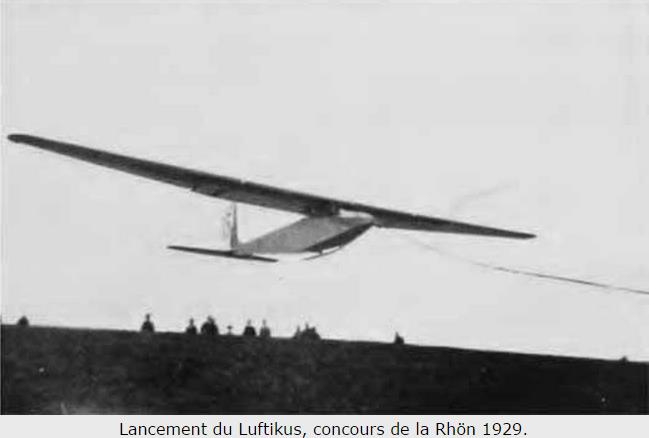
The 9th Rhön Competition was already legendary, and the year was drawing to a close when the glider was finally finished. The christening then took place in May 1929 with liquid air. Subsequently, Otto Bedau successfully flew the aircraft from the windmill hill in Berlin-Gatow, which rises ten meters above the plain. There was only a little to make improvements for competition participation.
Since 1926, the Rhön Gliding Championships had been divided into three classes, since- with all participants having equal chances, namely in a shoe practice and performance competition. The pilot who wanted to participate in the performance competition had to have passed his C-exam before January 1,1926.
When the Berliners arrived with completely inadequate transport equipment, finally making it to the Wasserkuppe for the 10th Rhön Competition on a horse-drawn, straw-padded cart, just like in pionee  times, their pilot Bedau was only a simple B-pilot. But that changed quickly: As early as the third day of the competition, he took off first at 8:25 a.m. and stayed in the air for 6 minutes 10 seconds for the C conditions. One day later, he was already flying in the clouds and reached an altitude of 610 meters above takeoff.
At the end of the competition, the B.S.V. could be satisfied with its design and proud of its pilot: Bedau won the altitude prize in the practice competition. With the addition of all takeoff altitudes, he achieved a total of 4,930 meters and was thus able to place himself ahead of such outstanding competitors as Erich Bachem (3,414 m on Württemberg) and Rudolf Neiniger (2,724 m on Darmstadt).
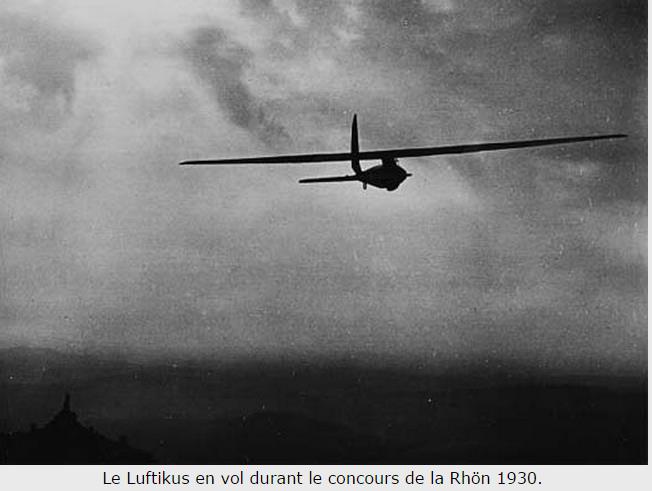
For the next Rhön in 1930, the transport issue was first addressed by acquiring a car, as well as the design and the construction of a transport trailer solved. Bedau started again with the Luftikus in the practice competition. The final result: He came in second place with a total flight time of 27 hours and 28 minutes and was once again the high-altitude winner. For the cloud flight described at the beginning, Bedau also received the "Prince Heinrich Prize," which was coupled with a challenge cup, which he received from the previous year's winner, the gliding legend Robert Kronfeld.
The Rhön region saw the Luftikus again in 1931. This time it was equipped with instruments such as a variometer and a parachute. Bedau launched for the first time in the Leis-tungsklasse. However, he only managed a few short flights. To this end, he made the daredevil known to wider circles through the new glider towing method. The introduction and testing of the "American wire-towing" method with car or tow plane, which Hans Helbig of the gliding committee of the DLV (German Aviation Association) had initiated in 1931, took place at the Berlin airports. An old Albatros B training glider, a design from the First World War, served as the tow plane. This was borrowed to tow a training glider acquired by the Pomeranian State Association of the DLV from the B.S.V. in flight. Since an airshow was taking place in Stettin at the same time, it was decided to tow the Luftikus at the same time to present a two-glider tow as an attraction. Later, in Berlin, the Luftikus was also involved in the first three-glider tow. Initially, attempts were made to train other club members who were significantly involved in the design and construction to become pilots for the Luftikus, which not only failed but also led to the first breakup. However, members who were more thoroughly trained and already experienced competitive pilots soon followed. could demonstrate practical experience.
Thus, at the Rhön competitions in 1932 and 1933, various pilots took turns flying the aircraft.
Among them was Heinz Kensche.
He had joined the aircraft testing station in 1931 and established the testing system at the DVL in Berlin-Adlershof. In 1928, he had learned to fly gliders in his homeland with the "Silesian Eagles." He became a recipient of the Golden Performance Badge No. 16. Also in 1931, Otto Hohmuth had joined the B.S.V. Based on the Luftikus and looking very similar to it outwardly, a new high-performance glider, the Windhund, was developed and brought to the workshop, in which the wing had been slendered to a very narrow wingspan of 18 meters by attaching external parts. Kensche undertook significant work for the static design. For this purpose, he flew it exclusively at the Rhön competition in 1933 and achieved several multi-hour flights. At the next competition, the Luftikus was no longer present for the first time – but its descendant, the Windhund, was, this time flown by Ernst Gunther Haase (the later recipient of the gold performance badge No. 17). Haase successfully participated in further Rhön competitions and, in the 1950s, together with Kensche (and financed by a gliding veteran, the needle manufacturer Schmetz), realized the fundamental ideas for the high standard of today's high-performance gliders with their then two- and single-seat designs HKS-1 and HKS-3.
Although these were still built of wood, their laminar airfoils possessed such a high surface quality and aerodynamic-technical characteristics that glide ratios of around 40 allowed for glide ratios. The HKS models can be considered a milestone on the way to modern high-performance gliders made of composite materials. But they were built on a foundation from which both designers could start – namely, the Luftikus. It was an extraordinary construction for its time, exceptional in appearance and exceptional in performance.
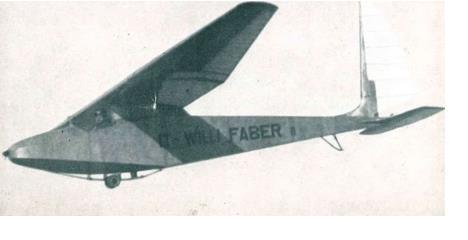
Only three machines of this type were ever built: the original of the B.S.V., secondly a replica in Magdeburg by the local air police gliding group (Flugverein luwa of the regional group XIII in the DLV), which flew under the name D-Willi Faber II, and thirdly a replica built by the Spandau glider pilot Hans Böhnert, who was shot down over Norway during the war, in his father's boatyard in Berlin-Pichelsdorf.
The mastermind behind the Luftikus, Otto Hohmuth, had to withdraw from the project in the mid-1930s.Transferred to Breslau, withdrawing completely from aviation, but after theoutbreak of war, despite his age and the not fully healed injuries from his crash in the Rhön, he reacquired his glider pilot's license and ran a gliding school in Prague-Gbell.
In 1980, during his first visit to the Wasserkuppe after more than 50 years, he met his early successful pilot, Otto Bedau, again.
After some time training in powered flight with Deutsche Luftfahrt GmbH, Bedau had to give up gliding when he joined the Berlin Airship Operating Company in 1933, which used the hard-shell airship ODOL as an advertising vehicle. In 1934, Bedau acquired the helmsman's license.
Airship pilot's license and a year later the airship pilot's license (No. 4). From 1937 to 1939, now employed by the German Zeppelin Shipping Company as 3rd officer, he flew on the airships Graf Zeppelin and Hindenburg. Finally, at the end of 1939, drafted into the Luftwaffe as an aircraft pilot, he spent almost the entire war years as a navigation instructor. As a navigation instructor, he also joined the newly founded Lufthansa in 1955 and remained there for 18 years until his retirement in 1974. Otto Bedau regularly visited the Rhön region – but he never flew a glider again, so that the glider could remain his first and great love.
Type Werk.Nr Registration History
D-Willi Faber II Replica in Magdeburg by the local air police gliding group (Flugverein luwa of the regional group XIII in the DLV),
Built by the Spandau glider pilot Hans Böhnert