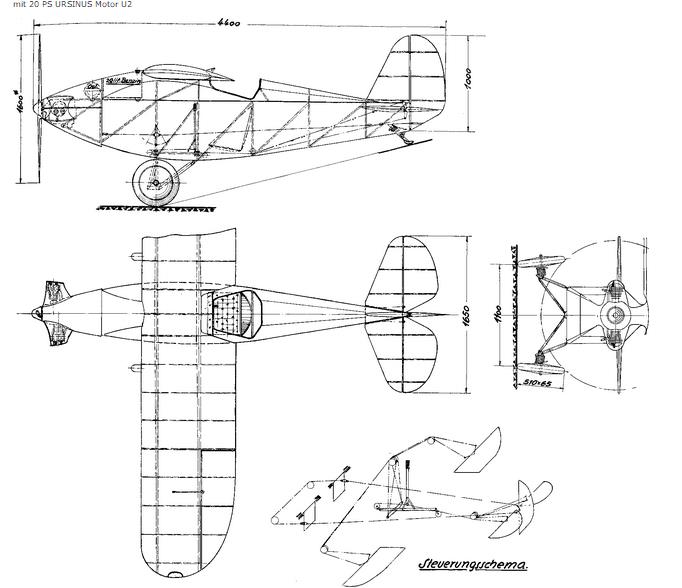
Ausgehend von dem Grundsatz, ein billiges, einfaches und leichtes Volksflugzeug mit wenig PS zu schaffen, wurde das Leichtflugzeug KE. 8 entwickelt.
Schon der äußere Aufbau läßt ohne weiteres erkennen, daß diese Grundsätze weitgehend verwirklicht wurden.
Das Flugzeug ist ein freitragender Hochdecker mit einem 15/20 PS U2 Ursinus-Motor, der infolge seines geringen Gewichtes von nur 27,5 kg für die Konstruktion dieser
Art von Leichtflugzeugen nur in Frage kommt.
Bei der Konstruktion des Rumpfes wurde der bewährten Stah I roh rb au weise der Vorzug gegeben, d. h. geschweißtes Stahl roh rgerü st mit Rohrdiagonalen. Auf die
Auskreuzung mit Stahldraht zwischen den einzelnen Feldern wurde mit Rücksicht auf eine einfachere und billigere Herstellungsweise verzichtet, da eine rechnerische
Nachprüfung fast gar keinen Gewichtsunterschied zwischen beiden Konstruktionsarten ergab. Die Erfahrungen der letzten Jahre haben gezeigt, daß Stahlrohrrümpfe
bei Brüchen den Insassen eine höhere Sicherheit gewähren als Holzrümpfe, wie sie eine weit größere Kräfte- und Arbeits auf n ah mefähigkeit besitzen. Die Rumpfform
ergibt sich durch Bespannung mit Stoff. Die im Aufbau sehr einfach gehaltene Knüppelsteuerung kann nach Lösen von 4 Bolzen, durch Unterlagen von Scheiben sehr
leicht ausgerichtet werden. Die Betätigung des Seitensteuers erfolgt durch hängende Pedale, die mittels Ausgleichrollen organisch verbunden sind. Das Steuerwerk wird
aus Hebeln und um Seilrollen geführte Seile gebildet. Alle Teile sind gut zugänglich und die Lagerstellen mittels Subnippel geschmiert.
Der Ursinus-Motor Type U2 hängt in einem mit dem Rumpf verschweißten Stahl roh rgerü st, und besitzt 3 Punkt-Auf hängung, bei denkbar einfachster Einbaumöglichkeit.
Für die Dreipunktbefestigung des Motors sind 3 kräftige Pratzen am Motor angeordnet, und zwar derart, daß nur der obere Befestigungsbolzen auf Abscherung
beansprucht wird. Bei den beiden unteren Befestigungsstellen wirkt der Reaktionsdruck fast senkrecht auf den Holm. Der Motor und Rumpfbug sind
aluminiumverkleidet. Um die Zylinder liegen seitliche Hauben, die vorne und hinten offen sind, in der Art des bekannten Town-end-Ringes. Die Motorhaube ist in der
Mitte geteilt und läßt sich nach Lösen von einigen Schnellverschlüssen nach oben und unten auf- bzw. abklappen, und gestattet dann infolge des jetzt völlig
freiliegenden Motors eine gute Kontrolle desselben. Hinter dem Motor befindet sich ein Brandschott.
Vor dem Brandschott befindet sich der 2,5 Liter fassende Oel-tank, und hinter dem Schott auf den oberen Rumpfholmen der ca. 20 Liter fassendel Kraftstofftank,
welcher für eine Zeit von fast 4 Vollgasflugstunden ausreicht.
Das Tragdeck mit einer Spannweite von 5,6 m wird mit 4 Bolzen auf dem nach oben erhöhten und eingezogenen Rumpfe befestigt. Es ist in einem Stück bei
gleichbleibender Flügeltiefe zweiholmig ausgeführt mit abgerundeten Enden. Im Bereiche des Führersitzes ist ein kleiner Sitz aus schnitt vorhanden. Das Tragdeck ist von
Oberkante Hinterholm über die Flügelnase bis Unterkante Hinterholm mit Sperrholz von 1,2—0,8 mm beplankt. Ueber die ganze Fläche sind im ganzen 6 normale Rippen als Kastenrippen ausgebildet. Die Sperrliolz-beplankung der Fläche ist zwar etwas schwerer in der Ausführung, ist aber billiger als Innenverspannung, zumal letztere beim
freitragenden Flügel sich sehr ungünstig auswirkt, und Schubplatten auch das Profil sehr gut erhalten, eine Bedingung, die bei diesen kleinen Flugzeugen eine
Notwendigkeit ist. Als Profil wurde Gott 593 verwendet.
Am Hinterholm schließen sich außen die je 0,36 nr großen Querruder an. Sämtliche Lager sind ausgebuchst und leichtgängig. Ausführung in Stahlrohr.
Beim Fahrgestell mit einer Normalspurweite von 1,10 m wurde der Drehpunkt der gefederten Achse nach unten verlegt, um eine größtmöglichste Montagegenauigkeit zu
erreichen, ohne Verwendung von Schablonen. Durch einfaches Nachstellen der inneren, nach dem Rumpfmittel gehenden Zugstrebe, kann die Spurweite zu jeder Zeit
nachreguliert werden. Die nicht durchgehende Achse bietet die bekannten Vorteile beim Starten und Landen auf unebenen oder mit Gras bewachsenen Plätzen. Der
Federweg beträgt 50 mm + Elastizität des Reifens.
Die am Boden verstellbare Dämpfungsflosse von 0,43 m2 ist zweiteilig in Stahl rohrfach werk ausgeführt, und wird seitwärts in die Hinterschneide des Rumpfes
eingesteckt. Sie ist durch Stahldraht nach dem Steven und nach oben zum Seitenflossenholm abgefangen.
Das Höhenruder ist ebenfalls zweiteilig ausgeführt und durch ein Rohr verbunden, Pro Seite befinden sich 2 Lager, welche mit Messingbuchsen ausgebuchst sind.
Auf der Verlängerung des Rumpfstevens schließt sich die Seitenflosse an. Der vordere Randbogen ist auf dem vorletzten Spant befestigt.
Das 0,3 m2 große Seitenruder ist am Seitenfbssenholm dreimal gelagert und mit Messingbuchsen versehen.
Sämtliche Ruder sind stoffbeplankt und nicht entlastet.
Die Montage der Maschine ist die denkbar einfachste. Durch Lösen von 4 Querruderkabeln und 4 Steckbolzen kann der Flügel abgenommen werden.
Daten: Gesamte Flügelfläche 5,25 m2, Aerodyn. Flügelfläche 5,0 m2, Seitenverhältnis rt = 0,167 : rt= 1:6; Flügelprofil Gött: 593,
Reisegeschwindigkeit 141 km-Std., Höchstgeschwindigkeit 161 km-Std., Landegeschwindigkeit 79 km, Steiggeschwindigkeit 2,3 m-Sek.; Rüstgewicht 110 kg, Zuladung
= 100 kg, Fluggewicht 210 kg, Flächenbelastung 40 kg-m2, Leistungsbelastung 10,5 kg-PS, Spannweite 5,6 m, Länge 4,4 m, Höhe 1,45 m, Motor: Ursinus U2, 20 PS,
Aktionsradius 500 km.
| Type |
|
| Engine |
|
| Dimensions |
Length , height , span , wing area , |
| Weights |
Empty , loaded , max. take off weight |
| Performance |
Max.. speed , cruising speed , range , endurance , service ceiling , climb |
| Type |
Werk.Nr |
Registration |
History |
|
|
|
|







