Versuchsflüge mit Arno Vogel-Schwingenflugzeug.
Schwingenflugmodelle sind schon seit 1909 auf der IIa in Frankfurt am Main geflogen. 1920 erschien Senator Zeise (vgl. „Flugsport'4 S. 209/1933) auf der
Wasserkuppe zum ersten Rhön Wettbewerb mit einem Segelflugzeug mit Yortriebsschwingen. Dieses Flugzeug ging leider vorzeitig in die Brüche. Ferner ließ sich Dr.
Brustmann, nachdem seine Versuche 1925 („Flugsport" S. 369/1925) mit einem Schwingenfahrrad keine Erfolge brachten, von A. Lippisch einen gleitfähigen
Schwingenhoclidecker konstruieren, mit dem Werner Krause und Fritz Stamer Gleitschwingenflüge ausführten und dabei den Gleitflug auf das doppelte verlängerten
(„Flugsport" S. 372/1930).
Seit jener Zeit sind wesentliche Fortschritte auf diesem Gebiet nicht gemacht worden. Versuche zur Bestimmung des Leistungsbedarfs von Schwingenflugmodellen
wurden verhältnismäßig wenig durchgeführt. Die Hauptsache war, zunächst zu untersuchen, ob der Leistungsbedarf bei Schwingenflugmodellen geringer ist als bei
Drachenmodeilen. Solche Untersuchungen wurden von Arno Vogel, Plauen, 1941 (vgl. „Flugsport" S. 221/1941), welche auch einen sehr einfachen
Schwingenmechanismus, der beim Aufschlag ein möglichst widerstandsfreies Durchschneiden der Luft gestattet und beim Abschlag eine Auf- und Vortrieb erzeugende
Wirkung ermöglicht, durchgeführt. Die Moclellfhigversuche von Arno Vogel ergaben beim Drachenmodell 5,2 mkg/sec und beim Schwingenflugmoclell nur 4,1 mkg/sec
Leistungsbedarf.
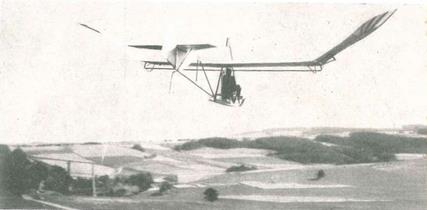
Vogel entschloß sich nun, seine Schwingen in natürlicher Größe für Menschenflug zu versuchen. Er baute seine Schwingen mit Antriebs Vorrichtung durch Beine unter
Mithilfe von Dr. Karl Förster NSFK. und Martin Förster FLHJ. in einen Schulgleiter 38 ein. Vgl. die nebenstehende Abb. Bei den Flugversuchen galt es festzustellen, wie
sich die Wirkung der Schwingen auswirkte und die Gleitflugentfernung vergrößert wurde. Die Versuchsmaschine wurde von Flugzeugführer Stubaf. Pult, NSFK.-Stan-
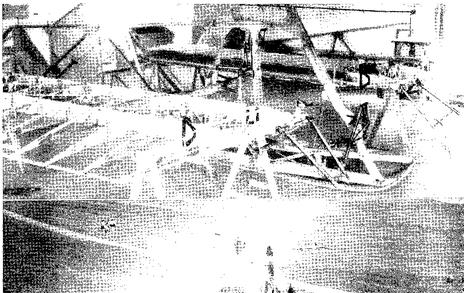
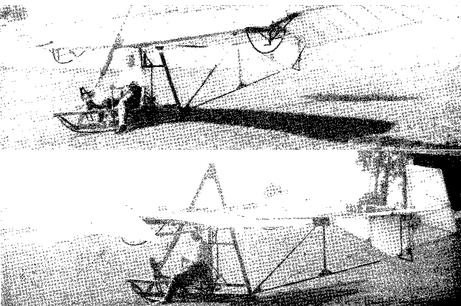
darte 37, Chemnitz, zunächst mit festgestellten Schwingen im Gleitflug und dann zum Vergleich mit Betätigung der Schwingen, ohne jegliches Arno-Vogel-Schwingen Versuchsflugzeug. Man erkennt an dem Rumpf des Schulgleiters 38 das angebrachte Antriebsgestänge und an dem abgeschnittenen Flügelende
die Hebelanordnung für die Schwingen. Unten: Gleitflug mit festgestellten Schwingen. Gesamtfläche 14 m2. Gew. 108 kg. Bilder Dr. Förster (5)
vorhergegangenes Training geflogen, wobei trotz der Betätigung der Trethebel durch Beine und Betätigung des Knüppels durch Hand eine gute Längs- und
Querstabilität festgestellt wurde.
Die Flugergebnisse waren folgende: 18. 8. 42 Gleitflug: Querruder mit Seitenruder gekuppelt, Flugdauer 14 sec.
18. 8. Schwingenflug: Fluglage gut, Rechtskurve, 18 sec.
18. 8. Schwingenflug: Strecken Verbesserung beobachtet, 18 sec.
19. 8. Schwingenflug: Zur Erzielung eines rascheren Abschlages der Schwingen wird längs der Zugstangen ein Gummiseil gespannt. Ergebnis: Streckbewegung
bequemer, Aufschlag ist zu langsam, 17 sec.
19. 8. 3 Gleitflüge: 1. SW-WincI 2-4, Flugzeit 12 sec, Flugstrecke 159 m.
Arno-Vogel-Schwingen Versuchsflugzeug. An Stelle der Seitenruderpedale sind Hebel, die mit den Beinen nach vorn getreten werden und die Kraft durch Gestänge und
Winkelhebel betätigen, angebracht.
2. Gleitflug: SW-Wind 3-5, Flugzeit 13 sec, Flugstrecke 163 m. 3. Gleitflug: SW-Wind 3-5, Flugzeit 12 sec, Flugstrecke 168 m,
19. 8. Schwingenfliig: Ohne Seilvorspannung, rascher Sch wi n gen aufs ch lag, größere Kraftanstrengimg beim Abschlag, SW-Wind 3—5, Flugzeit 18 sec, Flugstrecke 200
m, Strecken Vergrößerung 37 m.
20. 8. 2 Schwingenflüge: Versuch mit geringerer Seilspannung. Aufschlag immer noch zu langsam. Flugergebnisse dadurch ungünstig. 1. Schwingeu-flug: Wind 2—4,
Flugdauer 10 sec, Schwingenflugstrecke 175 m. 2. Schwin-genflug: SW-Wind 3—4, Flugdauer 10 sec, Flugstrecke 165 m.
20. 8. Gleitflug: SW-Wind 0—2, Flugdauer 9 sec, Flugstrecke 152 m. 20. 8. Schwingenfhig: Ohne Gummiseil, Flugergebnisse werden besser.
SW-Wind 1—3, Flugdauer 12 sec, Flugstrecke 192 m, Strecken Vergrößerung 40 m.
20. 8. Gleitflug: SW-Wind 0-1, Flugdauer 12 sec, Flugstrecke 215 m.
20. 8. Schwingenflug: Ohne Gummiseil. Startstelle liegt einige Meter höher. SW-Wind 0—1, Flugzeit 19 sec, Flugstrecke 258 m, Strecken Vergrößerung 43 m.
Wegen einsetzenden Gewitters tu rmes und starken Regens konnten weitere Versuche nicht mehr durchgeführt werden.
Schwingeilflugversuche wie die von Vogel und Brustmann sind außerordentlich wichtig. Nur auf diesem Wege ist es möglich, Schritt für Schritt das Problem zu lösen
und Unterlagen über Leist ungsbedarf herauszuarbeiten. Schwingen können nur in der Luft versucht werden.







