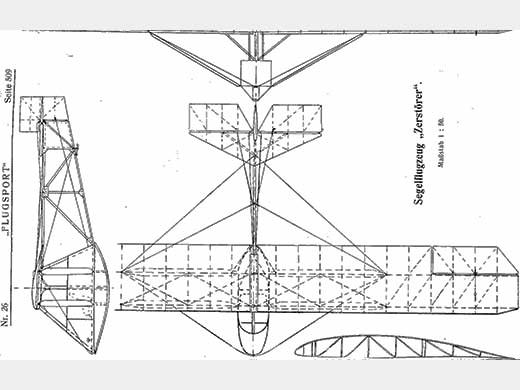
Schul-Segelflugzeug „Zerstörer".
Das nachstellend beschriebene und in umstellender Zeichnung ersichtliche Segelflugzeug „Zerstörer" ist ein verstrebter Eindecker mit einem kurzen Boot und abnehmbarem (iittersehwanz. Das Flugzeug eignet sich besonders mit zum Schulen und wurde im November 1926 dem Flugtechnischen Verein Hamburg e. V. von dem Besitzer -einem Mitglied desselben - speziell zu diesem Zwecke zur Verfügung gestellt. Die Maschine ist von Ingeneur Hans Wagener. Hamburg, konstruiert und gebaut worden und hat durch schon mehr als 50 Flüge ihre Festigkeit wie auch gute Flugeigenschaften bewiesen.
Die Maschine hat eine Spannweite von 12 m, eine Länge von 5,90 in, 18 m2 Fläche: die Flächenbelastung beträgt ca. 10 kg. Der Einstell winke! beträgt <S (irad, während der Anstellwinkel im Fluge ca. 5.6 grad beträgt. Die Fläche ist zweiteilig und wird durch vier gleichlange Stiele zum Boot hin abgefangen. Um bei eventuellem Bruch der Fläche eine leichte Reparaturmöglichkeit zu haben, sind zwei Brettholme Mpn 125 mm Höhe und 15 mm Breite verwendet, die außerdem an den Angriffspunkten der Stiele noch durch min Sperrholz verstärkt sind. Bis zum vorderen Hohn ist die Fläche ohne Einbau Eines besonderen Nasenhohns mit 1.5 mm Sperrholz versehen.
ln der Mitte werden beide Flächenhälften durch nur zwei Bolzen an dem Bootsaufbau befestigt. Der mittlere Bootsaulbau ist besonders kräftig gehalten und ähnelt dem des Pegasus. Bas Boot selbst ist sehr leicht ausgeführt, da es keine besonderen Kräfte aufzunehmen hat, zum bequemeren Ein- und Aussteigen ist auf der linken Seite eine Tür angebracht.
Der Gitterschwanz ist unmittelbar hinter dem Boot abzunehmen und ist durch 6 Stahldrähte nach dem hinteren Flächenholm am Angriffspunkt der Streben verspannt. Von hier aus gehen ebenfalls zwei Kabel nach der Bootsspitze. Das Höhensteuer ist geteilt und hat Eine dreieckige davorliegende Dämpfungsfläche, welche durch zwei Stiele nach dem unteren Gitter-schwanzholm abgefangen ist. Das Seitensteuer ist ausgeglichen. Das letzte Feld des (iitterschwanzes ist mit Stoff bespannt und dient dadurch gleichzeitig als Richtfläche. Sämtliche Steuerflächen haben sich als vollkommen ausreichend gezeigt. Die Steuerung ist die normale Knüppelstcuerung. Der Gleitwinkel des Zerstörers beträgt laut den Messungen bei den bisherigen Flügen 1:15.
Das Auf- und Abmontieren geht sehr schnell, da die Maschine verstrebt ist und der Gitterschwanz abgenommen werden kann. Außerdem nimmt sie dadurch in demontiertem Zustande nur einen kleinen Raum ein.
| Type |
Single seat glider |
| Dimensions |
Length 6,0 m, height , span 12,0 m, wing area 18 m2 |
| Weights |
Empty 100 kg, loaded , max. take off weight |
| Performance |
Max.. speed |
| Type |
Werk.Nr |
Registration |
History |
|
|
|
|