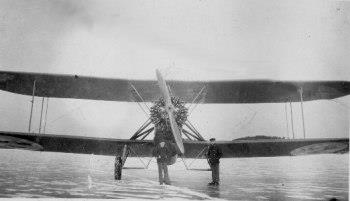
Type 3-seat torpedobomber, land 3-seat torpedobomber, sea
Engine 1 Armstrong Siddeley Leopard
Dimensions Length 12,2 m, height , span 18,0 m, wing area 96,9 m2 Length 13,0 m, height 5,20 m, span 18,0 m, wing area 96,9 m2
Weights Empty 2170 kg, flying weight 4170 kg Empty 2570 kg, flying weight 4570 kg
Performance Max. speed 205 km/h, landing speed 80 km/h, climb to 1000 m 5,8 min., service ceiling 4000 m Max. speed 196 km/h, landing speed 86 km/h, climb to 1000 m 6,8 min., service ceiling 3300 m
Armament 1 45 cm torpedo m/17
Type Werk.Nr Registration History
T1 308 20, 220, 2120, 120 After testing in October/November 1928 it was flown to Sweden in Dec. 1928. In service with the F2 Wing, out of service in 5/5 1939 atfter 300 h
T1 309 21, 221, 2121, 121 After testing in October/November 1928 it was flown to Sweden in Jan.. 1929. In service with the F2 Wing, out of service in 15/2. 1938 after 160 h and 304 flights
The Navy had tested a torpedo aircraft of Heinkel’s design in 1925-1926, the HD 14, but this aircraft did not fulfil the stipulated requirements. Heinkel improved the design, and in February 1928, two HD 16 were purchased by the Air Force. Trials were executed in Germany in the end of 1928. The trials indicated that some modifications had to be done. 
When the two aircraft were approved by the Air Force, they were flown to Sweden. The Heinkel HD 16 got the Air Force designation T 1, and the two aircraft got the individual numbers 20 and 21. The numbers were soon changed to 220 and 221. The numbers were one again changed to 2120 and 2121 in 1931.
The T 1 was fitted with a 14-cylinder Armstrong Siddeley Leopard double radial engine, developing 675 hp. The aircraft carried one torpedo type m/17. This torpedo was Swedish-built, of 45 cm calibre and weighing about 800 kg. The aircraft was also armed by one 7,7 mm machine gun.
At the delivery, the pilot and the observer were placed side-by-side. The cockpit was modified and the two crew became placed in tandem to allow a better view for the observer.  
The T 1 made no history in the Swedish defence. It brought experiences regarding the torpedo launching from aircraft, but could never be regarded as a combat aircraft. The two T 1s did not fly much. 2120 was written off in 1938 after 160 hours of flying and 2121 was written off in 1939 after 300 hours. 
Mikael Forslund describes an episode in his book ”Torpedflyget i Sverige” (”The Torpedo Aviation in Sweden” -  the book contains a summary in English.). The aircraft was rather big ( it was sometimes nick-named ”the Summer House”). In the end of the career of 2120, the aircraft was going to take off from F 2 at Hägernäs. But the pilot never succeeded to take to the sky. It showed itself that ten conscripts had hidden the spacious fuselage to get some sleep!
Span 18,00 m. Length 13,00 m. MTOW 4,470 kg.
Swedish T1 - HD 16