| Type |
Single seat glider |
| Dimensions |
Length 5,6 m, height 1,25 m, span 12,7 m, wing area 15 m2 |
| Weights |
Empty 102 kg, max. flying weight 172 kg |
| Performance |
|
| Type |
Werk.Nr |
Registration |
History |
| S-5 |

|
|
|
|
|
|
|
|
|
|
|


'Due to the Treaty of Versailles, in Germany after the First World War, activity in the field of aviation was strictly prohibited. The existing aircraft were almost entirely destroyed by the Allied powers, and it was hoped that this would have driven flying out of the Germans! Since aviation at that time was equated exclusively with powered flight, recreational aircraft were exempt from this prohibition, forgotten, or simply not taken. Whether recreational flight would have found so many followers, researchers, and designers so quickly after the First World War without this prohibition of powered flight, I dare to doubt. The Aachen students recognized this situation and returned to the glider idea, which had been proposed by Otto Lilienthal and later by the students from Aachen. The flight-obsessed students, who became active in 1920, were not aviation novices; some had been pilots in the war, were very familiar with aircraft, and simply wanted to fly! At the Technical University in Aachen, they found the best conditions, valuable suggestions, and unwavering support from the then head of the Aerodynamic Institute, Professor Theodore von Nan. There was a well-equipped workshop with Karl Köhler, an expert in lightweight construction, who knew how to manufacture aircraft. And another insignificant circumstance came to the attention of Aachen students:
Professor von Karman had excellent connections to powerful citizens of Aachen; these could be gained in the process, who to support the plans and projects of the students.
At the beginning of 1920, Wolfgang Klemperer came from Dresden to the Aachen University of Technology and became assistant to Prof. von Karman.
Klemperer had come from the Austrian Air Force discharged and subsequently began studying mechanical engineering in Dresden.
But flying never let him go during his studies. Based on the successful gliding experiments of the Darmstadt students and schoolchildren, he became convinced that unpowered flight was an ideal activity for young people and for all those who couldn't give up flying despite the ban on powered flight.
When Klemperer arrived in Aachen, he was greatly surprised to find a group of students, led by Paul Stock, who were already considering building a glider. Karman entrusted Klemperer with the technical management of this group and also provided them with a workshop.
Somewhat mysterious, often with a student standing guard in front of the workshop door - they weren't quite sure whether gliders might not also be the general ban on the construction of aircraft fell under the general prohibition of aircraft construction. In just four months, the FVA-1 ‘Schwatze Duvel’, designed by Klemperer and the FVA students, was built. The FVA-1 was financed by the Aachen silk merchant Katzenberg; without his financial injections, the construction would have been impossible. Katzenberg probably also supplied the covering fabric for the FVA-1, a particularly fine black the voile fabric; this covering probably also gave rise to the nickname ‘Black Devil’.
Oskar Ursinus, later known as the ‘Father of the Rhön’, announced the 1st Rhön Gliding and Sailing Competition in his magazine ‘Flugsport’ on March 24, 1920. The Aacheners naturally wanted to go to the Rhön, which meant the deployment of the entire group and required the semi-official founding of a club.


This took place on July 1, 1920; the club was named 'Aachen Aeronautical Society', abbreviated FVA. The founding was probably semi-official because the new club could not be registered in the official register of associations due to the still existing ban on construction or prohibition of aviation activities. Paul Stock was the founding chairman of the FVA; he led the club for three years. The club emblem of the FVA, which is still valid today, probably also dates from 1920. Karl Heidler. The author of the 179-page,
thick, and excellent brochure about the FVA (Flying Research Institute) arv for its 60th anniversary in 1980, presumes the year 1919 to be the actual birth year of the FVA. It is said to be proven that in that year, the first rubber-band starter rope was ordered from the Kamp-Schulte company in Solingen by the Aachen students. Please allow me to briefly digress to the FVA brochure from 1980. "Brochure" is probably the wrong term—it's a magnificent book, with many historical photos, wonderful stories, technical descriptions of FVA-1 to FVA-20, and many three-view drawings. Unfortunately, this chronicle is no longer available. Dear Mr. Heidler, if your time allows, please expand the book. And perhaps the FVA will be able to release a second edition. I think so. Not only we model builders will be happy about that!
Since the FVA-1 was completed rather late, the FVA men and their aircraft only appeared on the Wasserkuppe towards the end of the Rhön competition. The transport from Aachen to the Rhön was quite adventurous, passing through three military occupation zones, as can be read in the FVA chronicle or in Peter Riedel's 'Erlebte Rhöngeschichte' (Experienced Rhön History). The twin-skided low-wing FVA-1 'Schwatze Duvel' completed its flight on the Wasserkuppe under pilot-Lot Klemperer conducted the first flights.
Not only the appearance and flight characteristics caused great astonishment among those present, but also the fact that, for the first time, a pre-tensioned rubber rope was used for launching instead of the usual hemp rope. From those days on, until the advent of winches or aircraft towing, rubber rope launching was the most commonly used launching method.
Klemperer was the undisputed winner of the 1st Rhön Gliding and Soaring Competition in 1920. On September 4, 1920, he flew for 2 minutes and 22 seconds, covering a distance of 1,830 meters – thus more than doubling the 1912 record held by student Hans Guthermuth from Darmstadt. Incidentally, Klemperer's record flight was the first known soaring flight in which a motorless aircraft could maintain a position in the updraft for some time. At the time, this was a groundbreaking achievement, and it is thanks to the Aachen glider pilots that they proved, through the takeoff altitude, that soaring, and not just gliding, was possible. This spurred further development of the motorless glider. After Klemperer's sensational flights, several other
members of the FVA also tried their hand at the art of gliding - well, the machine was wrecked, but besides the demolished FVA-1, they also brought back the considerable prize money of 11,500 Reichsmarks to Aachen.
After returning from the Wasserkuppe, the first task was to repair the FVA-1. In the summer semester of 1921, two aircraft were designed and built from the FVA-1 for the 1921 Rhörv Competition. The new development was called the FVA-2 ‘Blue Mouse’ and resembled the ‘Black Devil’ in appearance. It was subsequently built in three prototypes by the ‘Aachener Segelflugzeugbau GmbH’ (Aachen Glider Construction Ltd.), founded in 1922. The founding of this company for the Industrial glider construction was initiated at the suggestion of Professor von Karman.
After Klemperer achieved the first long-distance flight in the history of gliding with the FVA-2 on August 30, 1921, on the Wasserkuppe, a flight lasting 13 minutes and covering 4.6 km, it was foreseeable that gliding was not merely a stopgap solution for the prohibited powered flight. The whole world took notice after this world record flight. The well-known English journal 'Flight' reportedly They wrote: ‘Had someone told us a few weeks ago that it was possible to stay aloft for a quarter of an hour in a motorless aircraft without external propulsion, we would have, to put it mildly, at least doubted it.’ Now, they thought that industrial glider construction could also be very financially interesting. The industrialist Privy Councilor Talbot provided financial resources and premises in his wagon factory. FVA founding member Stock became managing director, Ferdinand Bernhard Schmetz became plant manager, and Karl Köhler became workshop manager; the latter had already helped the students with the construction of FVA-1 and FVA-2. Klemperer was the design director, and Karman was responsible for the design.
took over the scientific management. The company only existed until the mid-1920s. It unfortunately became apparent that profitable work in this way and at that time was not possible. For the wagon manufacturer Talbot, this venture was certainly a great financial loss.
Although the company did not exist for long, several designs were created here. After the ‘Blue Mouse’, they ventured into the construction of a canard glider, designated FVA-3 ‘Duck’. Again, it was designed as a twin-skid glider with side-by-side seats. The ‘Duck’ appears in the registration list of the 3rd Rhön, but not in the success lists. The two skid legs failed at the slightest sideslip landings and broke off repeatedly. However, a design prize of 2,000 Reichsmarks was awarded for this unusual aircraft.
Simultaneously with the FVA-5 ‘Rheinland* shown in our documentation, a simple training biplane called the FVA-4 ‘Pipö’ (Prof. von Kar-man’s sister was nicknamed ‘Pipö’) was built. The design came from the students Nowack and Landmann. Nowack later became known for his glider ‘Schlägel & Eisen’(*), an aircraft that reminds me somewhat of the FVA-5 ‘Rheinland*; in particular, the fuselage and vertical stabilizer are almost identical according to the pictures available to me from the Riedel publication. Back to the FVA-4. The training biplane was intended to make learning to fly easier for the experienced FVA pilots, because it became increasingly apparent that pilots who hadn't already gained flying experience in World War I were often hopelessly overwhelmed by the FVA's high-performance gliders. The robust 'Pipö* took on the usual challenges of flying. Beginner's mistakes not so bad
and are said to have proven quite good.
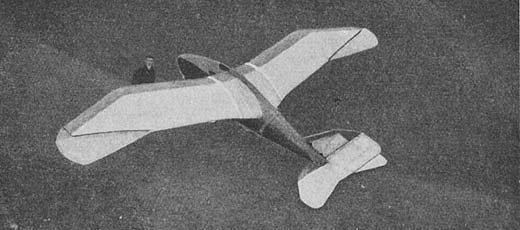
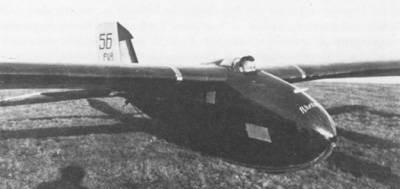
The next design was the FVA-5 •Rheinland’, also called Aachen K.E. or S-5, and please do not confuse it with the FVA-10b 'Rheinland' of the same name (MFI documentation from April 1993). The FVA-5 'Rheinland' is only briefly mentioned in the FVA chronicle; in the appendix, in which the FVA aircraft are presented with technical data, photos, and sometimes drawings, there is a photo and the note ‘Technical data not known’. In the spring of this year, I received a whole stack of documents (see source) from Joachim Ewald about the FVA-5 and the K.F. motor glider developed from it. (This ancestor of motor gliders/light aircraft will be the topic of the next scale documentation!) Despite the extensive photos, the drawing was a laborious
reconstruction project. A three-view drawing available as a hand sketch was of no help to me. I drew the fuselage based on the length and height specifications,naturally taking the photos into account; the unfinished photos in particular were a valuable help. I was able to extract the wing and tail outlines from the somewhat better drawing of the K.F. (motor glider), as these are more or less identical to those of the FVA-5. Two or even three aircraft of the ‘Rheinland* were built in 1923. Characteristic is the short, flattened, teardrop-shaped fuselage; the wings were slightly swept forward up to the aileron area, then swept back relatively sharply to the wingtip. The wing is reminiscent of the ‘pigeon wings’ often used before the war.
The pendulum horizontal stabilizer appears very oversized and was modeled on the wing's planform.
The version shown in our drawings should with starting number 56 at the Rhön Competition 1923. Unfortunately, there was a breakage even before the competition, so she could not participate in the actual comparison. On September 12, 1923 - after the competition - Klemperer achieved a 22-minute flight, during which he achieved a takeoff altitude of 140 meters at a wind speed of 7 m/s. Whether an inexperienced pilot could have achieved this flight is questionable! The FVA-5 exhibited longitudinal oscillations at certain speeds, which were probably so extreme that the first scientific flutter investigations in the history of aviation were likely conducted with this machine. The vibrations of the FVA-5 were thoroughly investigated by F. N. Scheubel in the wind tunnel of the Aerodynamic Institute of the Technical University of Aachen using
models.
In the scientific annual report 1925 of the Scientific Society for Aviation, which I have before me, the vibration phenomena of the glider ‘Rheinland* are documented in detail. The main problem, observed by the various pilots, was peculiar longitudinal vibrations. In a specific, narrowly defined angle-of-attack range, the elevator began to oscillate back and forth. At the same time,The entire aircraft with increasing deflections around the lateral axis. When the pilot pulled or pushed, the machine calmed down again. The vibrations were so strong that the control linkage came loose several times within a short period! Karman's assistant, Dipl.-Ing. Ilse Kober, continued these vibration investigations and invented mass balancing as a remedy for this problem. For this work, she received a doctorate in aviation in 1929, the first woman to do so! But aircraft manufacturers failed to properly appreciate the value of her research for a long time; only after many accidents and years later did the designers realize the importance of control surface mass balancing. Once again, back to my assumption that not just two, but three examples of the FVA-5 were produced.
Photographs of the two unfinished aircraft at the Talbot Wagon Factory clearly show that both aircraft had a rudder with aerodynamic compensation; otherwise, at least on the aircraft in the background, the main spar of the rudder would have had to curve to the edge; I consider it unlikely that it was added later. The FVA-5 in the foreground has a rounded section on the trailing edge of the wing center section; this attractive rounded section was not present on the prototype Without aerodynamic rudder compensation, the second aircraft also suffered a minor crash during the Rhön competition.
My conclusion: There must have been three examples! As for the ailerons, it is unknown whether all aircraft later received the larger aileron. - Incidentally, I was surprised to discover that all control surfaces were actuated by internal drives.
One description states: 'The control linkages are removed from the airflow!' And I spent some time looking for the control surface levers in the photos. I consider this solution for the ailerons rather daring for the time and the state of the art, especially since I can see a visible pulley in one photo. That the thing was controlled with ropes!
An interesting aircraft and documentation, produced to the best of my knowledge and belief: What's still missing is the model builder who dares to attempt a replica. So, if you're not keen on the super-orchid from the kit, if you enjoy building from your own drawings and love such challenges, you might consider whether you'd like to appear at the Wasserkuppe or other slopes with an FVA-5 'Rheinland' - scale 1:4 or even 1:3, wouldn't that be something? I would be delighted if the phone rang sometime and I heard that there was an FVA-5 'Rheinland' lying on the hangar!
Technical description
Fuselage: Teardrop-shaped fuselage with pointed oval cross-sections. Superstructure made of frames and stringers, completely covered with plywood. Open canopy; only the pilot's head protrudes from the fuselage. Behind the cockpit, a clean aerodynamic flow channel.
Wing center section rigidly connected to the fuselage. Pneumatically sprung skid, large tail skid. Wing surface: 'Pigeon-like' planform. Slight sweep to the aileron with constant chord, stronger sweep towards the outer wing. Two-spar construction, torsionally rigid plywood leading edge, slightly recessed behind the main spar. Delicate rib construction. Airfoils unknown - FVA in-house developments or a mix from the Göttingen 300/400 series. Profile at the wingtip almost symmetrical. Two aileron configurations of identical length, the larger aileron, however, extends further back. Inboard aileron drive. No landing aids such as brakes or spoilers. Four-point attachment at the wing center section, gap cover made of thin aluminum sheet. Slight dihedral, exact
specifications unknown, dihedral of approximately 3 degrees determined from the photos.
Tailplaner: Vertical and horizontal stabilizers constructed of plywood with sheeted torsion leading edges, otherwise fabric covering. From the second aircraft onward, a rudder with aerodynamic compensation. The horizontal stabilizer is designed as a pendulum elevator. It is mounted on small stubs, which are attractively arranged at the tail. Rudder and elevator are two-spar.
Paintwork: Prototype aircraft: all plywood parts natural, fabric
covering transparent.
'Rhön Competition Aircraft': Fuselage and parts of the empennage dark red (color cannot be confirmed).
Wing leading edge white, fabric-covered panels transparent.
Ailerons, rudder and elevator also painted white, except for small red markings. After the repair of the Wasserkuppen breakage, the plywood skinning of the wing was also painted red.