| Type |
Single seat glider (Pilot laying down) |
| Dimensions |
Length 5,1 m, height 1,82 m, span 10,0 m, wing area 12 m2, aspect ratio 8,33, mean chord 1,2 m, chord at wing root 1,3 m, dihedral 5º, width 0,58 m, frontal area 0,35 m2, stabilizer 1,8 m2, elevator 1,8 m2, fin 0,9 m2, rudder 0,9 m2 |
| Weights |
Empty 90 kg, flying weight 170 kg, wing load 14,17 kg/m2 |
| Performance |
Max. speed 450 km/h, glide ratio 19,8 at 81 km/h, min. descent 0,68 m/sec. at 64 km/h, max. load factor 14 g |
| Type |
Werk.Nr |
Registration |
History |
|
|
|
Built in 1937, first flight 21/3 1938 |
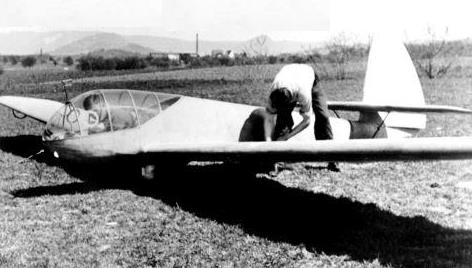
The fs 17 was designed to find out whether a lying pilot can fly with feeling and enough endurance. The arrangement with a lying pilot allows a smaller cross sectional area an thus less drag. In addition a lying pilot can better bear higher load factors. In the literature the members of the Akaflieg coun't find anything and the opinions of the experts differed. Practical test haven't been done since the days of the Wright brothers.
The pilot's safety was emphasized in this project because the pilot appeared to be more endangered due to his arrangement. The aircraft was therefore designed as a low wing plane with an extra stiff fuselage. Stall safety and a good efficiency of the ailerons in low speed flight were also important design features.
Since the fs 17 was pure experiment aircraft, some other test were included, too, because the constructors didn't want to test them on high performance planes. For example it was tested whether the wing spar should also absorb torsion, because the then usual torsion noses deteriorated after some time. New airbrakes were tested, installed in the tail of the fuselage



Stuttgart Fs 17 The first experimental aircraft for a prone pilot
Until the early 1930s, the Stuttgart Akaflieger (a student flying club) had no tradition of constructive aircraft design. They saw their role primarily in the field of flight. But then they created remarkable in-house developments.
On May 8, 1937, Hermann Göring opened the Reich Exhibition "Working People" in Düsseldorf, a National Socialist industrial performance review featuring a model settlement and garden show. It was intended to propagandistically support the Four-Year Plan decreed on October 18, 1936, with a program for the armaments-oriented management of the economy, which had been necessitated by a severe supply crisis in the summer of 1936. Forty-two halls and 30 pavilions were erected on a site of 72,492 square meters.
When the exhibition closed on October 17, 1937, after 163 days, 6,904,907 visitors had been officially registered, which the organizing National Socialist Party considered a great success.
The visitor count, estimated today at around 4 million, was likely much more realistic, because a large part of the population of Düsseldorf and the Lower Rhine region was skeptical of the Gau leadership and its show. This had already become apparent during the preceding carnival parade, which, despite offered financial support for a promotional parade design in line with the party leadership – on the contrary, ridiculed
And it became more obvious when, shortly before the exhibition opened, the Escher scandal made headlines nationwide. Tax director Escher and accomplices had extorted Düsseldorf companies for years, companies whose accounting records contained minor irregularities. Gauleiter Florian and mayor Wagenfuhr were allegedly involved in the scheme. Furthermore, they were supposed to also gained further financial advantages through the exhibition. Thus, the show remained controversial even among convinced Nazis.
Undisputed, however, was the success of the Stuttgart Akaflieger in the aviation section of "Schaffendes Volk" (Creative People). The students had presented a model half the size of their experimental glider Fs 17, which was to be controlled by a prone pilot, as a dummy clearly demonstrated. The object therefore met with undivided interest.However, the viewer was not immune to witty mockery, of which the one with the tenor "learning to fly in your sleep" was still the mildest.


Today, a reclining seat in high-performance gliders surprises no one. Back then, the idea of having to fly an aircraft lying down defied all rational thought. But the rapidly increasing speed of aircraft, which led to ever higher acceleration loads, concerned aviation medicine specialists. It had become apparent that the crew, in their normal sitting position, where centrifugal forces act roughly parallel to the major blood vessels, were exposed to enormous blood displacement. Therefore, preventative measures were investigated.
A significantly improved tolerance through a modified sitting position was demonstrated. For example, raising the legs at the hip joint reduced the pooling of blood in the lower extremities. Leaning the upper body forward ensured sufficient cerebral blood flow, as the height difference between the heart and the base of the skull was reduced. And it was precisely this realization, that the vertical distance between the brain and heart must be as small as possible, that tipped the scales in favor of a supine position. In this position, the centrifugal forces act perpendicular to the direction of the major blood vessels. In centrifuge tests, it was found that supine pilots could withstand accelerations of 12g for over 150 seconds and for up to 3 minutes without significant disturbances. This corresponds to twelve times the normal acceleration due to gravity, which is 9.78 m/s² at the equator. At just 8 g, blood is as heavy as liquid iron!
The question that then arose: flying while lying down, yes – but how? The supine position came increasingly into focus as the war progressed because it better suited military needs. The prone position, with its field of vision mainly below the horizon, leads to poorer space utilization due to the rear space that needs to be kept clear for egress, the restricted forward visibility, and the reduced possibility of armor plating.
Nevertheless, the supine position initially had hardly any advocates. The prone position was preferred less for medical or visual reasons than for a connection to nature and tradition. The research was conducted at the German Experimental The German Aerospace Center (DVL) in Berlin-Adlershof decided to involve the newly founded Flight Engineering Groups (FFG) in the design of an experimental aircraft with a prone pilot in the National Vocational Competitions. The national winner, with their Fs 17 design, was the Association of Academic Flyers at the Stuttgart Technical University.
This group had been formed in September 1924 when an academic flying group was established within the Stuttgart Flight Engineering Association, which had been founded in 1919. It became independent in September 1926 and grew rapidly. It was able to largely maintain its status when, at the end of April 1933, in the course of the National Socialist "Gleichschaltung" (coordination), almost all Akafliegs were dissolved, their workshops closed, and their equipment transferred to the newly formed German Air Sports Association (DLV). In late 1934, responsible gentlemen in the Reich Air Ministry (RLM) – Dipl.-Ing. Otto Fuchs as an "Old Boy" of the Darmstadt Academy and Ministerial Councilor Dr. Bäumer – once again enabled an engineering education characterized by technical research, in the spirit of the old Akaflieg. Aeronautical engineering groups were formed, including, after renaming, the Stuttgart Aeronautical Research Group (FFG Stuttgart). Since it was directly subordinate to the DVL (German Aeronautical Research Institute), it was able to continue its work freely and independently for the conditions of the time, although it was constantly subjected to attempts at partisan political co-optation.
In 1936, it built its first in-house design, the 16-meter wingspan high-performance glider, the 76 Wippsterz, which was successfully test-flown in February 1937. Kurz
larauf received the order to create the winning Fs 77 of the Reich Vocational Competition as a model with a five-meter wingspan for the »Düsseldorf exhibition »Creative to realize the vision of the people. Two weeks were available for this purpose. On the night before the exhibition opening – one hour before the agreed time – the Fs 77 model arrived in Düsseldorf in a glider trailer. At the same time, construction work on the original began.
Since the Fs 17 was intended to be a purely experimental aircraft, achieving high gliding performance was deliberately avoided from the outset. The primary focus was on the high strength required for the planned acceleration tests (the breaking load factor was more than 14) and a high level of safety for the pilot lying on his stomach during crash landings, which led to the choice of the low-wing configuration, unusual for gliders. Furthermore, stall stability in stalled flight was ensured by generously sized ailerons. The cardinal question was and remained: Is it even possible to fly with feel and sufficient endurance while lying down? One group member: "Practical experiments with prone pilots seemed to have been unconducted since the days of the Wrights. And the opinions of the experts we consulted varied widely.
Thus, we arrived at the reassuring certainty that our experiments, even in the event of failure, would have 'high academic value.'" A fuselage mock-up was built to precisely determine the position of the pilot and the control surfaces (which consisted of a short knob for the ailerons and elevators in front of the pilot's head, resting on a chin rest, and a horizontal slider for the rudder, operated by the tips of the feet and designed like a ladder to accommodate pilots of different sizes). The chest rested on a repurposed seat parachute, and the pilot was strapped in by five straps converging on the back, the buckles of which could be released with the left hand. For the pilot's easy entry, an open-fronted fuselage was chosen – the hallmark of all subsequent Stuttgart designs, which was naturally at a static disadvantage compared to a closed fuselage nose with a seat cutout. Sufficient dimensions were determined through crash tests. For the wing, which had a wingspan of only ten meters, the group developed a new spar construction as a middle ground between a two-spar and a single-spar design with a torsion nose. On March 21, 1938, Karl Baur, former chairman of the Akaflieg and experienced competitive pilot of the group, made the first flight of the Fs 17 at the Teck airfield. After a tow flight to 800 He rated the aircraft well and had only a few complaints, including the high sensitivity of the pendulum elevator. He suggested a retractable standard landing gear instead of the central wheel.
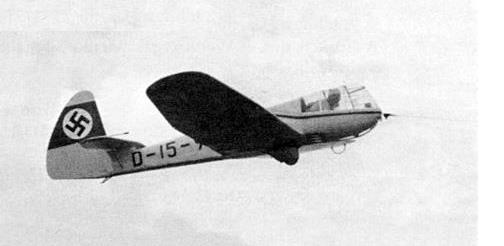
On February 12, 1939, Hermann "Bubi" Ruthardt flew the improved aircraft, registered as D-15-932, in a one-hour flight on the same grounds. It now featured a damped elevator, a rudder enlarged downwards, built-in armrests, a new chin rest, and a more spacious, angular canopy.
His preliminary assessment was also positive, except for a few minor points.
As early as spring 1939, the group received an order from the DVL to develop an experimental aircraft for centrifugal force tests, equipped with two 105 hp (77.2 kW) Hirth engines, for a prone pilot, with which a top speed of 400 km/h was to be achieved. When, after the outbreak of war, the group was drafted into the army, When operations almost came to a standstill, the
Fs 17 and the preliminary designs and drawings of the powered aircraft that had been created in the meantime had to be handed over to the Berlin specialist group. This group designed and built their B9 from these, which was completed in the spring of 1943.
Fifteen pilots completed a total of 98 flights in 59 flight hours on the Fs 17, including a flight of 3 hours and 5 minutes and a 5-hour and 35-minute tow flight to Prien for comparative flying, where the Fs 17 was presented to the ever-astonished public.
Technical description
Wing: One-piece rectangular/fapezoidal wing made of wood with torsion spar, plywood-planked leading edge and fabric covering at the rear. NACA 23012 airfoil over the entire wingspan. Root angle 3°, twist angle 4°. V-shape 5°. Root depth 1.30 m, mean joint depth 1.20 m. Four-section aileron with differential, total area 1.22 sq m. Wingtips with
sliding wingtips.
Fuselage: All-wood shell construction with reinforced open bow section and one-piece Full-view canopy. Maximum fuselage width 0.58 m, maximum fuselage height 0.73 m, maximum fuselage cross-section 0.35 sq m. Prone pilot seating with padding under chest parachute deployment and with padded chin rest. Central seatbelt buckle on the back, opened by the pilot using a pull strap.
Tailplane: Wooden frame with plywood torsion leading edges and subsequent fabric covering. NACA 009 airfoil. Horizontal stabilizer wingspan 2.80 m. Wings: Vertical stabilizer 0.90 sq m, horizontal stabilizer 1.80 sq m.
Landing gear: Short, tennis ball-sprung central skid under the nose with a fixed, faired single wheel behind it.
Paintwork: Ivory-colored with approval in black and national emblem as a red ribbon with a white circle and black swastika.