Do 20: Nie gebaut und doch geflogen
1939 befindet sich das modernste Flugboot von Dornier - eine Do 20 - im Landeanflug auf eine mediterrane Hafenbucht. Im Vordergrund der Szene sehen wir den Typ 540 K von Mercedes-Benz. Diese plakative Illustration befindet sich auf der Umschlagseite eines Automobilprospektes der Daimler Benz AG. Kunstliebhaber sind fasziniert von der schönen Zeichnung und Dornier-Fans leicht irritiert.
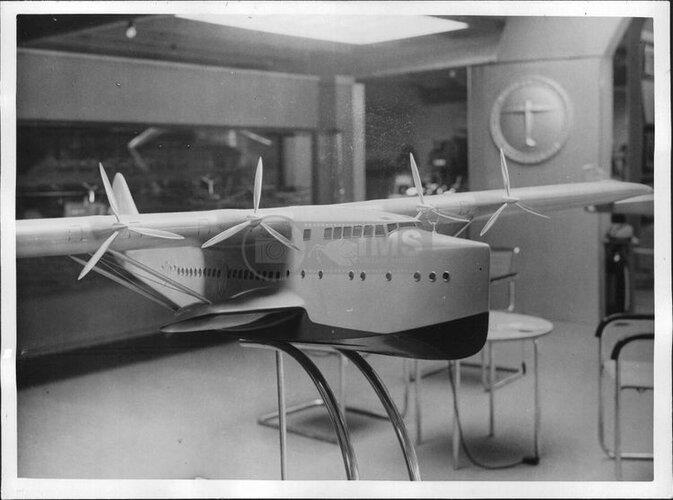
Die Do 20 wird zwar 1936 als Nachfolgekonzept der Do X im Modellbauformat auf der internationalen Luftfahrtausstellung in Stockholm vorgestellt. Die Presse berichtet auch ausführlich über die spektakuläre Konstruktion, die den transatlantischen Flugverkehr beflügeln soll. Und auch die Konstrukteure sind davon überzeugt, dass sie einen Entwicklungsauftrag von der Lufthansa erhalten werden. Dornier erhält jedoch keinen Auftrag von der Lufthansa oder einem anderen Kunden und musste das Projekt einstellen. Weder im Dornier-Museum, noch im Archiv der Lufthansa ist heute eine plausible Erklärung für die Ablehnung der Pläne zu finden.
Warum der Illustrator des schönen Mercedes-Prospektes die Do 20 mit Lufthansa-Logo noch 1939 für sein Motiv auswählt, ist ebenfalls unbekannt. Möglicherweise liegt die Begründung in wirtschaftlichen Hoffnungen des Flugmotorenherstellers Daimler Benz. Oder es ist einfach nur eine späte ästhetische Faszination des Künstlers (vermutlich Maiwald), die der Do 20 eine virtuelle Flugstunde gönnt.
| Type |
Transatlantic passenger carrying flying boat (15 - 16 passenger in high comfort, 60 passengers short distances) |
| Engine |
8 Diesel engines (2 coupled driving one prop. through gearbox and shaft) |
| Dimensions |
Length 40.0 m, height 9.50 m, span 40.00 m, wing area |
| Weights |
Empty 29500 kg, load 26500 kg, flying weight 56000 kg |
| Performance |
Max. speed ~340 km/h, cruising speed ~250 - 300 km/h |
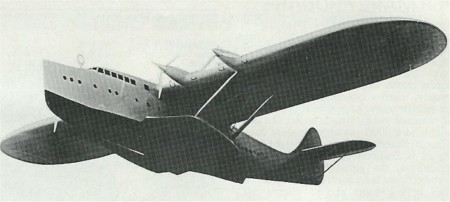
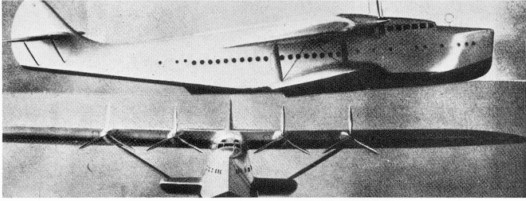
The Do 20 flying boat project was a development of the Do X. II was to be used on transoceanic services. The planned range was more than 5000 km, the planned maximum speed approx. 340 krn/h. The cabin configuration was either for 12-16 passengers with spacious lounges and sleeper compartments. or seating for some 60 passengers.
The hull had a more favourable aerodynamical design than that of the Do X, but the under-water shape and the sponson arrangement remained unchanged. The braced wing had the same rectangular planform with rounded wing tips than the Do X, but its span was extended by one metre- The greatest progress was to be achieved over the Do X by more powerful engines: 8 diesel engines rated between 800 and 1000 HP each The engines were completely integrated into the wing and were to drive one large propeller each via a gearbox and an extension shaft.
The Do 20 model was exhibited by Domier at the 1936 International Aviation Exhibition in Stockholm (ILIS). A development contract was never awarded by Deutsche Lufthansa.