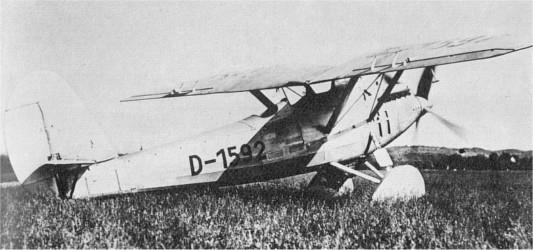
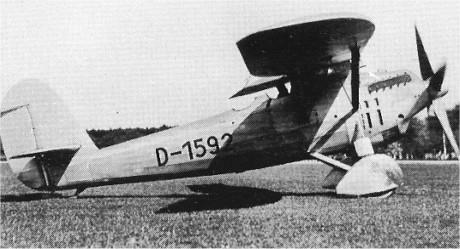
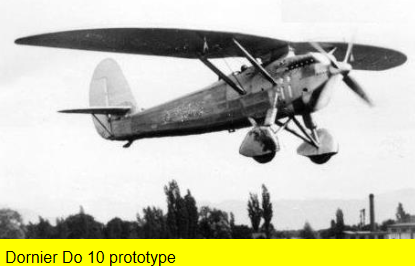
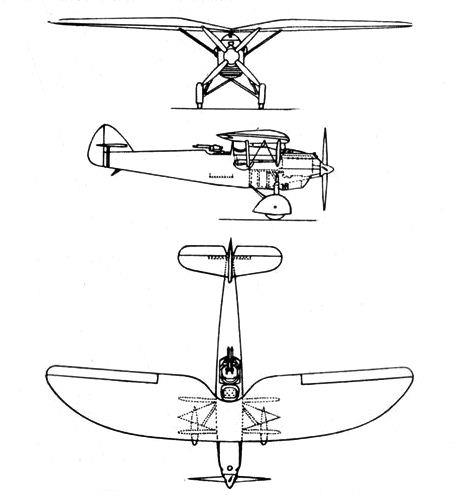
The Dornier Do 10, originally designated Dornier Do C4, was the name given by the Reichsluftfahrtministerium (RLM) of a pre-World War II German aircraft.
It was a two-seat parasol-wing monoplane, intended to be used as a fighter. Two prototypes were built in 1931 to fulfil a requirement for a two-seat fighter. Having failed to gain a production order, the Do C4 / Do 10 was used to test a tilting engine installation and propellers to suit, for STOL tests.
| Type |
2-seat fighter |
| Engine |
1 Hispano-Suiza 12Ybre |
1 BMW VI 7.3 |
1 Rolls-Royce Kestrel IIIS |
| Dimensions |
Length. 10,60m , height 4.30 m , span 15.00m, wing area 32.85 m2. |
| Weights |
Empty weight. 2 200 kg., flying weight.2 640 kg |
Empty weight 2200 kg, flying weight 2640 kg |
Empty wight1600 kg, flying weight 2300 kg |
| Performance |
Max. speed 272 km/h at sea level, 318 km/h at 3500 m, range 800 km, service ceiling 9500m, time to 1000 m, 2 min.
|
Max. speed 288 km/h at sea level, cruising speed 250 km/h, climb to 1000 m 1 min. 54 sec., to 5000 m 12 min. 48 sec., range 800 km, service ceiling 7500 m |
Max. speed 278 km/h at sea level, 315 km/h at 3500 m, range 800 km, service ceiling 9100 m |
| Armament |
2 fixed forward firing MG 08/15 and 1 x 2 MG 08/15 movable in the observers position |
| Type |
Werk.Nr |
Registration |
History |
|
226 |
D-1592 |
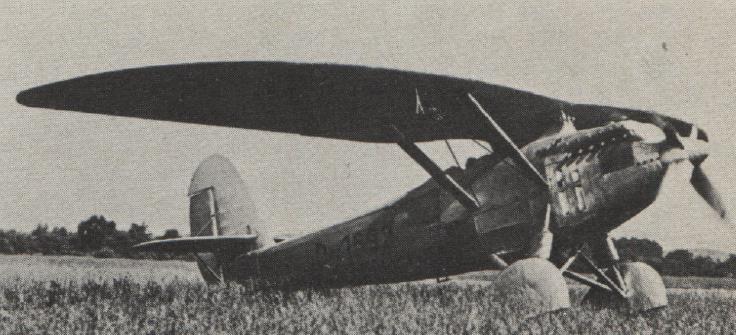
Tested in 1931 at RDL Erprobungsstelle, Staaken. First with BMW VI engine |
|
227 |
D-1898 |
Tested in 1931 at RDL Erprobungsstelle, Staaken. First with BMW VI engine |
DORNIER Do 10 also known as Dornier C1 or C4?
One of the Dornier designs secretly developed for the Reichswehr is remarkable for its type designation Do 10: It represents the beginning of a system (or probably even several) introduced by an association of German aviation companies during the turn of the third decade of the last century. This system was intended to coordinate the aircraft designs of the various factories through the merging of one-time allocations of numbers. must be clearly marked.
This also seemed urgently necessary, because most of the German aircraft manufacturers had logically labeled their products with the numbering started with one and then continued in ascending order. This resulted in a number of identically numbered samples, which were generally only distinguishable by the preceding company abbreviation – usually a single letter. The new practice of avoiding duplicate assignments eliminated errors, facilitated communication, and even contrary to secrecy,
which suggests that the military, in particular, had its fingers in the game.
The Reich Aviation Ministry, established years later by the new rulers, took over the preparation and refined it to perfection in a so-called RLM list, which ultimately ranged from the number 10 initially assigned to Dornier up into the six-hundreds. But 15 years passed.
It is not the purpose of this article to investigate the reasons which aspects were criteria for the distribution and why the first block of numbers, starting with 10, was released specifically for Dornier. Perhaps it was the fact that Dornier already used a two-letter company abbreviation, Do, as was now prescribed, with a capital letter at the beginning and a lowercase letter following. Perhaps it was also the fact that that Dornier had not used consecutive numbers for the model designation. This allowed him to adopt figures from the lower region, which other companies used with their products were long gone.
However it may have been: It all started with the Do 10. However, the Do 10 previously had an internal designation. As Do C, it was integrated into the system that Dornier introduced for its products after the First World War: Each aircraft type that was eligible for potential production received a specific letter from the alphabet, which was used for planning and work following the abbreviation Do (for Dornier), whenever these activities began. The series ranged from the letter A (for single-engine light aircraft) through B (for single-engine passenger aircraft) to at least the letter Y (for three-engine fighter aircraft).
If a successor type of the initial pattern existed in a category, it was identified by the additional number 2 appended. Should this also be improved into a successor pattern, it received the next highest number. Thus, designations such as L 2 and L 3 for the further developments of the single-engine Do L Delphin transport flying boat can be explained.
The letter C designated single-engine military multi-purpose aircraft, and the first of these models – a modification of the civilian Do B – was delivered to the Japanese acceptance commission as the Do C at the end of 1924. However, at the end of the 1920s, the type was fundamentally redesigned at Dornier.
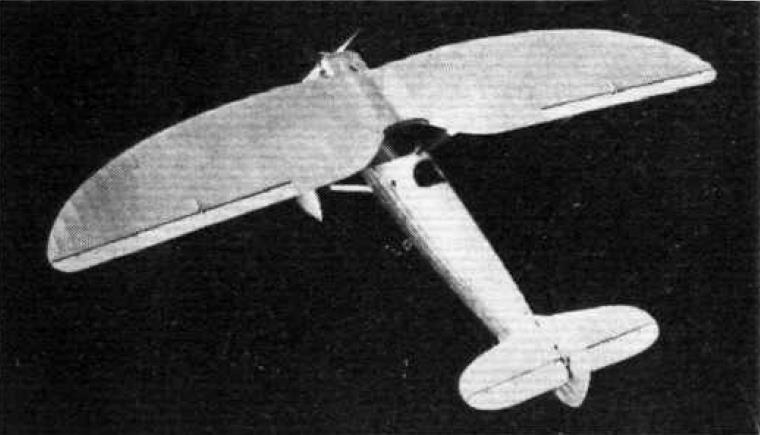
The more modern two-seaters retained the type designation Do C, but probably because of the significant difference compared to the earlier design, the initial model was designated Do C 1. It was the first of a parallel-developed series of similar-looking designs with harmonized construction criteria – a semi-cantilever high-wing aircraft with a two-part, three-spar wing. The leading edge was strongly elliptical towards the rear, leading to the straight, but swept-back trailing edge. In addition, it had an extremely thin profile in the root area, to provide the pilots seated behind it with a better field of vision. The propulsion for the home-made four-bladed propellers was to consist uniformly of Hispano-Suiza 12 liquid-cooled V-engines with 12 vertical cylinders, to make the aircraft particularly attractive for export, especially since they could optionally be used for inland-were to be used or could be mounted on floats.
The reconnaissance variant was designated Do C 2, which, in its floatplane version—called Do C 2a—first flew on July 25, 1931. It even found a buyer, as a consequence of the Leticia conflict. This border dispute, almost forgotten in the shadow of the Gran Chaco War, concerned a 6,000 square kilometer area of primeval forest between Colombia, to which it had been granted by a 1922 treaty ratified in 1928, and Peru, which it illegally occupied at the end of August 1932, triggered an arms buildup on both sides. Four Do C 2a aircraft went to the Colombian armed forces.
Since military operations were conducted almost exclusively from the air until the armistice in May 1933, the strengths and weaknesses of the aircraft used quickly became apparent. With the Dorniers, it was the climb rate that was criticized. This obvious performance weakness had already been addressed by the design office with an additional to improve the small underwing. The semi-detached aircraft, also equipped with floats for comparison, was designated Do C 3a and made its maiden flight on September 18, 1931.
The version subsequently described as a two-seater fighter with the later type designation Do 10 is usually referred to in current literature as the former Do C 4. It would thus have been a younger variant of the C 2 and C 3. However, this is questionable.
Although a contemporary description also refers to the model as Do C 4, this may have been a marketing measure to make it appear younger. The attached sketch drawing of the aircraft bears the number 9626, is dated 9.2.1931, but without any type designation. In contrast, on a drawing number 11696, the depicted design is designated as the Do C 4. However, it shows a new, completely redesigned aircraft with a slimmer fuselage, retractable underbody cooler, higher-mounted fixed machine guns, and—most noticeably—a new wing (and empennage) outline. While the semi-oval leading edge was retained, the sweep was reduced by straight trailing edges.
Furthermore, the central section of the now two-spar wing, equipped with a thicker airfoil, is no longer attached to a pylon protruding from the fuselage spine, but rather rests on struts.
In this design, all the structural weaknesses that had emerged during the flight testing of the two-seater fighter have been eliminated. And this testing had already been running for quite some time at the time the drawing was created.
Thus, it appears that the two-seater fighter was quite clearly the basic design. This was also the view of Director Eugen Jäger, who classified this model as the Do C 1. Jäger, formerly head of the Dornier project office, had conducted type research from the 1960s onwards and rebuilt the company archive.
This version as a two-seater fighter, in any case, was what aroused the interest of the Reichswehr. They ordered three aircraft (of which, however, only two were built). The design work could begin in early 1930 at the Dornier plant in Manzell, Friedrichshafen, because the type – disguised as a mail aircraft – had been commissioned by the Reich Ministry of Transport.
The design effort amounted to a modest 852 hours by the end of the year. For this, a rather unusual aircraft was conceived.
The wing planform with a semi-oval leading edge was to become a characteristic of various Dornier designs from this period. But in none of the prototypes was it designed so extremely, with a particularly thin root profile and thin, pointed wingtips due to the swept trailing edge, as in this new Do C series.
Structurally, robustness and resistance to gunfire were given particular consideration. was. Thus, the wing, with its three spars, was designed as a statically over-constrained truss structure, which offered sufficient residual structural safety even if a complete spar was lost due to a bullet hit. And all control surfaces were fitted with multiple bearings to ensure their function even if individual control surfaces were damaged by gunfire.
In 1931, the number of structural modifications performed rose sharply to 34,923. This was not only a consequence of the detailed design, but initially also of official change requests. Thus, instead of the planned Hispano-Suiza engine, a slightly less powerful BMW VI U geared engine from domestic production had to be provided. Subsequently, numerous changes were made as a result of the commencing flight testing. Work on making the prototype ready for series production cost an additional 3,822 design hours in 1932 and a further 2,888 in 1933, so that the total number finally amounted to 42,485.
The first flight of the Do 10 – referred to as a launch flight in a Domier publication – took place from the FriedrichshafervLöwental airfield on July 25, 1931, under the pilot Egon Fath, exactly one month to the day after the 33rd birthday of this pilot, who, since his appointment as a test pilot in 1927, had flown almost all of Domier's new designs. He had been drafted into the military in 1916 and trained as a pilot in 1917. From May 1918, he flew infantry support with a field aviation unit (Fea 36) and, since the end of the war, had been studying engineering at the Konstanz Technical College. In May 1923, he renewed his pilot's license on a Dornier Libel-/e-Aphibum. Here he was able to
establish contact with the company Dornier Metallbauten GmbH, for which he traveled to the Soviet Union from December of the same year to train personnel on Dornier Komet/FV transport aircraft, which had been ordered by Russian companies. From October 1925 he operated in Dorniers' assignment at Bodensee Aerolloyd on De/ph/n-Flugbooten air traffic. In 1934, Egon Fath received the title of flight captain, in 1936 he became flight director. After the Second World War, he worked for the Friedrichshafen gear factory in Passau, but as early as 1956, Dornier appointed him again as flight director in Oberpfaffenhofen.
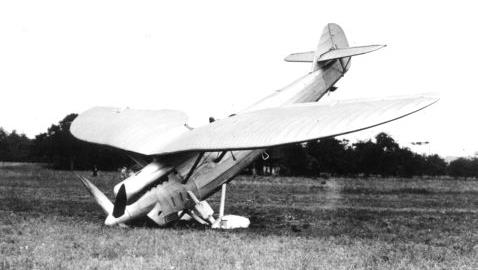
But that is far ahead of the events. Back to the flight testing of the Do 10. It did not go too well. Probably already during the taxiing trials, the aircraft hit a soft spot in the grass.a nose-over, during which it was slightly damaged. The first test flights then showed that the vertical stabilizer was considerably undersized. It was gradually enlarged. However, the main problem proved to be the wing. With its strongly swept and inward-facing wingtips, it tended to flutter. Now, vibration problems have existed in aircraft since the first designs of the Wright brothers. This interaction between the elastic aircraft structure and aerodynamic forces – today elegantly called aeroelasticity – was already the object of intensive research early on and became so increasingly as the problems accumulated with increasing flight speed. And connections were recognized very early on, for example, in the understanding of the influence of ailerons on wing vibrations. But these were highly scientific investigations.Searches with results that were difficult to understand and even harder to express in simple formulas.
Dr. Ing. Hans Georg Kussner, who had come to the German Research Institute for Aviation (DVL) in Adlershof as a scientific staff member in 1928, was still working on fundamental investigations, for example, on the theory of a "floating wing with rudder." When he published them, along with corresponding recommendations for construction and strength regulations, in the 1935 annual volume of Luftfahrt-Forschung (Aeronautical Research) under the title "Current State of Development of the Question of Wing Flutter," he was already able to cite the Do 10 as a typical example. This was because an accident had occurred with it. During a test flight in the critical speed range of approximately 450 km/h, the wing had fluttered so violently that an aileron broke. Subsequently, both outer wing structures disintegrated, each up to the aileron centerline. The severely damaged aircraft nevertheless landed smoothly on the Swiss Altenrhein airfield, located on the shores of Lake Constance, was a flying masterpiece by Pilot Egon Fath.
Since strengthening the structure always comes at a price, attempts were made with the Do 10 to control the vibrations through additional measures on the ailerons: These were ultimately fitted with the five auxiliary rudders, designed as small wings, which are common in many Dornier designs; initially arranged above the ailerons, then below them. In this final phase of flight testing, the replacement of the massive, rigidly built underside of the fuselage with one that could be retracted into a slimmer underside of the nose was also tested. All these measures repeatedly resulted in an improvement in flight performance. However, what never met expectations were the insufficient climb rates, the cause of which was eventually found in the thin airfoil of the center wing. Attempts to increase lift in this area by adding auxiliary wings yielded neither an improvement in climb rate nor in altitude. Finally, as a test for an engine that could be swivelled in flight as needed, the engine was rigidly installed in one of the Do 10s at a certain angle of attack to the fuselage's longitudinal axis. However, disadvantages such as the loss of horizontal speed are said to have outweighed the advantages in this experiment. The assessment of the Do 10 states: "Primarily due to its low climb rate, this model was not included in the procurement process." Only two prototype aircraft were built. They had the serial numbers 226 and 227, differed by 35 kg less soot mass and some additional cooling slots in the newer aircraft, and received the registrations D-1592 and D-1898 respectively, with which they were officially registered to the RDL (Reich Association of German Aircraft) in 1931. aviation industry), test center Staaken, were acquired. Whether they reached the secret test centers of the Reichswehr or were each equipped with weapons is not recorded. Incidentally, Dornier experienced a belated justification of the C-aircraft concept: The Do 22 multi-purpose aircraft, further developed from the C 1 to C 4 aircraft in 1938, with the 880 hp (647 kW) Hispano-Suiza 12 Y21 engine, could be delivered in both wheeled and floatplane versions in approximately 30 units to various European air forces.
Technical Description
Wing: Semi-cantilevered wing with a semi-oval leading edge and a straight, swept-back trailing edge. Three-spar structure with crossbeams and wire bracing. Spars and ribs made of duralumin. Fittings and wires made of steel. Wing leading edge with intermediate ribs and sheet metal covering. Otherwise, fabric covering. Covering the entire wing structure. Two-part wing, hinged above the fuselage centerline to a pylon shaped like a cutting edge, detachably by bolts, and supported by two parallel, teardrop-shaped struts (crossed with profiled wires) towards the center fuselage stringers. Ailerons mounted on a duralumin torsion tube with duralumin ribs and fabric covering, ball-bearing mounted and balanced. Aileron control by pushrods (partially guided within the struts).
Fuselage: Steel tube frame; forward section as a six-chord truss, rear section four-chord with wire cross bracing. Formed frame made of duralumin bulkheads and longitudinal profiles.
Only partially metal-sheeted, otherwise fabric-covered. Removable fuselage spine. Large inspection hatches in the rear fuselage.
Tailplane :: Structure with spars made of duralumin profiles. Duralumin ribs, wire cross bracing, and fabric covering. Vertical fin trailing spar in the rear fuselage, which is designed as a bearing, seen from above.Plugged in and rotatable for adjusting the distortion angle. One-piece horizontal stabilizer, mounted in the vertical stabilizer and supported by struts towards the fuselage. Adjustable from the pilot's seat via handwheel and worm gear for trim. Elevator and rudder have internal balance, are each triple-bearing mounted, and are controlled via cables and bellcranks. Dual elevator control.
Landing gear; shock absorbers with rubber compression damping. Mounted on the center fuselage stringers and supported towards the underside of the fuselage by V-struts. Electron wheels individually hydraulically braked. Low-drag wheel fairings made of Elektron. Swiveling and rotating tail skid with Elektron tail shoe and replaceable steel sliding plate. Rubber ring sprung.
Engine: A liquid-cooled, geared-down, twelve-cylinder V-engine, BMW VI U 7.3, with 710 hp (515 kW) takeoff power and 500 hp (368 kW) continuous power.
Removable engine mount. Fixed four-blade Dornier propeller with a large pitch. 270-liter fuel tank in the lower fuselage behind the firewall, with a recess in the forward upper section for the 18-liter oil tank.
Armament: Planned were two fixed, synchronized, propeller-firing machine guns on either side of the pilot's seat in the fuselage sidewalls, as well as a movable twin machine gun on a swivel mount of the rear seat.
Paintwork: Complete Cellon lacquering in silver bronze. Approval in black.