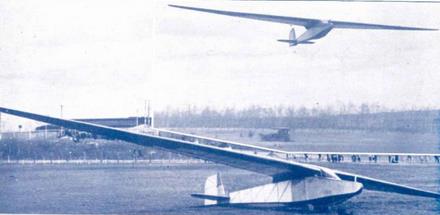
Type Two seat glider
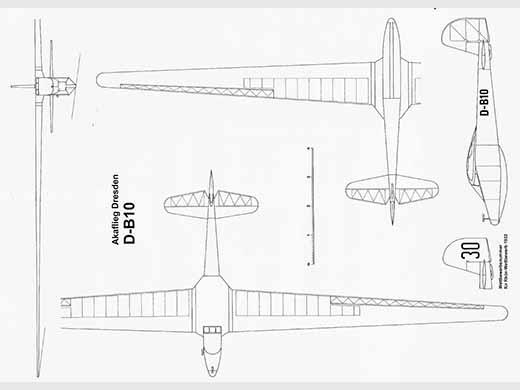
Dimensions Length 7,15 m, span 20 m, wing area 18,20 m2, aspect ratio 22
Weights Empty 220 kg, loaded 300 kg, load factor  13,5
Performance Glide ratio 1:30, lowest sink 0,55 m/sec., normal speed 65 km/h, max. speed 130 km/h
Type Werk.Nr Registration History
D-B10 The last design of Akaflieg Dresden and the first with a closed cockpit. Flew for the first time in the Autumn 1931 or in the Spring 1932. Focus on high stability (By the use of plywood). Erhard Muschick took part in the 13th Rhön, got no awards, but later acheived the Silver-C in Sachsen. In 1935 Otto Bräutigam achieved a distance record of 504 km together with three other pilots at the XVI Rhön.. After the close down of the Akaflieg Dresden, the aircraft was used by the Segelflugschule Großrückerswalde-
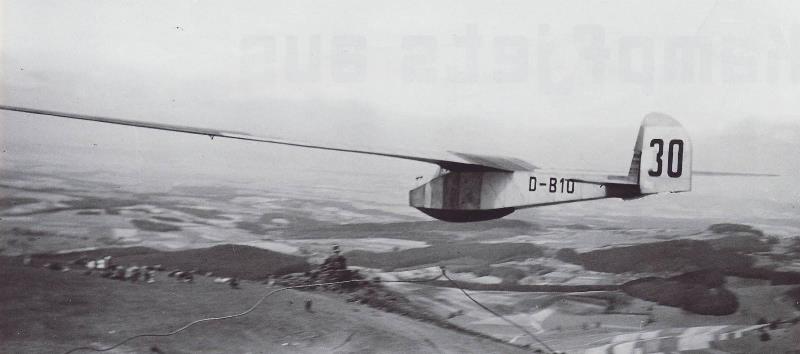
Glider D-B 10 Akaflieg Dresden.
The glider, built by the Akad. Fliegergruppe Dresden, is built in a single-spar, cantilevered construction with a torsionally rigid nose. The surface is divided into two parts, and the driver's seat is completely closed. For the first time, duralumine was used on a large scale for spars and frames. The chassis can be ejected after
take-off. Year of construction 1931, construction number 10, set-up weight 220 kg, payload 80 kg, flight weight 300 kg, wingspan 20 m, area 18.2 m2, natural vibration coefficient 145 per min., load multiple n = 13.5 (vSich = 130 km/h), lowest descent speed v = 0.55 m/sec., best glide angle 1:30, flight speed Vnorm = 65 km/h, profile Gö 549 (modified), aspect ratio 1:22
In a series of essays from 1952/53, the Coburg engineer Walter Stender (1905-2000) summarizes the historical aspects of the technical development of unpowered flight in order to use them as a basis for the design of future glider believed at the time that he was at the beginning of a new, fourth development period - and he was right. His vision was based on investigations of the third period, which had replaced the periods of experimental exploration and pure slope soaring and which had been initiated by the discovery of thermal soaring with long cross-country flights. Stender noted in retrospect that for aircraft of this third development phase, a low sink rate remained advantageous, but became secondary. When it came to quickly bridging the distance between two updrafts with the lowest possible sink rate, the best glide ratio within an extended speed range had become more important. For this, the wing loading could be higher. However, this presented no difficulties, because the slimmer cantilevered The wing with thinner, less curved airfoils required more construction mass anyway.
And the pursuit of minimal drag increasingly called for, for example, inexpensive but heavy Plexiglas covers for the pilot seats.
So far, so good. But Stender also saw the angular fuselages for high-performance gliders disappearing. Here the esteemed prophet was mistaken. Angular fuselages continued to appear until the end of the third period. One of the earliest, but most striking examples was probably the D-B10 of the Dresden Akaflieger.
Designed and constructed for the Rhön competition in 1931, it could not be completed in time. Muschick himself then flew it in the 1932 competition. With its predecessor, the D-B9, developed in 1930, he had created a braced two-seater with a watertight fuselage floor and sealed wing panels, enabling it to land on the Elbe River if necessary in the updraft- and landing-area-poor environment around Dresden. It still had open seats, but an oval fuselage cross-section. Why Muschick chose a plumb , it is not recorded why the box fuselage was chosen, even though the proportion of empty weight would have been irrelevant to the desired higher wing loading. At that time, in the late 1920s, when the Akaflieg Dresden turned exclusively to gliding for cost reasons, its guiding principles were: high structural reliability, high wing loading for higher speeds, and the highest possible quality of aerodynamics. Great structural reliability was achieved, as evidenced by the high structural mass of the D-B10. But despite the bulky fuselage, the aerodynamics were also excellent, because the model, with its glide ratio of 30, was outstanding for its time and, thanks to its wide speed range, very suitable for cross-country flights.
This aircraft was the tenth and, unfortunately, the last aircraft design of the Akaflieg Dresden, which was founded in 1922 at the local Technical University. It initially remained a subgroup of the Dresden Aviation Club, where students planned and built the first two gliders, D-B1 and D-B2, which were then entered in the second and third Rhön Gliding Competitions (see Volume 1 of the Classic Scale series "Historical German Aircraft up to 1945," starting on page 58). On April 14, 1924, the Akaflieg became independent. During its existence, it received strong support from the Chair of Technical Mechanics, Professor Dr. phil. Dr. Ing. h.c. Erich Trefftz (1888–1937).
From 1925, its first chairman, Friedrich Schicht, took over the leadership and never relinquished it until its complete dissolution.
In 1927, Schicht brought the glider builder Karl Fritsch (1900-?), originally from the Sudetenland, to Dresden. Fritsch had learned the model-making trade in Berlin from 1914 and became an aircraft builder at Rumpler.
From July 1927 to July 1933, he held the position of workshop foreman at the Akaflieg Dresden and played a key role in the design of the newer aircraft types, including the D-B10. Since Fritsch, as a foreigner, did not receive a work permit, he had to live off Schicht's private donations. Fritsch could ultimately look back on 25 years of work at three different Akafliegs.
The end of the Akaflieg Dresden came very quickly after the change of power in 1933, as it was – according to witnesses – very critical of the new system. The newly founded German Air Sports Association (DLV), into which it was to be absorbed, completely cleared out the workshop within two days. Professor Trefftz had to leave the university. Muschick went to Berlin, and most of the Akaflieg members went to Darmstadt. That's why the Dresden students, unlike the other Akafliegs, were later unable to join a program organized by the German Association
The research institute for aviation initiated a relatively unpolitical flight engineering specialist group, which was transformed and only experienced a
re-establishment of its Akaflieg (Academic Flying Group) in 1998. Their then fleet of two training gliders, as well as the D-B9 and D-B10, was also requisitioned by the DLV (German Air Sports Association).
Their official performed remarkable flights with the D-B10: The Bavarian Otto Braeutigam (1912-1941) had earned his A license in 1929 on the Dörnberg near Kassel, his B license the following spring on the Wasserkuppe, and finally, at the Rhön competition of the same year, on a design from the glider construction of his brother Bernhard in Weimar, he earned his C license and fulfilled the requirements for the official license. In 1931, he obtained his tow-launch license in Griesheim, and a year later, also there, his airborne flight license. In 1934, he added powered flight licenses. At Messerschmitt, he flew prototypes of the cargo glider Me 321 together with the glider pilot Bernhard Flinsch, who came from the Akaflieg München (Academy of Flying Clubs Munich). During the testing of this glider, with a wingspan of 55 meters and a with a flight mass of 35 tons, the world's largest glider both met their end in May
1941.
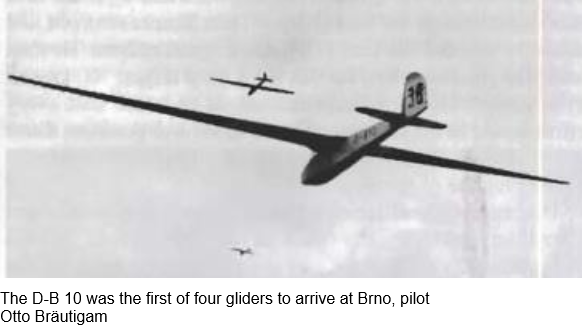
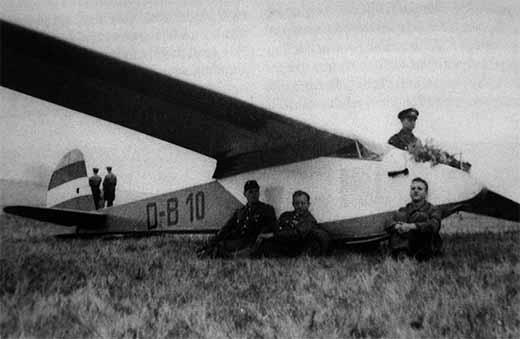
Otto Braeutigam joined the DLV (German Air Sports Association) full-time in July 1933 and became head of the flying school in Dresden. Here he used the D-BIO, which had come into the association's possession, for cross-country flights, during which he logged a total of 10,000 km in his logbook by 1938. Notable long-distance flights with the D-BIO included 222 km on September 7, 1933, from Großenhain to Neuendorf (with which Braeutigam earned the Performance Badge No. 17), 195 km on July 28, 1934, from the Wasserkuppe to Aue, and 242 km on August 26, 1934, from Laucha to Erntebruck. In 1934 and 1935, Braeutigam participated in the Rhön competitions with the D-B 10. On July 27, 1935, he achieved the longest distance covered at this event. 504.2 km at the military airfield in Brno (Brunn), Czech Republic, as the first of a total of four pilots to reach this goal. Among them was Rudolf Oeltzschner.
He lost his life during the return transport by aircraft tow on August 1st near Selb, when, in severe turbulence, the front fuselage of his factory-built Condor broke off due to poor workmanship. He was posthumously declared the winner of the competition.
At the 17th Rhön 1936, Braeutigam no longer flew the D-B10, but one of the standard glider designs from the DFS (German Research Institute for Gliding), a Rhönadler, which was particularly typical for this competition year. It carried the registration D-Rudolf Oeltzschner. It remains to be hoped that even
after Braeutigam with the high-performing D-B 10. Despite the seemingly unsuitable fuselage, the B10 still managed many beautiful flights.

Technical Description
Wing: Single-spar, cantilevered trapezoidal wing. Short center section with increased chord, rigidly connected to the fuselage, and two detachable outer wings. Modified airfoil Gö 549. Wooden superstructure with a torsionally rigid plywood leading edge and a duralumin component in the spar construction. Inner parts of the outer wing behind the spar and the ailerons are fabric-covered.

Fuselage: Rectangular box fuselage in truss construction made of wood with four stringers and bulkheads containing duralumin; plywood-covered up to the wing and tail, otherwise fabric-covered. Enclosed pilot's seat with a rearward-folding canopy.

Tail unit: Cantilevered conventional tail unit in wooden construction with plywood-covered fins and fabric-covered rudders.

Wheels: Sprung central skid. Launch on detachable two-wheeled chassis.

Paintwork: Plywood surfaces and covering natural, impregnated with clear varnish. The designation D-B10 in black on the fuselage sides, was considered an approval mark because of the D at the beginning. From 1933 with flag stripes on the vertical stabilizer, on the right still black/white/red, on the left the swastika flag, from 1934 on both sides. Fuselage from 1935
two-tone with white at the front and green at the rear, which was replaced by blue in 1936.