Type Single seat glider
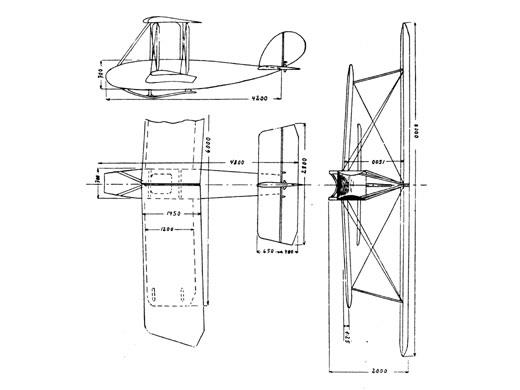
Dimensions Length 4,80 m, height 2,00 m, upper windpan 8,00 m, lower wingspan 6,00 m, wing area 18,7 m2
Weights Empty 70 kg, flying weight 140 kg, wing loading 7,5 kg/m2
Performance max. glide ratio 1:8
Type Werk.Nr Registration History
First flight 23/8 1921. Took part in the Rhön competition 1921, 1922. Crashed just before the 1923 Rhön
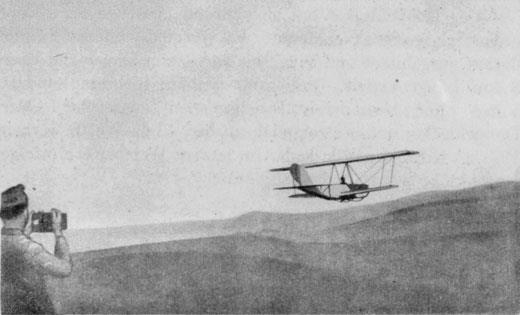
Before the formal formation of the Akaflieg Dresden in about 1924, there was collaboration between the Technical High School Dresden (TH Dresden) and the local flying club, the Flugtechnischer Verein Dresden (F.V.D.). The Stehaufchen was one result, named and designed by three TH Dresden students, Horst Muttray, Reinhold Seiferth and Rudolf Spies. The biplane configuration was chosen to ensure strength against rough handling and its small size by the need to fit within the 4.20 m  limit set by rail transport. Construction began on 11 June 1921 and the first flight took place only about ten weeks later on 23 August on the Wasserkuppe.
During its career, the glider was known in England at least as the F.V.D. Stehaufchen after the club, or just as the F.V.D. glider to distinguish it from the F.V.D. monoplane or Doris of 1922. After the founding of the Akaflieg Dresden it was retrospectively renamed the D-B1 Stehaufchen, numbering it as the first of their ten designs.

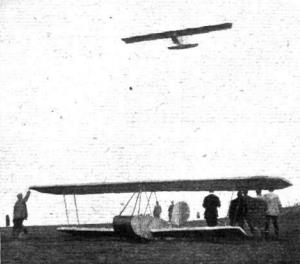
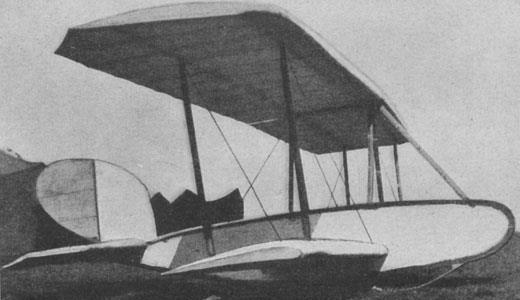
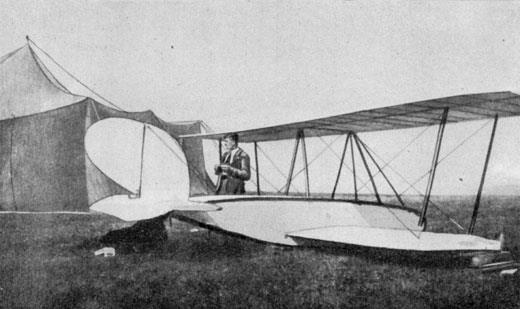
The Stehaufchen was a single bay biplane with two spar wings of unequal span mounted without stagger but with an unusually large interplane gap of 1.50 m . The lower wing was mounted on the lower fuselage and the upper one held high above it by three pairs of inverted V-struts, one pair leaning backwards from the nose to the forward spar and the two other running vertically from the upper fuselage longerons to the two spars on the centre line. On each side a pair of parallel, slightly outward leaning interplane struts connected the forward and rear spars from the lower tips and the bays were cross braced with wires. Both wings were roughly rectangular in plan and slightly swept (1.2°); only the lower one carried dihedral (2°). The ratio of upper to lower wing areas was about 1.6:1. The wings, like the rest of the aircraft had a wooden structure: the spars were both wooden boxes and the leading edges were double ply skinned. Elsewhere the wings were fabric covered. Roll control was by wing warping on both planes.

The glider had a simple, wide, rectangular cross section fuselage with four cross braced longerons forming trusses. It was skinned with two-ply, with a final fabric covering. From the side the nose was smoothly rounded into a single curvature form with the open cockpit behind it, placing the pilot's seat close to quarter chord. Aft the depth decreased and the tailplane was attached to the top with the fuselage ending at the coincident elevator and rudder hinges. The horizontal tail surfaces were roughly rectangular and the elevator was a single piece structure. The fin was a quadrant and the rudder almost semicircular but cut away below for elevator movement. All the tail surfaces were wood framed and fabric covered. The Stehaufchen's undercarriage was a parallel pair of skids, intended to protect the low set lower wing on take-off and landings. The unusually broad fuselage enabled the skids to be separated by 700 mm . These were ash, laminated and of double curvature attached at three points, one below the pilot's feet and the others below each wing spar. The final section behind the rear mounting point curved down a little to protect the tail.

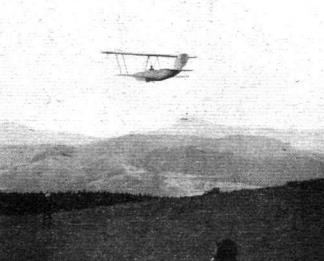
The Stehaufchen first flew at the 1921 Rhön contest, the second of the series. Muttray began with a flight on 23 August which lasted just 38 seconds but five days later flew it for three minutes. More than one third of the competing aircraft were biplanes but of these the Stehaufchen was the most successful and its three designers received a 1,500 Mark prize. After the competition the Stehaufchen stayed on the Wasserkuppe until September, making flights of up to 4.5 minutes and enabling Seifert and Spies to get their pilot's certificates.

The Stehaufchen was damaged on the rail journey home and during the rebuild the upper wing was increased in span from 8 m (26 ft 3 in) to 9 m (29 ft 6 in). It resumed test flying in the spring of 1922, launched by bungee cord. In this period several more pilots gained flight experience and their certificates. It then went to the third Rhön contest, where it gained first prize for total time in the air (1851 seconds) and second prize for distance covered in a single flight (2.7 km ).

It went once more to the Wasserkuppe in 1923 but did not take part in the contest; during a practice flight, it crashed and was destroyed.

A BIPLANE AS A GLIDER The Dresden "Stehaufchen"
At a number of technical colleges, Academic Flying Groups had formed, primarily from the early 1920s onwards. These smaller groups, known as Akafliegs for short, served to allow students to complete an internship alongside their studies independently.
They were mainly students of technical disciplines who – sometimes with considerable initiative – carried out innovative work in aviation technology. driven. But the political change of 1933 completed the long-sought-after Gleichschaltung (coordination) of all universities. This meant the end of the Akafliegs' independence. Their expertise would certainly be welcome to the new rulers – but not the free development of the practitioners. They were - also brought into line - transferred to the newly founded German Air Sports Association (DLV).
As early as April 21, 1933, there should have been no more Akafliegs. As a rule, their workshops were cleared out, their aircraft added to the DLV inventory. But already at the end of 1934, those responsible for the Reich Air Service, concerned about the next generation of engineers, found Ministry of the Interior (RLM) a niche, to enable these small working groups - now under the name Flight Technology Specialist Groups (FFG) and affiliated with the German Research Institute for Aviation (DVL) - to continue their work, a relatively apolitical even. One of the leading aeronautical associations, however, was no longer present: the one from Dresden. Its members had refused to submit to political scrutiny and scattered to the four winds.
This aeronautical group, which emerged from the Dresden Technical Educational Institution, founded in 1828 and elevated to the status of a Technical University in 1890, who had  worked quite successfully. Between 1921 and 1933, a total of ten aircraft were produced, eight in-house designs and two conversions. As with the other Aka-fliegs, the majority were gliders. But there was also a motor airplane and a motor glider among them. They were numbered from D-B1 to D-B10, the 20-meter wingspan high-performance single-seater with which Otto Bräutigam, as one of four pilots, achieved the world distance record of 504 km from the Wasserkuppe to Brunn in 1935. But more about that in a later post. This one is to deal with the beginning, with the D-B1, the Dresden "Stehaufchen" – the name says it all.
Early aviation activities in Saxony's capital originated with the Dresden Aviation Association (F.V.D.), which was founded in 1914 and existed in this form until 1924. Predominantly students of the Technical College were involved. They pursued model aircraft construction within him and organized competitions.
It was here that the students and later assistants of the Dresden University of Technology, Wolfgang Klemperer (1893-1965), born in Prague, and C.W. Erich Meyer (1898-1944), who came from Elberfeld, met.
The two former war pilots were the leading figures of the club in 1920, even though engineer Andersen had taken over the chairmanship. Meyer had already written a series of essays on gliders and sailplanes in 1919 and finally inspired his five-years-older colleague with his dynamic, determined manner (which had earned him the name "Full Throttle Meyer") to issue a "call to all glider and sailplane enthusiasts". It appeared on March 24, 1920, in the magazine "Flugsport" and, with the help of its editor Ursinus, led to the first Rhön competition in 1920. The presidency was offered to the Dresden club, which, as the most efficient, also held the rotating chairmanship of the Association of German Model and Gliding Clubs (D.M.G.V.). Unfortunately for the club, Klemperer left for Aachen in May 1920, and Meyer was preparing to move to Berlin. For these reasons, no Dresden aircraft came to the Rhön in 1920.
At the F.V.D. general meeting on February 11, 1921, however, it was decided to build their own aircraft for participation in the 1921 competition. The Saxon Aviation Association, government agencies, and other sponsors signaled their financial support. At the urging of Prof. Dr. Pöppl – lecturer in special technical mechanics as well as aero- and hydrodynamics – the Dresden University of Technology provided the association with workspaces and workshops for construction, "to support the scientific and practical endeavors of the association."
The association reciprocated by tolerating the founding of the Aka-flieg Dresden as a subgroup.
In various meetings “for the detailed discussion of design and layout,” it was finally decided that the Dresden design, after completion and participation in the competition, should be used for scientific purposes and as a training aircraft. This effectively blocked the path to a high-performance competition aircraft for the three individuals selected for the design and construction—the engineering students Muttray, Seiferth, and Spies—a path that their former colleague Klemperer had demonstrated in Aachen with the “Black Devil.” Horst Muttray became the first maintenance supervisor and thus the team leader. Born on August 30, 1898, in Göditz, Saxony,
and trained as a seaplane pilot at the Wilhelmshaven seaplane station in 1917. He subsequently remained true to experimental aviation: From 1924, as a young graduate engineer, he worked at the German Research Institute for Aviation (DVL) in Berlin-Adlershof, and in 1925, he moved to the Aerodynamic Research Institute for Aviation (AVA) in Göttingen as a research associate. Finally, from the summer of 1937 until the collapse in 1945, he was head of department at the German Research Institute for Gliding (DFS), initially in Darmstadt. to serve in Ainring.
After the war, he was abducted by the Soviets and never returned. His colleagues were Reinhold Seiferth, born on August 17, 1898 – later head of department at the Aerodynamic Research Institute for Aviation (AVA) in Göttingen – and Rudolf Spies, born on December 2, 1895, in Moscow, who later dedicated himself successfully to military flight engineering and rose to the rank of general engineer. Spies, who died in 1978, entered gliding history as the co-designer of the "Konsul" glider of the Akaflieg Darmstadt, who can be considered the father of the modern Liberhaupt glider.
In 1921 there were no guidelines and only a few models for the design of engineless aircraft. The design work of the three young students was further hampered by additional restrictions (such as the requirement for the smallest possible enclosure in an enclosed space to save transport costs).
(Railway wagon) not facilitated. It was precisely this requirement, which limited the fuselage length to 4.20 meters from the outset, that ultimately tipped the scales for the design as a single-bay biplane. The compactness of such a construction also guaranteed the high strength essential for training and practice. In order to position the launch hook centrally and near the center of gravity under the fuselage, two parallel skids were provided under the fuselage sides for takeoff and landing. Since they were not to be too close together, the fuselage supporting them had an unusually wide width of 700 mm. This, in turn, despite the large seat cutout for the pilot, caused no problems with torsional stiffness due to the chosen truss construction. The torsional stress proved to be quite considerable, because despite greater structural effort, the lower control inputs were dispensed with because of the use of normal ailerons in favor of wing twist.
The large wing spacing, which gives the aircraft its typical appearance, had to be chosen to make it easier for the pilot to get in, because his seat, which could be partially covered with a canvas, was located in the center of gravity area between the decks. Another concern for the designers was (because it was complex and expensive) to use as few fittings as possible. They were therefore limited to wing and spar connections. For all other joints, rigid solutions were found by gluing with bonding.
Construction could begin on June 11, 1921. It extended into August and practically paralyzed all other club activities. But the machine arrived at the water tower just in time before the end of the competition. On August 23, 1921, Muttray took off for its maiden flight. It lasted 38 seconds and covered a distance of 400 meters. Muttray passed his pilot and aircraft tests with it and received number 13 of the newly created glider pilot's license issued by the D.M.S.V.
which the then association- President (and later Professor) Georgii himself signed it. On August 25th, he already flew 1,340 meters in 98 seconds. And on August 30th, he finally completed a beautiful three-minute flight.
The "stand-up" aircraft had proven its worth. It possessed excellent flight characteristics and the desired robustness. The fear that takeoff would be difficult due to the low position of the lower wing proved unfounded. Ground contact never occurred, even though the wing was only 400 mm above the ground. The skid design also proved perfectly capable of handling landings on blizzards or under lateral stress.
Finally, the three young designers were able to confirm that their biplane was the only one, besides the superior monoplanes, capable of longer valley flights. They received a prize of 1,500 marks.
The ten tireless Saxons who had traveled to the Rhön (in addition to the designers, the sports director, the sports assistants, and helpers) stayed with their "Stehaufchen" (a small, glider) until September. During further flights, flight distances of up to 2.25 km and flight times of up to 4 minutes and 40 seconds were achieved. Spies and Seiferth completed their check flights for glider pilot licenses No. 14 and 15. The aircraft was damaged during the return rail transport.
The repair work was the reason to increase the upper wingspan from eight to nine meters. During the Pentecost holidays of 1922, the modified "stand-up" glider was tested at the new training ground of the Dresden glider club near Geising in the Ore Mountains. The somewhat suitable terrain allowed flights up to 550 meters with a 70-meter difference in altitude. Here, the requirements were met. The biplane – which was launched with a rubber rope but had to be carried back to the launch site on the backs of the participants – and two other students fulfilled the requirements for the glider pilot's license. No. 23, issued on June 17, 1922, for a flight on June 6, was awarded to Fritz Loose (1897-1982), Muttray's fellow flight school student in Wilhelmshaven, who had been discharged from military service to his parents in Dresden and later became the famous Junkers test pilot and flight captain. No. 24 went to Hermann Pohlmann (1894-1991), another student at the Dresden University of Technology, who later became head of design at Junkers (creator of the Ju-87 Stuka) and subsequently at Blohm & Voss. Both in their memoirs, disrespectfully refer to the squat aircraft as "pig's belly."
The Rhön competition, held for the third time that year, saw the biplane at the starting line again. Here it according to the "Luftfahrt" columnist Gerhard Gohlke in his article "The Success of the Rhön Gliding Competition 1922," new standards were set "in terms of overall flight duration, because the Dresden pilots Seiferth, Muttray, and Spies flew at every opportunity the wind offered them."
Distances of up to 2,700 meters were achieved, which led Gohlke to judge the design: "...(it) appears to me as the most recommendable type of home-built sport glider."
For the 1923 Rhön competition, the biplane was once again positioned on a slope of the Wasserkuppe. Approved and cleared for test flights, it finally crashed during these flights.

Technical Description
Wings: Two-part, two-spar wing decks with wire bracing, hinged to the fuselage canopy at the top, and to the fuselage 250 mm above the lower fuselage edge. Slight swept-back shape (1.2°). Slight dihedral only of the lower decks (2°); slight negative camber. Wooden construction with box spars 36 mm wide: spar height 90 mm at the front, 70 mm (top) and 90/60 mm (front) at the rear; cutouts in the side walls for torsional flexibility. Wing leading edge planked with two layers of veneer glued together; wire bracing in both planes, rigid at the front, movable at the rear for warping and lateral control. Completely covered in muslin and double-layered. Wing depth: upper 1.45 m, lower 1.20 meter; In-house developed airfoil of medium thickness.

Fuselage: Wooden frame made of strips, tapering to a horizontal
edge at the rear; planked with two layers of veneer glued together at exposed
locations, completely covered in muslin and double-layered. Upper wing canopy made of six drip-shaped, hollow, glued, and wrapped struts, rigidly connected to the fuselage without fittings; largest fuselage cross-section 700 x 700 mm.

Tail assembly: Cantilevered, nettle-covered wooden structure with double cellophane lamination as a single fin assembly that lies flat on the fuselage. Dampened, but unbalanced, rudders; undivided elevator. Horizontal stabilizer wingspan: 2.80 meters; horizontal stabilizer: 650 mm deep with 1.82 sq m area; elevator: 400 mm deep with 1.12 sq m area. Rudder: 0.4 sq m area; moment arm: 2.7 meters.

Landing gear: Two 50 mm wide, S-shaped parallel skids constructed from 5 mm thick layers of ash wood glued together (to support the tail section with the delicate control surfaces); attached to the fuselage lower chords only by gluing and binding.

Paintwork: Natural muslin, cellophane. At times, the forward hull surface and the hull side edging were painted in color, probably in yellow, the city color of Dresden.