






| Type |
Two seat reconnaissance seaplane, project |
| Engine |
1 Napier |
| Dimensions |
Length 6,58 m , height , span 10,0 m , wing area , |
| Weights |
Empty , loaded , max. take off weight 1780 kg |
| Performance |
Max.. speed 250 km/h, cruising speed , range , endurance , service ceiling , climb 2 min. to 1000 m |
| Armament |
3 machineguns |
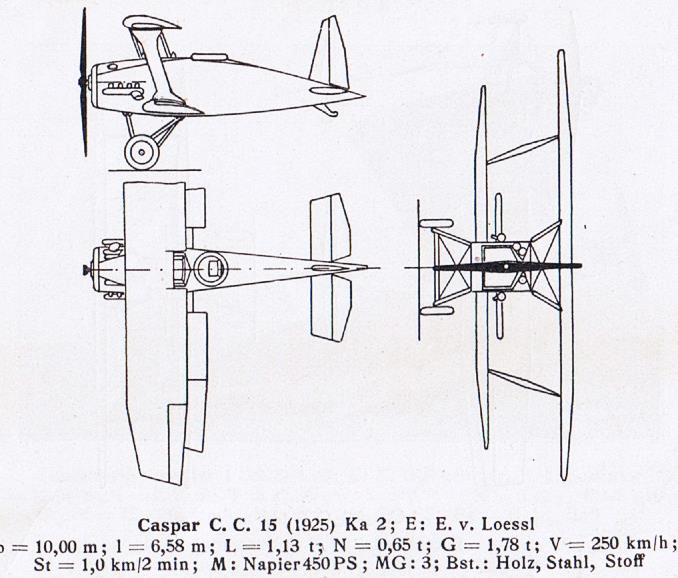

The two-seat combat and reconnaissance aircraft was designed as a cantilever biplane of mixed construction, equipped with two fixed machine guns and a movable machine gun, as well as attachments for a continuous-image camera. In its design and shape, it was practically a slightly enlarged C 14, Version 1, with two seats. The design and construction were again the work of Dipl.-Ing. Ernst von Lössl. The two wing sections were made entirely of wood and were relatively far apart to minimize crosswind interference. The upper wing had a greater wingspan than the lower wing, and its underside was straight, while the upper surface of the lower wing was straight. The wings consisted of two box spars each, connected by ribs and covered with a load-bearing outer skin of impregnated plywood. The continuous upper wing was supported on canopy struts above the fuselage. The lower wing consisted of two halves, whose leading and trailing spars ran through tunnels along the fuselage floor to the fuselage centerline. There, they were coupled using the wedge-shaped quick-release fasteners already employed on other Caspar models. The two wing sections were braced against each other by I-beams made of sheet steel profiles with aerodynamically optimized plywood covering. Ailerons were located only on the upper wing. The forward fuselage half was constructed of a steel tube truss extending to the rear wing spar attachment point and had a covering of partially removable aluminum sheeting up to the observer's position. In contrast, the interior of the rear fuselage section was a pure wooden construction, the outer skin of which consisted of impregnated plywood, which – where necessary – also contributed to load-bearing capacity. The pointed, hinged end cap of the fuselage was made entirely of duralumin. Behind the engine was the cockpit. A headrest on the upper fuselage, which tapered to the rear for improved airflow, was designed to protect the pilot's head in the event of a rollover. Beneath the pilot's seat was a fuel tank sufficient for 2.5 hours of flight. The adjacent observer's compartment provided ample space for camera and radio equipment. The seat there was adjustable and could be moved to the side to allow for standing – for example, when operating the movable machine gun. Both the horizontal and vertical stabilizers had a slightly trapezoidal outline, conventional control surfaces and damping surfaces, and were covered with plywood. All control cables and levers were housed inside the fuselage. The main landing gear had the usual dihedral and consisted of profiled steel struts. It was hinged to the lower chords of the fuselage and had additional steel cable crossovers. The continuous axle and auxiliary axle were made of steel tubing and covered with a teardrop-shaped plywood fairing. The wooden tail skid was hinged in the rear of the fuselage. The planned engine was the Napier "Lion IV" twelve-cylinder W-engine (450 hp/331 kW). It was mounted on an adjustable steel tube frame, which was braced against the firewall and the steel tube truss of the forward fuselage. A large front-mounted radiator was located in the nose, forward of the engine. The armament was to consist of two fixed machine guns, mounted on the upper front of the fuselage and firing through the propeller arc. The observer's compartment was also equipped with a rotating machine gun ring, which carried the movable machine gun on an adjustable pivot. The Caspar CC 15 evidently remained only a project; presumably, there was a lack of serious buyers.