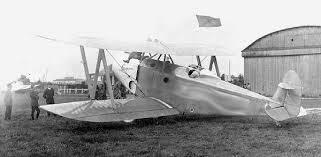
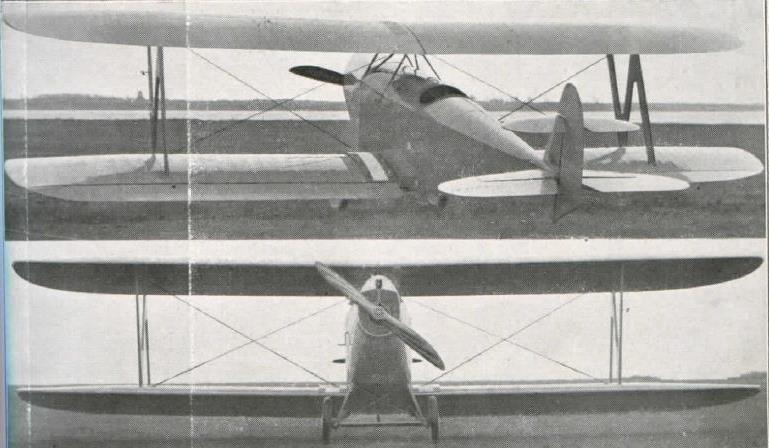
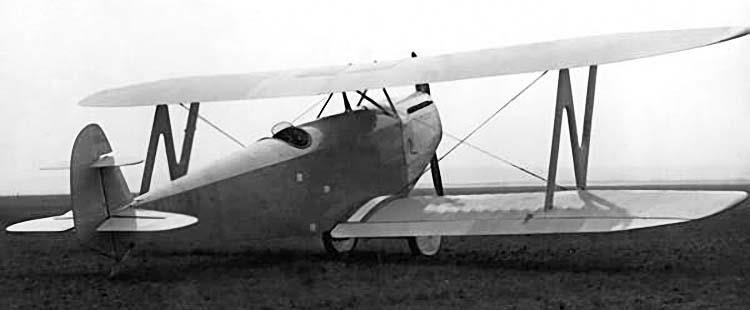
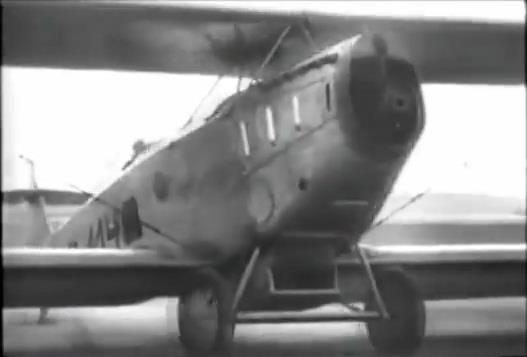
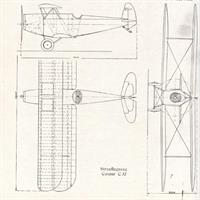
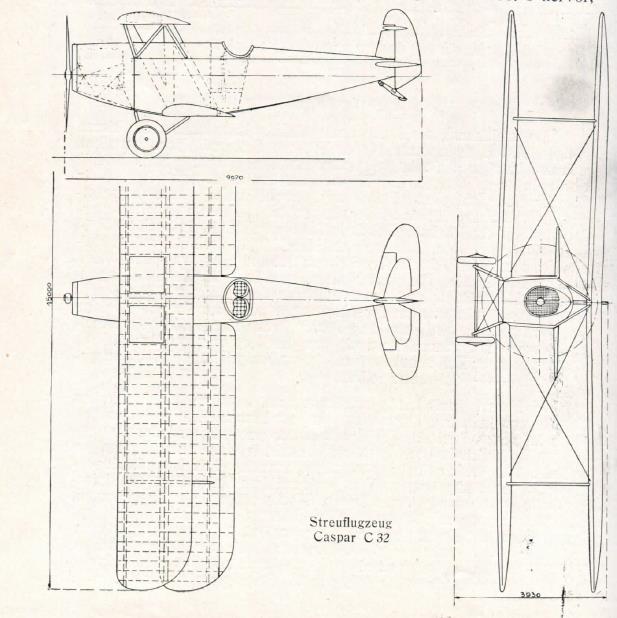
Konstruktionseinzelheiten der. Streuflugzeuges Caspar C 32.
In Frgänzung unseres Berichts über das Spezialflugzcug C 32 der Caspar-Werke A. ü., Travemünde, in letzter Nummer bringen wir heute einige Konstruktionsein/.elheiten dieses interessanten Typs, der, wie bereits erwähnt, von dem Chefkonstrukteur der Firma, Herrn Weinhold Mewes, der schon seit 1916 im Flugzeugbau tätig ist und während des Krieges sowie nachher Mitarbeiter des bekannten Flug- zeugkonstrukteurs Dorner war, geschaffen wurde.
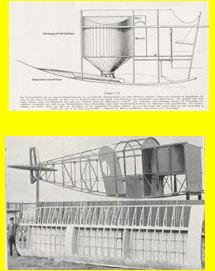
Der Rumpf ist zur Unterbringung einer möglichst großen Last besonders hoch, und breit in reiner Holzkonstruktion ausgeführt. Die Sitze für Führer und Orter sind sowohl der Höhe als auch der Länge nach leicht verstellbar, wodurch ein möglichst bequemes Sitzen für beide erreicht wird. Der Orter hat in seinem Raum soviel Platz zur Verfügung, daß er sich aufrecht im Rumpf frei bewegen und beliebige Arbeiten vornehmen kann, ohne durch den Luftzug irgendwie belästigt zu werden und ohne den Führer bei seiner Tätigkeit zu stören. Er kann ferner auch durch eine Bodenklappe hindurch von einem niederen zweiten Sitz im Rumpf aus photographische Aufnahmen macheu. Die Innenkonstruktion des Holzrumpfes geht aus Abb. hervor. während Abb. 6 die klare und übersichtliche Anordnung der Instrumente usw. gut erkennen läßt. Das Handrad der Steuerung ist auf eine aus Stahlblech gebaute starke Steuersäule aufgesetzt und betätigt durch direkten Seilzug die über die ganze Länge der Unterflügel hinreichenden Querruder.
Der verwendete 230 PS BMW-IV-Motor wird mit einer Andrehvorrichtung (BMW-Konstruktion), durch eine außerhalb der Motorhaube drehbare Kurbel angeworfen. Der Anlaßmagnet ist direkt mit der Handkurbel verbunden, so daß Unfälle, wie sie früher dadurch eintraten, daß der Motor durch Drehen am Propeller und Betätigung des Anlaßmagnetes vom Führersitz aus angeworfen wurde, bei der neuen Anordnung vollkommen vermieden werden.
Die Motorbrücke (Abb. 5) besteht aus Stahlrohr und ist am Brandspant in der heute allgemein üblichen Weise durch 4 Bolzen befestigt. Auf ihrem Vorderende befindet sich der Tragrahmen für den Stirnkühler. Line Motorhaube aus Aluminiumblech verkleidet den Motor vollkommen, bietet aber durch genügend große, bequem zu öffnende Klappen gute Zugänglichkeit zu allen Teilen der Maschinenanlage. Der Oelbehälter liegt hinter dem Brandspant, die Brennstoffbehälter in den oberen Flächen.
Die Flächen sind mit doppelten Kastenholmen in Holzbauart ausgeführt (Abb. 2). Die Rippen wurden nach eingehenden Versuchen so gewählt, daß sie gute Elastizität mit hoher Festigkeit vereinigen. Die Rippen am Flügelanschluß und über den Stielknotenpunkten sind als breite geschlossene Kastenträger mit Sperrholzbeplankung so starr durchgebildet, daß sie eine gute Entlastung gegen Verdrehungsbeanspruchimgen bieten. Das obere Tragdeck ist am Spannturm über dem Rumpf angehängt, die unteren Flächen schließen an der Rumpfunterkante ab.
Der Streugutbehälter ist, wie aus Abb. 1 hervorgeht, vor dem Führerraum untergebracht, in seinem Oberteil zylindrisch, in seinem Unterteil trichterförmig ausgebildet. Starke Spanten versteifen ihn besonders gegen den Brandspant und gegen den vorderen Spant des Führerraumes.
Zu den letztgenannten Daten und Leistungen ist hinzuzufügen: Flächenbelastung 43,4 kg/m2, Leistungsbelastung 10 kg/PS, Landegeschwindigkeit 50 km/Std., Steigzeiten bei Fluggewicht 2300 (2150) kg: auf 1000 m 8,6 (6) Min., auf 2000 m 20,4 (14) Min., auf 3000 m 41 (27) Min., Gipfelhöhe .3730 m, Betriebszeit 5 Std., Hochflugzahl 7,12, Schnell- flugzahl 16,26, Weitflugzahl 5,86.
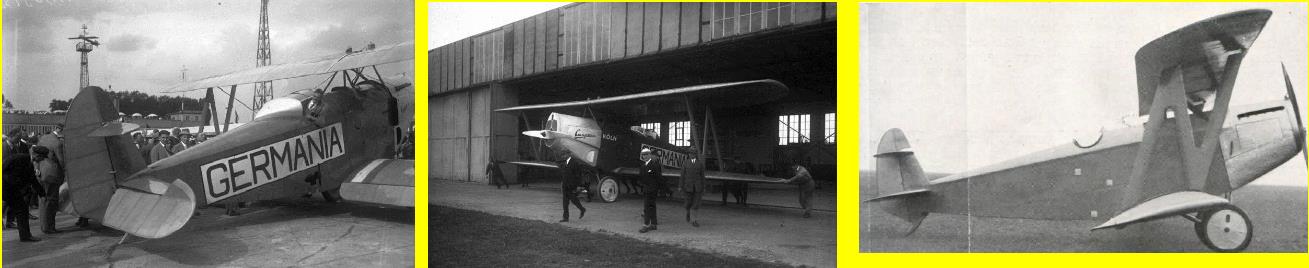
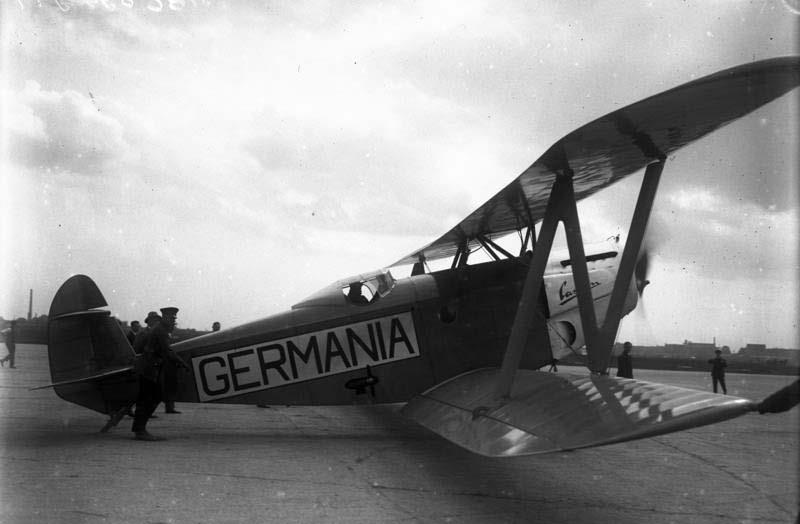
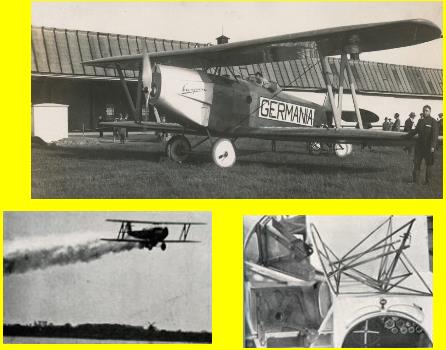
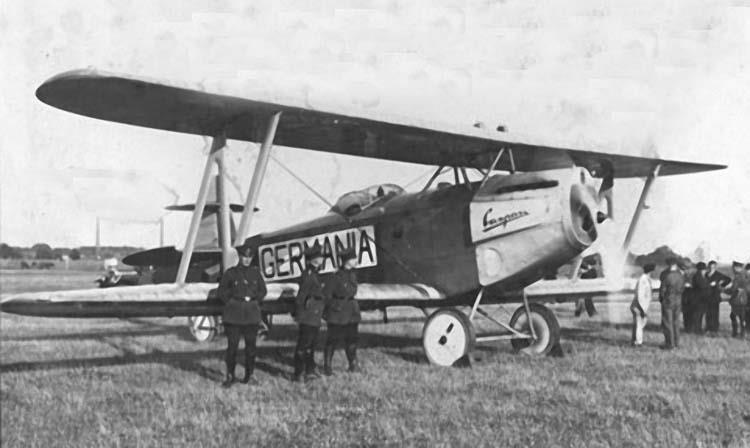
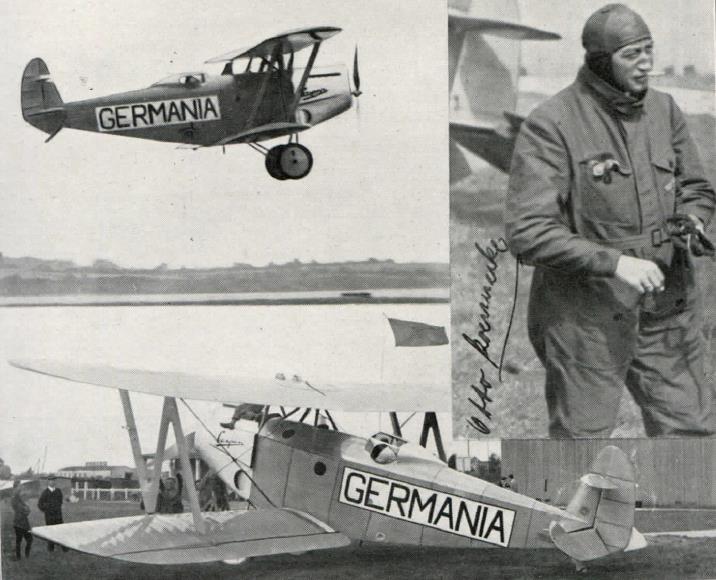
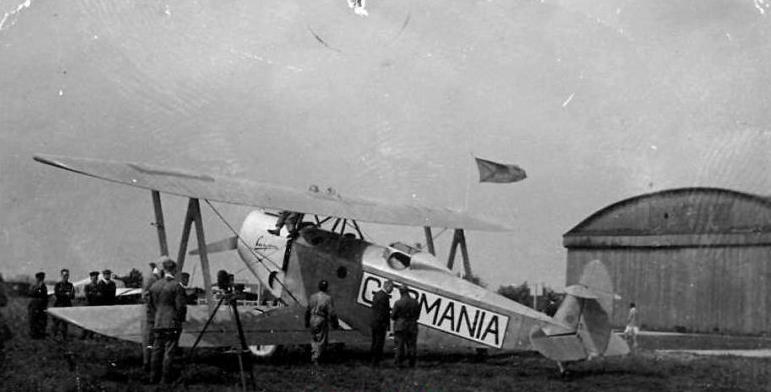
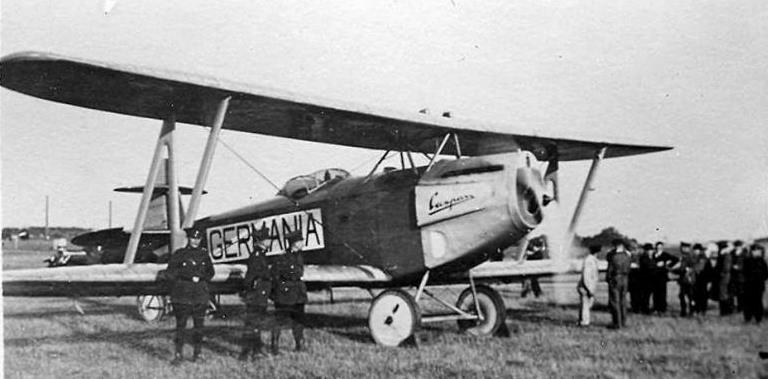
Das Caspar-Atlantik-Flugzeug „Germania" Type C 32.
Bereits in clor letzten Nummer haben wir das von dem bekannten Pour-le-Merite-Flieger Koennecke und
Grafen Solms-Laubach bestellte Flugzeug „Germania" kurz beschrieben. Es ist ein von dem Konstrukteur
Reinhold Mewes entwickelter, in Holz gebauter Rumpf- Doppeldecker, abgeänderter Typ 32, mit normalem
Fahrgestell. Auf Grund der außergewöhnlich hohen Leistungen als Lastflugzeug erschien das Flugzeug den
Auftraggebern für Durchführung größter Landstreckenflüge besonders geeignet. Durch Entfernung des
Streubehälters zwischen Motor und Fülnerrauin wurde die Möglichkeit gegeben, einen großen kabinenartigen
Laderaum zur Unterbringung des Betriebsstoffes zu schaffen, welcher durch eine Tür vom Führerraum aus
zugänglich ist. Auch im Vorderteil des Führerraumes wurde ein weiterer schrankartiger Raum zum Einstapeln
von Kanistern eingebaut. Der für einen Flug von 50 Stunden erforderliche Brennstoff wird größtenteils in dem
Kabinen-Laderaum und in dem schrankartigen Raum im vorderen Führersitz und zum Teil im Falltank im rechtenoberen Tragdeck untergebracht. Im Laderaubefinden sich unten zwei größere Messingtanks von zusammen
1,5 cm3 Inhalt. Ueber diesen und im Vorderteil des Führersitzes wird der restliche Teil vonBetriebsstoff in
Kanistern von ca. 30-40 kg Inhalt aufgestapelt. Sämt-licher Betriebsstoff wird aus den Behältern im Rumpf
durch eine Pumpe nach dem Falltank gepumpt, welcher gut für 3 Stunden Betriebsstofffaßt. Von hier aus wird m
der Betriebsstoff unter Vorschaltung von 2 Filtern dem Motor zugeführt. Die leeren großen Tanks sowie ein
großer Teil der entleerten Kanister dienen dem Flugzeug für den Fall einer Notlandung in See als Schwimm-
körper. Ein Teil der Kanister wird bei Beginn des Fluges nach Entleerung über Bord geworfen, um Raum zu
schaffen. Diese Kanister werden gleichzeitig als Flaschenpost Verwendung finden. Das Oel befindet sich in
einem Falltank im linken oberen Tragdeck, der bis zu 190 l faßt.
Als Antrieb dient der bewährte Junkers L5-Motor in Normalausführung mit Sum-Vergasern, Scintilla-Magneten,
Boschanlasser und Boschkerzen. Nach vorne findet der Rumpf seinen Abschluß in einem Spezial-N.K.F.-
Stirnkühler. Mittels einer kleinen Pumpe ist es möglich, dem Kühler während des Fluges Zusatzkühlwasser
zuzuführen. Als Propeller kommt ein Metall-Propeller Patent „Reed" der Heddernheimer Kupferwerke, Frankfurt a. M., zur Verwendung.
Die Sitzanordnung blieb für den Führer die normale, es wurde jedoch ein besonders bequemer Sessel, ein ovales Handrad sowie besondere Seitensteuerschuhe nach Wünschen von Koennecke eingebaut. Das Instrumentenbrett wurde etwas nach vorne verlegt. Nach oben wurde der Führerraum durch einen stromlinienartig verkleideten Aufbau gegen Witterungseinflüsse geschützt. Durch Verwendung von Schiebefenstern ist die Möglichkeit gegeben, frei zu sitzen. Außer den normalen Bordinstrumenten, Umdrehungsanzeiger, Staudruckgeschwindigkeitsmesser, Oelmanometer, Kühlwasser-Thermometer, sind 2 Askania-Flugzeugkompasse Marke „Emil" zum Einbau gekommen.
Die Telefunkenstation Type „St 257 F" wurde auf der rechten Seite Hinterkante des Beobachterraumes eingebaut. Der Generator, auf Schienen herausschiebbar, kam hinter dem Führerschott im Rumpf zum Einbau. Die Funkanlage, in einem Gesamtgewicht von 60 kg, gestattet es, zu telegraphieren und zu telefonieren. Bei normalen atmosphärischen Verhältnissen ist mit einer Reichweite von 200 km bei Telephonie, von 240 km bei tönend Senden, von 600 km bei ungedämpft Senden zu rechnen, doch können bei günstigen Verhältnissen diese Reichweiten erheblich übertroffen werden.
Von Wichtigkeit ist der Einbau einer Klappe im vorderen Schott des Kabinenraumes. Sobald die oberen Kanister entleert und entfernt worden sind, kann der Beobachter nach Oeffnen der Klappe bequem an die beiden Magneten, an die Zündkerzen der hinteren Zylinder und an den Vergaser heran, um an diesen wichtigen Teilen des Motors die Beseitigung eventueller kleiner Störungen vorzunehmen. Anschließend die wichtigsten Angaben über das Flugzeug: Spannweite 15 m, Länge 9,1 m, Höhe 3,9 m Flügelfläche 53 m2, Motor Junkers L5 280/310 PS, Leergewicht 1400 kg.
| Type |
2-seater designed for aerial spraying |
3-seater modified for a record flight |
| Engine |
BMW IV 1 BMW Va , fuel consumption 55 kg/hour |
1 Junkers L 5 |
| Dimensions |
Length 9.10 m, height 3.9 m, span 15.0 m, wing area 53 m2 |
| Weights |
Empty 1400 kg, load 897 kg, flying weight 2300 kg |
Empty 1400 kg, max. load 2400 kg, max take off weight 3800 kg |
| Performance |
Max. speed 158 km/h, (2300 kg) climb to 1000 m 8.6 min., to 2000 m 20.4 m, to 3000 m 41.0 min., (2050 kg) to 1000 m 6 min., to 2000 m 14 min., to 3000 m 27 min., service ceiling 3730 m |
Max. speed 170 km/h, max. range 7500 km, endurance ~50 h |
| Type |
Werk.Nr |
Registration |
History |
|
7006
|
D-1142 |
From March 1930 BMW Va. In Febr. 1928 to Biologische Reichsanstalt für Land- und Forstwirtschaft, Berlin. From July 1933 to DLV e. V., Berlin |
|
7008 |
D-1143 |
"Wismar". In May 1928 to DVS GmbH, in August 1929 to DVL e. V., Adlershof, in June 1932 to DLH AG, uused as a freighter. Unregistered from April 1933 |
|
7009 |
D-1144 |
In Nov, 1928 to DVL e. V., Adlershof, in Oct. 1929 to DVS GmbH, in Dec. 1930 to DVL e. V., Adlershof, in May 1931 to DVS GmbH. In May 1932 placed in a museum with the colours and registration D-1145 and from 1932 as a "Replica" of the Koennecke-aircraft in the Berliner Luftfahrtausstellung |
|
7010 |
D-1145 |
"Germania". Owned by Grafs Solms-Laubach. The former WW I fighter pilot Otto Koennecke intended to use this plane for a flight cross the Atlantic in the east-west direction. Koennecke intended to start his epic flight in Cologne-Butzweilerhof. But bad weather over Europe contstanly prevented a take-off. Therefore Koennecke decided to try to reach America in a flight in eastern direction via India and Japan. On the 20th of September 1927 the "Germania" took off from Cologne. The flight was hampered by many unpleasant events and technical problems. Though Koennecke reached Calcutta in India the following year, he had to quit because of problems with both plane and crew, and returned to Germany. Scrapped 1927 |