Type Single seat glider
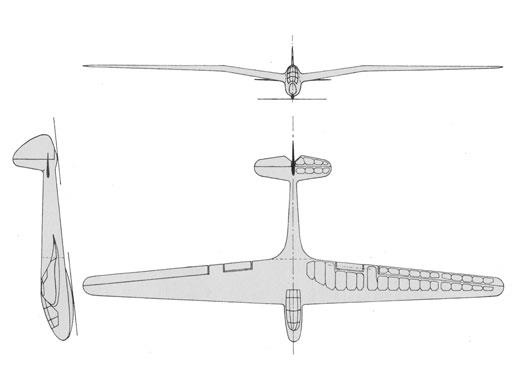
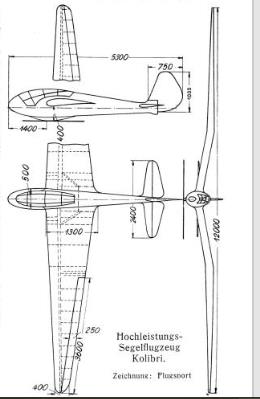
Dimensions Length 5,8 m, height 1,91 m, span 12 m, wing area 10,8 m2, aspect ratio 13,34, profileGöttingen 535 at root and middle wing, NACA 21012 at the tip, wing chord at root 1,3 m, at the tip 0,5 m, mean chord 0,9 m, dihedral 1,5º, max. width 0,52 m, stabilizer 2,31 m2 (Göttingen 410), elevator 0,99 m2, fin 1,8 m2, rudder 0,7 m2
Weights Empty 110 kg, max. weight 190 kg, wing loading  17,58 kg/m2
Performance Max- speed 220 km/h, gliding rato 1 : 23 at 70 km/h,  sinking speed 0,75 m/sec. at 60 km/h,
Type Werk.Nr Registration History
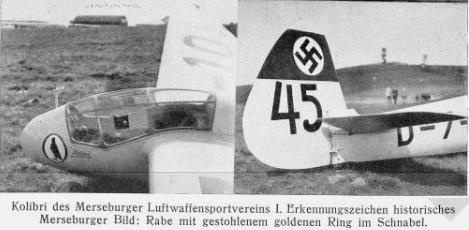
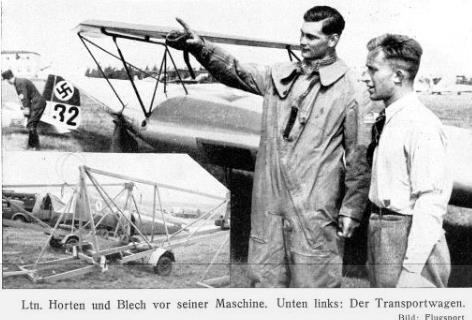
D-7-109 Built by the Segelflugabteilung Luftwaffen Sportverein I. Kampfgeschwader 153
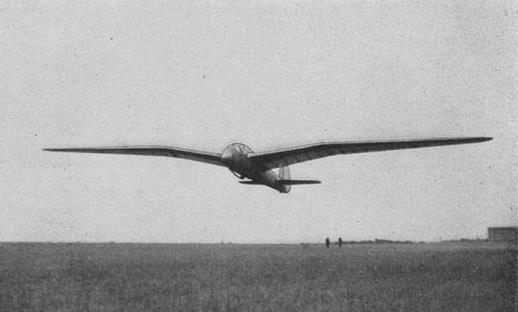
The Kolibri is a small sailplane of only 40 ft. span designed by Blessing and built by the glider division of the Luftwaffesportverein. The purpose of the design was to build a high performance ship as light and maneuverable as possible, which at the same time would offer no great constructional difficulties.
The Göttingen 535 section is used thinned 10% to the gull point and from there out 15%. There is a geometrical twist of 3°.
To avoid heavy wing fittings, the main spars join in the center of the fuselage which is supported from them by steel straps. The spar on the first model was made considerably over-strength and weighs 47 pounds. The next one will weigh only 28 pounds. The weight empty is 265 pounds, which in the next ship constructed should be reduced by 37 pounds.
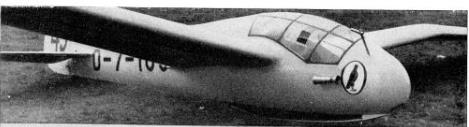
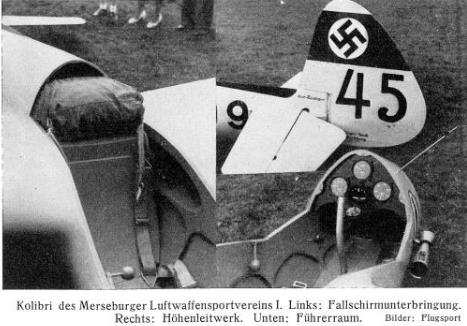
The cockpit has a semi-elliptical cross section. Its removable cover opens up the fuselage nearly half its length. In order to give the pilot more room, the parachute lies in the upper part of the fuselage behind the pilot's head. Airbrakes on the sides of the fuselage.
High-performance glider Kolibri,
Designed by Blessing, built by the glider department Luftwaffe Sportverein I. Kampfgeschwader 153. The intention was to build a high-performance glider that was as light and manoeuvrable as possible, which would not present any major structural difficulties. In order to save on the heavy spar fittings, a
continuous spar was used, to which the boat is firmly glued with straps. The spar weighs 19 kg, but is oversized. The next one will weigh only 11 kg
. Empty weight 106 kg, which is to be reduced by 15 kg in the next version. The rear part of the fuselage is removed with 3 bolts in the last third of the wing depth. Tail unit usual design, damped. The driver's cab has a semi-elliptical cross-section, the driver's cab canopy is removable in the entire half of the fuselage. In order to
give the guide more space, the parachute was placed in the upper part of the fuselage behind the leader's head
Designed by Blessing, built by the gliding department Luftwaffesportverein I. — Kampfgeschwader 153. There was theintention to build a high-performance glider that is as light and very manoeuvrable as possible, which does not require any major structural problems.difficulties.In order to save the heavy honing fittings, a continuous spar was used, to which the boat was fastened with straps.glued. The spar weighs 19 kg. but is oversized. The next one will weigh only 11 kg. Curb weight 106 kg.which is to be reduced by 15 kg in the next version.The rear part of the fuselage is removed with 3 bolts in the last third of the wing depth. Tail unit usual design, damped.The cockpit has a semi-elliptical cross-section, the cockpit is in the entire half of the hullremovable. In order to give the guide more space, the parachute was placed in the upper part of the fuselage behind the head of theFührer's lying downWingspan 12 m. Total length 5.3 m. Height 0.91 m. Area 10 m2, Wing loading 18 kg/m2, Empty weight forCompetition (2 barographs) 108 kg. largest fuselage cross-section 3000 cm2. Glide angle 1/23, descent rate 75 m/sec.,1.5 case per 100 km drive. Profile Göttingen 535th and up to the bend 10°/. diluted, from then on to the tip of the wing 15°/odiluted, geometric offset from the bend to the end 3°.