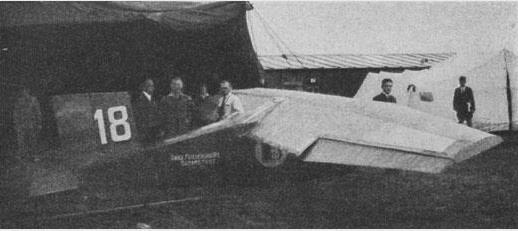
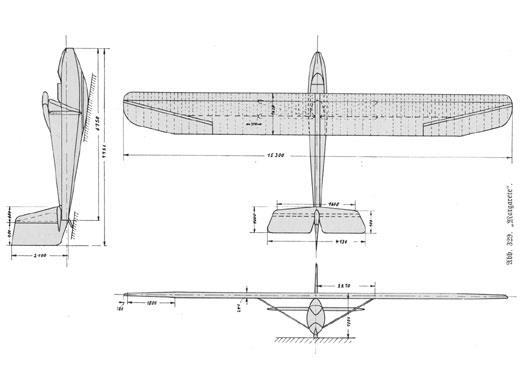
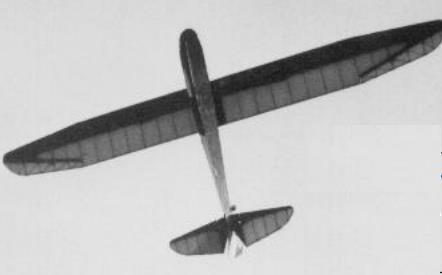
The aircraft was constructed by AJ Andersson on behalf of Augsburger Verein für Luftfahrt in Augsburg . It was named after the local cookie Zwetschgendatschi . When Andersson designed the aircraft , he placed a person on a trestle which he dressed up in a cabin mockup and this gave the fuselage minimal cross section with low air resistance. The wings were highly placed in a small canopy with profiled wing struts from the bottom of the fuselage to the wing center . The default format on the plywood disks length, 1.2 meters , could decide vingkordan . Veneer glued on top of the wing spar , and swept around the front edges, glued to the underside of the wing spar . The manufacturing method led to the minimize use of plywood . . The aircraft was designed to handle gusty winds and a load factor of 7.2 at load weight of 110 kg . This fulfilled the requirements to be allowed for aerobatics.
Type
Dimensions
Length 6,2 m , height , span 12.87 m , wing area 15,2 m2 , aspect ratio
Weights
Empty 90 kg , loaded , max. take off weight 180 kg, wing load 11,8 kg/m2 width 0,55 m
Performance
Max.. speed , cruising speed , range , endurance , service ceiling , climb
Type
Werk.Nr
Registration
History
Designed by A.J. Andersson, built by the Augsburger Verein für Luftfahrt.The aircraft took part in the local Bavarian competition in Hesselberg in 1930, and at the Rhön at Wasserkuppe July-August 1931
FLUGSPORT Nr. 1 Das Segelflugzeug „Datschi". Unter- den am 2. bayer. Segelf lug Wettbewerb am Hesselberg teilnehmenden Flugzeugen erregte die neue Maschine des Augsburger Vereifls für Luftfahrt, die „Datschi", besonderes Interesse. Im folgenden wird über die Entstehung und Konstruktion dieser Maschine kurz berichtet: Als der Gedanke aufkam, eine Maschine eigener Konstruktion zu bauen, wurden folgende Richtlinien festgelegt: Die Maschine sollte als Uebungsmaschine für wirklich Fortgeschrittene und erst in zweiter Linie als Leistungsmaschine dienen. Es wurde hauptsächlich aufwendigkeit und geringe Sinkgeschwindigkeit Wert gelegt. Irn Gegensatz zu den leichteren Seglern sollte das Flugzeug auch für höhere Windstärken brauchbar sein. Ferner sollte der Transport in einem geschlossenen Waggon möglich, außerdem die Herstellung möglichst billig sein. Als günstigste Bauart erschien der abgestrebte Hochdecker mit Sperrholzrumpf. Durch die Verladebedingung war die Spannweite bei zweiteiligem Flügel auf ca. 13 m beschränkt, eine Spannweite, die auch mit Rücksicht auf die gewünschte Wendigkeit als günstig erschien. Bei einer Flächenbelastung von 11—12 kg/m2 — geschätztes Fluggewicht rund 180 kg — wäre ungefähr 15,5 m2 Flügelfläche erforderlich, was ein Seitenverhältnis von rund 1 : 11 gibt. Eine auf Grund dieser Zahlen durchgeführte vorläufige Leistungsberechnung ergab für die beiden in die engere Wahl gezogenen Flügelschnitte — Gott. 535 und 549 — ganz annehmbare Sinkgeschwindigkeiten und Gleitzahlen unter der Voraussetzung, daß die schädlichen Widerstände niedrig gehalten werden könnten. Der Flügelgrundriß wurde jetzt in seiner endgültigen Form festgelegt: Rechteckflügel mit trapezförmig zugespitzten, abgerundeten Enden. Dieser Umriß kommt dem aerodynamisch günstig erkannten elliptischen sehr nahe und bietet auch statisch, besonders bei abge" -strebter Bauart, wesentliche Vorteile. Bei der Festlegung des statischen Aufbaues vom Flügel traten die wirtschaftlichen und herstellungstechnischen Gesichtspunkte in den Vordergrund. Um die Sperrholzplatten möglichst ohne Verschnitt auszunutzen, wurde der Hauptholm in einem solchen Abstand von der Flügelvorderkante gelegt, daß der Umfang der Nase der Länge einer Platte — 1,2 m — entsprach. Bei einer Flügeltiefe im parallelen Teil des Flügels von 1,3 m ergab sich der Abstand von der Vorderkante zu 546 mm oder 41,5 Prozent der Flügeltiefe, bei welcher Lage das gewählte Profil 549 noch nahezu seine größte Bauhöhe hat. Um den dritten Anschlußpunkt für den geplanten V- (Torsions-) Stiel zu schaffen, wurde ein Hilfsholm eingelegt, und zwar vor dem Hauptholm in 16 Prozent Flügeltiefe. Die beiden Holme wurden durch die Nasenbeplankung zu einem biegungs- und verdrehungssteifen viergurtigen Holm verbunden, dessen elastische Mittellinie durch geeignete Wahl der Gurtstärken annähernd mit dem Druckmittel beim Abfangen zusammenfällt. Beim Entwurf der Stiele wurde angestrebt, den schädlichen Widerstand durch eine saubere Verkleidung in Tragflächenprofil dadurch auszugleichen, daß sie den größten Teil ihres Eigengewichtes bei normalem Staudruck tragen sollten. Der Rumpf war von vornherein als ein weiterer Schritt in Richtung »bewußter Rückkehr zur eckigen Form" gedacht. Zur Feststellung des günstigsten Querschnittes wurde ein Mann auf einen Bock gesetzt und um ihn herum eine Attrappe gebaut. Hierbei erwies sich die später auch gewählte Rautenform als die in aller Hinsicht günstigste. Sie ergab bei guter Bequemlichkeit für den Führer eine möglichst geringe Querschnittsfläche und bot ausgezeichnete Befestigungsmöglichkeiterl für Flügelstiele, Starthaken, Kufe und Auslösevorrichtung. Dabei ist sie mit Ausnahme für die reine Rechteckform in der Herstellung die weitaus einfachste von allen in Betracht kommenden Formen. Das Leitwerk unterscheidet sich nur wenig von den bei den meisten Leistungsflugzeugen gebräuchlichen Bauarten. Der hauptsächliche Unterschied besteht darin, daß das Höhenruder in einem Stück ausgeführt ist, um die üblichen schweren Verbindungsrohre zu vermeiden. Die Steuerung wurde in Anlehnung an bewährte Ausführungen entworfen. Um die Querruderwirkung günstiger zu gestalten, wurde die Quersteuerung als Differentialsteuerung ausgeführt. Bemerkenswert ist, daß sich sämtliche Spannschlösser leicht zugänglich im Rumpfvorderteil befinden, wodurch jegliche Schauklappen vermieden wurden. Die ganze Steuerung enthält nur 3 Umlenkrollen, die sich alle im Rumpfvorderteil befinden. Außerdem wurden die Höhen- und Seitensteuerseile je einmal durch Hartholzklötze geführt. Diese Führungen sind auch leicht zugänglich. Die Auslösung des Halteseiles geschieht vom Führersitz aus und ist die Uebersetzung so gewählt, daß nur eine sehr geringe Kraft zum Auslösen nötig ist. Die Dimensionierung des Flugzeuges erfolgte mit Rücksicht auf die Verwendung bei starkem, böigem Wind nach den D. V. L-Vorschrif-ten für Motorflugzeuge für die Gruppe S 4 — beschränkt kunstflugtauglich — mit einem Bruchlastvielfachem = 7.2. Da das tatsächliche Baugewicht statt veranschlagten 110 kg nur 90 kg beträgt, erhöht sich das effektive Bruchlastvielfache auf ungefähr 9. Zu obigen Ausführungen ist nur noch zu bemerken, daß sich die Maschine im Fluge in allen Hinsichten glänzend bewährt hat. Daß ausgerechnet mit diesem Flugzeug der erste wirkliche Segelflug am Hesselberg ausgeführt wurde, war kein Zufall. Neben der Fähigkeit des Piloten, der jedoch vorher nie gesegelt war, und der auf der „Datschi" bisher nur 3 kurze Gleitflüge gemacht hatte, spielten hierbei die guten Eigenschaften der Maschine eine große Rolle. Auffallend war vor allen Dingen die enorme Wendigkeit und die dabei doch ausgezeichnete Stabilität. So wurde die Maschine während diesem ersten Segelflug auch freihändig geflogen, was besonders auffällig ist, da das Höhensteuer praktisch ungedämpft ist. Die gute Wendigkeit wurde, trotz von verschiedenen Fachleuten während des Baues als reichlich klein bezeichneten Seiten- und Querruder, wohl hauptsächlich durch systematisches Leichthalten der außenliegenden Bauteile — Leitwerk, Flügelenden und Querruder — erreicht. Auch diese klein gehaltenen Querruder — gesamte Querruderfläche nur ca. 10% der Flügelfläche — haben sich als voll ausreichend erwiesen. Diese Wirkung ist zum Teil der Differential Steuerung, aber auch, nach Ansicht des Verfassers, vielleicht in noch höherem Maße der günstigen Umrißform zuzuschreiben.