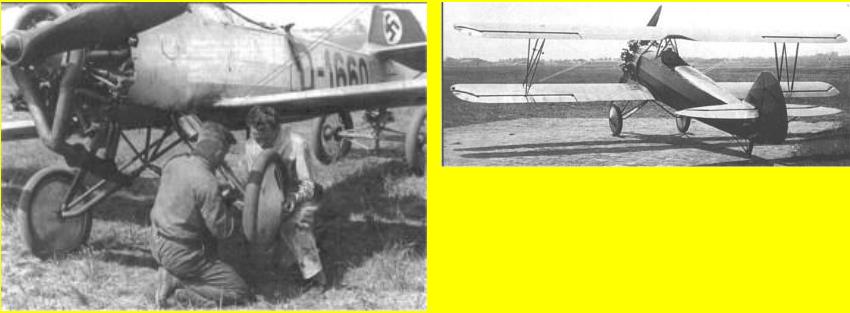
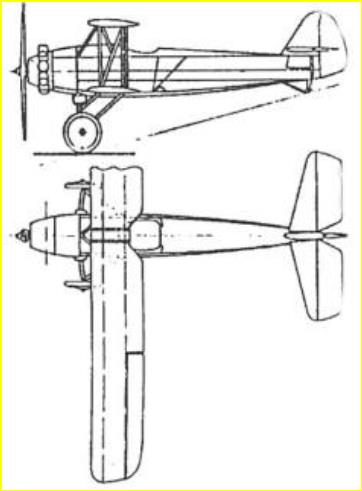
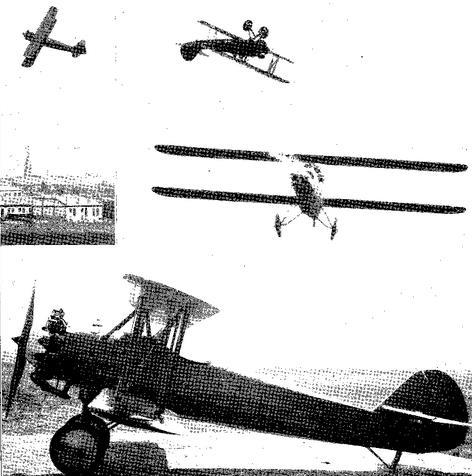
Albatros „Kobold" (L 79),
Das Flugzeugmuster Albatros „Kobold" (L 79) ist als einsitziges Versuchsflugzeug zur Erforschung des Verhaltens von symmetrischen Flügelprofilen auf Anregung der D V L entwickelt worden. Die Versuche sollten dabei außer allen normalen, auch besonders die Zustände in umgekehrter Fluglage (Rückenflug) umfassen. Das Flugzeug mußte, diesem Plan Rechnung tragend, in geeigneter Weise ausgebildet werden.
Das gesamte Flugwerk ist entsprechend den Forderungen der höchsten Qruppe der Lastannahmen dimensioniert. Für den Fall des Rückenfluges sind die Festigkeiten darüber hinaus um 50% erhöht.
Das Tragwerk besteht aus Ober- und Unterflügel von gleicher Spannweite ohne Staffelung und ohne V-Stellung. Je ein N-Stiel, Stromliniendraht-Auskreuzung in der Vorderholm-Ebene. Oberflügel am Spannturm, Unterflügel an Rumpf unterkante angelenkt Gleicher Flügelschnitt, symmetrisches Profil über die ganze Spannweite mit abgerundeten Enden. Kastenholme in üblicher Bauweise, Flügelnase und Oberseite mit Sperrholz beplankt. Doppelte Querruder aus Leichtmetall
Der Rumpf ist ein geschweißtes Stahlrohrgerüst. Die hinteren Felder sind mit Draht ausgekreuzt. Seitliche Türen und abnehmbarer Rumpfrücken. Verwendung von Sitzkissen- Irwing und Heinecke-Fallschirm vorgesehen. Hinter dem Führersitz Handkoffer aus Leichtmetall 550X350X150.
Längs des Rumpfes wurden die Massen möglichst zusammengeschoben, wodurch der Führer nahe an den Schwerpunkt heranrückt. Das Flugzeug nimmt infolgedessen im Trudeln keine großen Drehgeschwindigkeiten an, und der Führer arbeitet dabei mit geringen Fliehkraftbeschleunigungen. Der Brennstoffbehälter liegt nahezu im Schwerpunkt, so daß sich bei ver-änderten Zuladungen der Flugzeugschwerpunkt kaum verschiebt.
Die Leitwerke bestehen aus Stahlrohrgerippen mit Stoff bespannt. Die Höhenflosse ist am Boden verstellbar. Die Ruder sind ausgeglichen.
Das Steuerwerk besteht aus Stoßstangen, Hebeln und Seilzügen. Die Höhenruderseile sind doppelt. Fußhebel verstellbar.
Das Fahrgestell hat hochgezogene Achse und Druckgummifederbeine. Der Sporn besitzt ebenfalls Druckgummifederung.
Motor: Sh 12 mit Spritzvergaser „Sum U 36". Maßgebend für die Ausführung der Triebwerksanlage war die verlangte un-beschränkte Rückenflugfähigkeit. Die bisherigen Ausführungen konnten nicht als Vorbilder dienen, da sie entweder Druck-behälter, die verboten sind, oder Fallbehälter, die wegen der Vergrößerung des Luftwiderstandes nicht in Frage kamen, benutzten, und außerdem ihre Verluste an Schmierstoff zu groß, wie überhaupt ihr ganzes Schmiersystem unzureichend war. Trotz der unter den vorliegenden Bedingungen um ein Vielfaches größeren und mit der Drehzahl veränderlichen Förder-menge der Brennstoffpumpe konnte diese mit dem sehr druckempfindlichen Spritzvergaser in Einklang gebracht werden, und auch die Schmieranlage konnte trotz der für den Rückenflug und die Oelabdichtung der Brennstoffpumpe unbrauchbaren Zahnradpumpen des Motors betriebssicher ausgeführt werden. Die Brennstofförderung aus dem Kunstflugtank erfolgt durch die vollkommen lageunempfindliche Junkers-Deka-Brennstoffpumpe, deren Fördermenge durch eine Drossel und Ueber-laufleitung entsprechend dem jeweiligen Verbrauch des Motors trotz der Druckeinpfindlichkeit des Vergasers einwandfrei automatisch reguliert wird.
Der Schmierstoff fließt dem Motor in normaler Fluglage durch natürliches Gefälle und unter der Saugwirkung der Frischöl-zahnradpumpe des Motors zu. Nach seinem Kreislauf im Motor wird er durch die Rücklauf zahnradpumpe des Motors wieder in den Behälter zurückgefördert. Für die Schmierst offörderung im Rückenflug und für die Oel-abdichtung der Brennstoff-pumpe sind zwei zusätzliche Zahnradpumpen eingebaut, von denen die eine über ein Reduzier- und Rückschlagventil die Brennstoffpumpe mit etwa 1 Atm. abdrückt. Das aus dem Reduzierventil überfließende Oel wird durch ein automatisches Umschaltventil in normaler Fluglage in den Schmierstoffbehälter ziirückgeleitet, in der Rückenlage dagegen wird es in die Frischölleitung gedrückt, von wo es der Frischölpumpe des Motors zufließt. Die zweite zusätzliche Oelpumpe übernimmt das Absaugen des Schmierstoffs in der Rückenlage und befördert das heiße Oel in den Behälter zurück. Durch diese Schmierst off anläge sind Schmierstoffverluste vollkommen vermieden Worden und eine in jeder Fluglage einwandfreie Schmierung des Motors gewährleistet. Ferner ist aus Sicherheitsgründen der Frischöl-hahn mit einem Sicherheitszündschalter gekuppelt, so daß der Motor vor Oeffnen des Hahnes nicht in Betrieb gesetzt werden kann.
Die Betriebsstoffbehälter sind aus Leichtmetall und im Rumpf-innern untergebracht. Das Fassungsvermögen des Fallbehälters beträgt 34,5 l, das des für Figurenflüge besonders geformten Kunstflugbehälters 47,5 1 und das des Oelbehälters 5 1. Die Betriebsstoff menge reicht bei normaler Drehzahl für eine Flugdauer von 2,5 Std. aus.
Wird auf die unbeschränkte Rückenflugfähigkeit verzichtet, so kann die Triebwerksanlage dementsprechend vereinfacht werden. Der Motor erhält wieder die normalen Sum-Vergaser, und die Brennstofförderung aus dem Kunstflugtank übernimmt eine A.-M.-Pumpe, die den Brennstoff über einen Windkessel in die Schwimmervergaser drückt. Die Schmierstoffanlage erhält durch Wegfall der zusätzlichen Zahn-radölpumpen und Armaturen die bei den Siemens-Motoren übliche Ausführung.
Spannweite 8,8 m, Höhe 2,24 m, Länge 6,27 m, Flügelfläche 16,60 m2, Motorleistung 108/125 PS, Rüstgewicht: Reiseflug 465 kg, eingeklammert Kunstflug (465 kg), Zuladung 175 kg (120 kg), Fluggewicht 640 kg (585 kg), Flächenbelastung 33.5 kg/m2 (35,2 kg/m2), Leistungsbelastung 5,92/5,12 kg/PS (5,42/4,68 kg/PS), Höchstgeschwindigkeit 165 km/h (165 km), Landegeschwindigkeit 76 km/h (73 km/h), Flugdauer 2,5 h (1,25 h), Steigzeit auf 1000 m (DNA) 4,5 min (4 min), Steig-geschwindigkeit (bei 8 = 1,1 kg/m3) 3,2 m/sek (3,75 m/sek).
Die vorstehenden Leistungen werden garantiert mit 4% Abzug auf die Höchstgeschwindigkeit, mit 10% Zuschlag auf die Steigzeit und, je nach den Flugplatzverhältnissen, bis zu 10% Zuschlag auf die Landegeschwindigkeit
| Type |
Single seat sportplane designed for aerobatic |
Single seat sportplane, aerobatic |
| Engine |
1 Siemens Sh 12 |
| Dimensions |
Length 6.27 m, height 2.24 m, span 8.80 m, wing area 16.60 m2 |
| Weights |
Empty 465 kg, load 175 kg, flying weight 640 kg, wing loading 38.5 kg/m2 |
Empty 465 kg, load 120 kg, flying weight 585 kg, wing loading35.2 kg/m2 |
| Performance |
Max. speed 165 km/h, landing speed 76 km/h, endurance 2.5 h, climb to 1000 m 4.5 min., climb 3.2 m/sec |
Max. speed 165 km/h, landing speed 73 km/h, endurance 1.25 h, climb to 1000 m 4.0 min., climb 3.75 m |
| Type |
Werk.Nr |
Registration |
History |
|
10140 |
D-1660 |
In June 1929 to DVL. Minor damage in a landing 15th of May 1934 (Pilot Dipl.Ing. Geike) |
|
10165 |
D-1871, D-ETIZ |
In June 1930 to RDL Erprob.-Stelle. Staaken. Collided with Klemm L 26 IIa (D-2096) in 1933. After repair to Rechlin in 1934. Scrapped in April 1937. |