Prototype


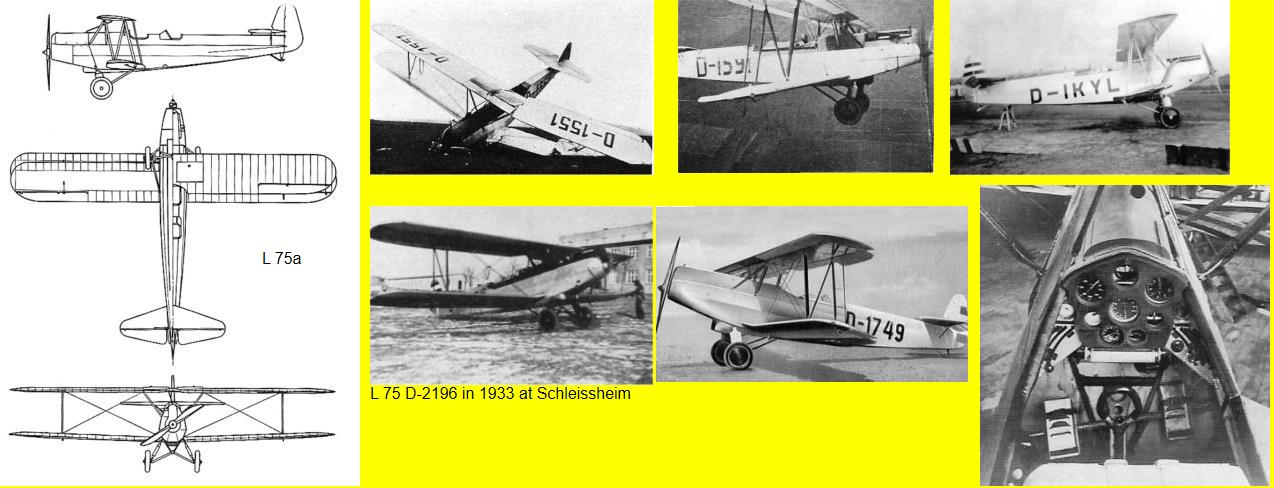
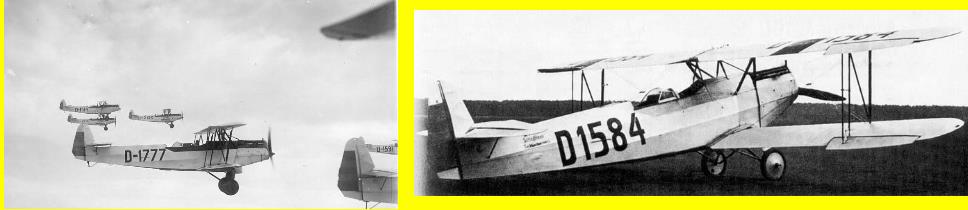
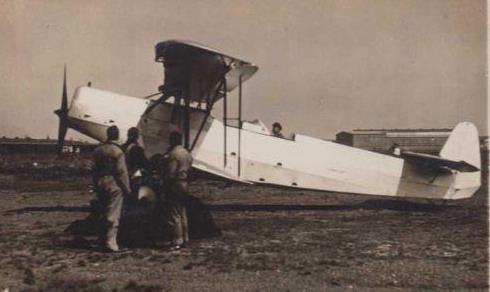
The Albatros L 75 Ass  was a German trainer biplane of the 1920s. Of conventional configuration, it seated the pilot and instructor in separate, open cockpits. The wings were single-bay, equal-span, and had a slight stagger. Production continued after Albatros was absorbed by Focke-Wulf.
Type a b c
Engine 1 BMW IVa 1 BMW Va 1 Junkers L5 1 BMW Va
Dimensions Length 10,0 m, height 3,71 m, span 12,5 m, wing area 37 m2
Weights Empty 1085 kg, crew 160 kg, fuel and oil 485 kg, load 55 kg, flying weight 1785 kg Empty 1150 kg, crew 160 kg, fuel and oil 485 kg, load 40 kg, flying weight 1835 kg
Performance Max. speed at sea level 205 km/h, climb to 1000 m 3 min. 36 sec., to 2000 m 8 min. 6 sec., to 3000 m 13 min. 54 sec., to 4000 m 21 min. 54 sec., to 5000 m 35 min. 24 sec., cruising speed 166 km/h, landing speed 85 km/h, range 1700 km, service ceiling 5370 m Max. speed at sea level 217 km/h, ., cruising speed 170 km/h, landing speed 90 km/h, range 1600 km, service ceiling 5500 m Max. speed at sea level 200 km/h,  cruising speed 165 km/h, landing speed 90 km/h, range 1600 km, service ceiling 5000 m Max. speed at sea level 217 km/h, ., cruising speed 170 km/h, landing speed 90 km/h, range 1600 km, service ceiling 5500 m
Type d E F DSA
DSB
Engine 1 BMW Va 1 BMW Va 1 Junkers L5G 1 BMW Va 1 Junkers L5
Dimensions Length 10,0 m, height 3,71 m, span 12,5 m, wing area 37 m2
Weights Empty 1150 kg, crew 160 kg, fuel and oil 485 kg, load 40 kg, flying weight 1785 kg
 
Empty 1140 kg, crew 160 kg, fuel and oil 485 kg, load 50 kg, flying weight 1785 kg Empty 1150 kg, crew 160 kg, fuel and oil 485 kg, load 40 kg, flying weight 1785 kg Empty 1140 kg, crew 160 kg, fuel and oil 485 kg, load 50 kg, flying weight 1785
Performance Max. speed at sea level 217 km/h,  cruising speed 175 km/h, landing speed 90 km/h, range 1600 km, service ceiling 6000 m Max. speed at sea level 205 km/h,  cruising speed 166 km/h, landing speed 90 km/h, range 1950 km km, service ceiling 5370 m m, landing speed  90 km/h, climb 3,94 m/sec., to 1000 m 3,6 min., to 2000 m 8,1 min., to 3000 m 13,9 min., to 4000 m 21,9 min., to 5000 m 35,4 min.
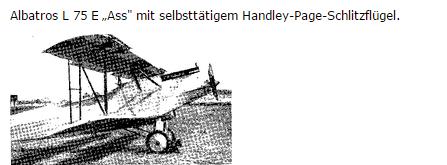
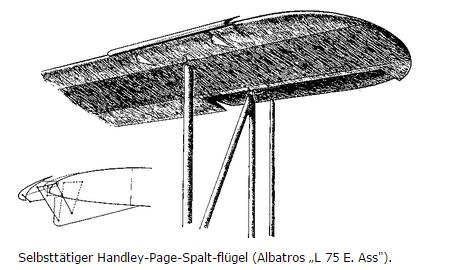
Albatros L 75 E  with slots wings.
Albatros Flugzeugwerke has been working with the English aircraft factory Handley-Päge for a long time. As early as 1926, the
well-known Handley-Page slotted wings - which at that time still had to be operated from the drivefs seat - were tried on some Albatros constructions.
In August 1929, after the automatically operated slotted wings had proven themselves in many countries and e.g. all aircraft belonging to the
English state were equipped with them, Albatros began to use an automatic slotted wing on a trial basis in one of its newest types, the L75 "Ass".
The adjacent illustration shows an L75 with an automatic Handley Page slotted wing; the slit is just open on both sides.
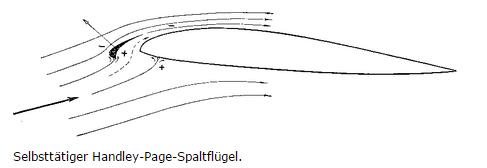
The arrangement of the auxiliary wing and its linkage guide are shown in the sketches'). In contrast to the older, controlled slit wing, which was initially intended to
reduce the landing speed, the automatic slit is primarily used to improve the aileron effect in exaggerated flight conditions.
If the aircraft falls below a certain dynamic pressure, i.e. if it exceeds a certain angle of attack, the gap
in front of the ailerons at the wing nose opens more and more with increasing angle of attack until it is fully open shortly before reaching the critical angle of attack. The pressure
gradient between the pressure and suction sides allows a band of air to pass through the nozzle gap at high speed on the suction side, so that the flow on the suction side
is still present even if it has already broken off at the inner parts of the wing that are not provided with gaps (exaggerated flight condition). This ensures full
aileron effectiveness up to the critical angle of attack.
If the angle of attack decreases again, the process is simply reversed. Since the movement of the auxiliary wing is visible to the leader, the automatic gap is a
valuable aid for assessing the flight attitude, which warns him in good time of involuntary transition into a spin.
The self-operation of the auxiliary wing is effected by a strong flow around the nose of the wing with a high vacuum at a large angle of attack; this
vacuum lifts the auxiliary wing from the wing nose. At smaller angles of attack, the flow divides at the wing nose: then there is a strong overpressure that presses
the auxiliary wing firmly against the wing nose.
At the time when State Secretary Erhard Milch demanded the production of over 4,000 aircraft within nine months, including more than half, namely 2,168, for training purposes, German aircraft manufacturers were only just beginning to ramp up their production capacity. The mass production of modern models, in particular, was still sluggish. By March 1, 1934, only 27 examples of the new B1 standard training aircraft, the Arado Ar 66, had been delivered. But B1 aircraft (single-engine aircraft between 1 and 2.5 tons gross vehicle weight) for advanced training were in particularly high demand.
Nevertheless, the order placed with Focke-Wulf to build a number of Albatros Al 102s was surprising – a design that the Arado competitor had beaten in comparative tests. It had therefore actually already been out of the running to become an economically viable replacement for the existing aircraft. Large biplanes for secret military pilot training. But even more unusual was the order for one of these old, heavy machines when the Bremen-based company received the order to manufacture 25 L75 Ass aircraft. It, too, was an Albatros legacy.
The Albatroswerke GmbH, founded in December 1909, with its main plant in Berlin-Johannisthal and its later branch plants, delivered a total of 8,082 aircraft during the First World War, 2,442 more than its fiercest competitor, LVG.
One name stands for this success: Dipl.-Ing. Robert Thelen (1884-1968). He began his studies in 1905 at the Technical University of Charlottenburg, completed them in 1909 with a diploma thesis on a four-cylinder engine, became a Wright student, and on May 11, 1910, became the ninth German to receive his pilot's license, which he used for several world records. The extremely successful competition and cross-country pilot, whose taciturnity was proverbial, had another passion.to design, and that solely at the price of successful completion. He was the typical flying engineer who lived only for his work, who saw the reward for his work solely in the successful fulfillment of the tasks he set for himself.
On April 1, 1912, he succeeded the aviation pioneer Helmut Hirth as chief designer at the Albatros works. Subsequently, he left his mark on all designs.
In the summer of 1914, Thelen became Technical Director. He remained so for ten years and a few months, before taking on the responsible post as head of the testing department at the DVL in Adlershof at the beginning of 1926. In 1935, he transferred to the RLM as a senior staff engineer and rose to the rank of colonel engineer. It is unclear why there was a split between Albatros founder Dr. Walther Huth (1875-1965) and such a skilled designer as Thelen. It could be explained by the course of the Albatros company under Huth as sole owner in the post-war period. As early as 1919, the largest and brightest assembly hall was converted into a film studio and rented out.
By 1922, Huth had restructured the factories so that six public limited companies could emerge from the centralized and compact GmbH (limited liability company) structure, which primarily produced cranes, trolleys, pulleys, centrifuges, and motor locomotives.
Aircraft manufacturing, with Albatros Luftfahrtzeugbau AG, remained the smallest of these companies. Despite some usable post-war designs, the company's importance was underestimated after a short time, so much so that it was no longer considered in negotiations for cooperation with the USA and the Soviet Union. Moreover, Huth,
unlike the major aircraft manufacturers (Junkers with 1,332 employees at the beginning of 1925, Dornier with 317, and Rohrbach with 308), who built exclusively in metal, had committed to maintaining the conventional mixed-material construction method. He justified this decision by arguing that it would simplify the equipment of the workshops as well as the composition of the 150 employees at Albatros at any one time.
However, Huth saw more than just the cost-saving factors as a major tactical advantage in the strategy of not committing to a specific construction method like all-metal construction Here he appreciated the greater flexibility through improvisation possibilities that traditional aircraft construction offered. The purpose of his niche policy was to obtain orders for the development of specially requested aircraft, which he could produce faster and more cheaply than the established manufacturers. In doing so, however, he underestimated smaller, purely development-oriented companies like Heinkel, which proved to be considerably more agile. Therefore, in 1925 Huth again reorganized his companies. He separated Albatros-Flugzeugwerke GmbH from Albatros AG and placed it under the management of the later director (from 1928) Dipl.-Ing. Rudolf Schubert (1888-1961), who had been continuously head of the Technical Bureau under Thelen since Ernst Heinkel's departure at the end of March 1914 and had become chief designer after the war. He had  as the larger companies also did a highly decorated former front-line pilot at his side as a military advisor: Dipl.-Ing. Walter Blume (1896-1964)..
A number of prototype aircraft appeared in rapid succession. Some of the military-usable ones went directly to the Soviet Air Force or to the secret Reichswehr training centers in the Soviet Union. Their demand for more metal on the aircraft was met by Albatros with a conglomerate of different components made of partially different materials. Decreasing design sensitivity and complaints about the construction were also evident.and especially the antiquated construction process (in contrast to the detailed drawing work with exact bills of materials at other companies, at Albatros important components were still being manufactured at the end of the 1920s without any sketches, solely according to instructions) quickly dampened the interest of the official authorities. A draft bill from September 1929 on the rationalization of the aircraft industry classified Albatros as no longer eligible for subsidies.
In September 1931, Focke-Wulf AG in Bremen and Albatros Flugzeugwerke GmbH merged. In plain terms, this meant that the Bremen company took over the Johannisthal plant while simultaneously increasing its share capital. Huth became one of the two chairmen of the supervisory board; Schubert and Blume resigned.
Despite this development, the L75 training aircraft became a success. Schubert had designed the two-seater at the end of 1927 for the further training of students on heavier aircraft and for long cross-country flights. For this purpose, it was intended to have an exceptionally long range of 1,450 km with normal engine power, or 1,950 km when throttled to 85%. At the same time, plans were made to expand its operational range by installing radio and camera equipment in the particularly wind-protected rear seat – equipped with dual controls for training and practice operations. The L75 prototype with serial number 10117, which may have first flown around the turn of the year 1927/28, was powered by a 250/300 hp (184/221 kW) BMW IV engine. It was registered with the DVS as D-1348 in March 1928 and deemed suitable during testing, but was lost in a crash just a few months later (listed as destroyed in the register in October 1928).
Various production series went into operation, which were virtually identical in size and hardly differed externally. Water-cooled six-cylinder engines from various manufacturers – all with upright cylinders – resulted in variations. Among the serial numbers 10125 to 10135, 10141 to 10150 and between the end of 1928 and 1929, Albatros built a total of 22 production models of the L75a, b, and c series, primarily for the training facilities of the German Air Transport School (DVS). They were structurally identical to the prototype. The L75a and the one-off L75c were powered by BMW IVa engines producing 250/320 hp (184/235 kW), while the L75b was equipped with Junkers L5 engines producing 280/310 hp (210/228 kW). The serial number block included three aircraft (10148 to 10150), which—equipped with Handley Page forewings—were designated L75E. Since this device, installed in August 1929, was intended to improve performance in slow flight Not satisfied, it was removed again and the aircraft were re-equipped to the L 75b standard – albeit with new slotted ailerons, which were subsequently fitted to all subsequent production series.
In February 1931, the first two L75d aircraft (serial numbers 10181 D-1994 and 10182 D-1998) were sent to the German Research Institute for Aviation (DVL) for testing. The successful completion of the trials led to an order for 16 production aircraft, which were built under Focke-Wulf's direction in Johannis-
thal by the end of the year and were all registered with the DVS from December 1931 onwards. The first nine aircraft still bore Albatros factory numbers (10191 to 10199), the following ones already had Focke-Wulf numbers (125, 126, and 149 to 153). Most of the delivered L75ds were aircraft from the A series (L75DSA) with a 320/360 hp (235/265 kW) BMW Va engine; only the last four, which received their certification in October 1932, came with a Junkers L5 as the L75DSB. At that point, with 45 units built—a relatively large production run for the time the L75 era would have come to an end, had Milch not called for a rapid delivery of training aircraft. At the beginning of 1935, after further orders, the L75 production line was reopened. Under Focke-Wulf works numbers 777 to 801, the aforementioned 25 aircraft in the latest L 75F version were delivered by June 30th. They differed mainly in a more powerful (380/425 hp or 279/313 kW) Junkers L5G engine.
The L 75, praised for its excellent flight stability around all three axes, was also valued as a weather aircraft. Some examples flew in meteorological service until 1938 – for example, at the Munich Weather Flight Station. The NSFK (National Socialist German Flying Corps), temporarily responsible for Luftwaffe recruitment, also received several L75s in 1938. The inventory lists continued to list the type for a long time. At the census on May 1, 1940, there were no fewer than 23 L75 aircraft in total. Some received the military registration mark introduced that same year. with VB+RV, one that flew in 1941 in Heiligenbeil, East Prussia.

Technical Description
Wings: Arrangement as a single-spar biplane, crossed by double streamline wires in one plane. Rectangular wings with the same outline and only moderate staggering. Angle of incidence 1°. Dihedral: upper wing 0°, lower wing 2°. Construction of timber with predominantly fabric covering. One-piece upper wing and two lower wing halves consist of truss ribs and two box spars each. No internal bracing. Forces are transferred by strong plywood sheeting on the underside between the leading and trailing spars. Balanced split ailerons in the upper and lower wings, constructed of wood with fabric covering.
Fuselage: Welded steel tube construction, forward with tube diagonals and sheet metal sheathing, aft with wire bracing and fabric covering. Two open seats in tandem with removable dual controls. Rear seating area equipped for FT or light/image equipment. Photo hatch in the floor. Luggage compartment accessible from the left exterior under the pilot's seat.
Tail assembly: Conventional. Adjustable, braced horizontal stabilizer in flight. Control surface balanced. Superstructure of duralumin spars and welded steel tube ribs, fabric-covered.
Landing gear: Main wheels with oil-damped rubber compression springs on wing axles. Rotating tail skid, also rubber-sprung.
Engine: One water-cooled, vertical six-cylinder in-line engine - 250/320 F (184/235 kW) BMW IVa, 280/310 F (210/228 kW) Junkers L5, 320/360 F (235/265 kW) BMW Va - on a removable steel tube frame. Main fuel tank in the fuselage behind the firebrick. Drop tank in the center section of the upper wing, total capacity 573 liters. Fixed two-blade wooden propeller.
Paint: Delivered in silver bronze with black registration markings. DVS
Aircraft generally with the company's blue/yellow stripes on the rudders and yellow painted parts of the underwings, mainly the plywood panels between the spars. Front fuselage upper surfaces partially painted with anti-glare dark gray/greenish-blue paint.