Type 2-seat sportplane 2-seat sportplane a  2-seat sportplane
Engine 1 Haacke 1 Stahlwerk Mark St.M3  1 Anzani
Dimensions Length 5.40 m, span 9.00 m Length 5.67 m, span 9.50 m  
Weights Empty , loaded 395 kg , max. take off weigt Flying weight 425 kg  
Performance Max.. speed 100 km/h , cruising speed  , range , endurance  , service ceiling   , climb Max. speed 110 km/h  
Type Werk.Nr Registration History
a D-827 a   D-827 Anzani engine
a D-873
D-912
D-942
a 10044 D-1176 In Febr. 1928 registered to DLV. Destroyed in Febr. 1931
a 10043 D-1262 In Febr. 1928 registered to DVL, Adlershof.  Stahlwerk Mark St.M3 engine
c 10093 D-1263 Registered to Akadem. Fluwiag, Königsberg in Jan. 1932
10049 D-1270
10046 D-1340 In March 1928 registered to DVL, Adlershof. Unregistered in April 1932
a 10048 D-1402 In June 1928 to Düsseldorfer Aero-Club
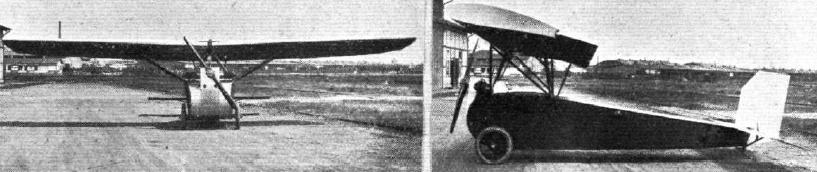
Albatros Small Sport and Training Aircraft Type L 66.

The Albatros Type L 66 aircraft can be used as a single- or two-seater and is also designed so that, after the installation of dual controls, it can be flown as a training aircraft. Special emphasis was placed on keeping its production cost affordable during the design process.
The general layout of the aircraft can be seen in the accompanying drawing. The strength and stability calculations were carried out in accordance with the currently applicable German construction regulations for aircraft.
The fuselage of the aircraft is made of steel tubing, the tube joints are welded, and the panels are braced with steel wire. It is covered with impregnated, waterproof single-sheet canvas. The interior layout is designed so that the pilot sits behind the engine and the passenger or student sits next to him. The fuel tank is located at the center of gravity and is rigidly connected to the wing pylon and enclosed by the wing panels. The fuselage carries the usual control surfaces at the rear; elevator and yaw control are achieved via stick controls. The rudder, which also acts as a tail skid and is rigidly connected to the rudder shaft, is operated by a foot lever, ensuring control during taxiing. The cockpit is designed so that the pilot and student can easily reach all controls for operating the aircraft and engine.
The wing is a monoplane design, consisting of two sections coupled at the spar tower and braced against the fuselage approximately midway. The spars and ribs are made of wood, and the wing is covered with impregnated, waterproof aircraft fabric.
Unlike the usual landing gear design, the landing gear is fixed within the fuselage. The wheels, as shown in the adjacent sketch, are mounted on the stubby Aelis struts, which extend laterally from the fuselage, with the wheels being self-sprung. This landing gear arrangement results in a very low ground clearance for the fuselage, making landings for this type completely safe.
The propulsion engine is a 30-40 hp engine, the type of which is at the customer's discretion; the condition is that it has the usual dimensions, the power output specified above, and weighs no more than ? kg.
Particular emphasis has been placed on road transportability. The two wings and the fuselage are designed so that they can be folded onto the fuselage after the elevator controls have been folded up onto the rudder. The folded aircraft has a width of 1.2 m, a length of approximately 5.4 m, and a height of approximately 2.2 m.
The fuel tank contains 33 liters of gasoline, sufficient for 3 hours of full-throttle flight; the gasoline flows to the carburetor by gravity.
Payload: 1 pilot: 75 kg, 1 passenger (student): 75 kg, 1 hour fuel: 25 kg, total 175 kg; empty weight 220 kg - takeoff weight 395 kg.
Wing area 13.5 m². Wing loading 29.3 kg/m², power load approximately 12 kg/hp, speed approximately 100 km/h, climb time to 1000 m approximately 15 minutes. Flight duration at full engine power approximately 3 hours.
Flight June 1924
The" L.66" is a type between the iow-power sporting type and the light 'plane, as the term is understood in this country. As will be seen from the two views published herewith, the"
L.66" is a parasol monoplane two-seater, with a horizontaliy opposed air-cooled two-cvlinder engine mounted in the nose. Simplicity and low cost of production are, obviously, the
objects aimed at by the designers, and the result is. as in so many cases where these are first considerations, not particularly pleasing to the eye. It does not, of course, follow that the
machine is not quite a good one aerodynamically, although the great amount of strutting employed in attaching the monoplane wing to the fuselage must offer a not inconsiderable
resistance. On the other hand, the undivided wing is probably fairly efficient, although the square and verv deep wing-tip ribs do not look particularly efficient.
Constructionally the Albatros" L.66" i s chiefly remarkable for the fact that, as distinct from all previous Albatros machines, it is largely of metal construction. Hitherto this firm has
made rather a speciality of all-wood construction, the Albatros fuselages having been ply-wood covered structures since several years before the War. In the" L.66," however, steel-
tube construction has been employed, and welding of struts to longerons, much after the style of the Fokker fuselages. Bracing is by wire, and the covering is ordinary doped fabric.
The two seats are placed side by side, and if it is desired to use the machine for school work the Controls can be duplicated. The usual stick and foot-bar Controls are fitted, and
present nothing out of the ordinary. The rudder and tail skid are, however, interconnected so as to enable the machine to be easily steered when taxying at low speed
The power-plant of the machine exhibited was a 30 h.p. Haacke, but other engines can be supplied if desired. The engine is mounted slightly above the nose of the fuselage, and
behind it is the oil tank, enclosed in a fairing which carries the instrument - board. The under-carriage is a simple axle with two wheels slung inside the fuselage, through the sides of
which the axle projects. Rudder and elevator are both balanced, and there is neither fixed vertical fin nor tail plane.
The monoplane wing, which has a considerable dihedral angle, is of ordinary wood construction, and is, as already pointed out, mounted on a rather elaborate system of struts. The
petrol tank is contained in the centre of the wing so as to give direct gravity feed. The ailerons have their leading edge working in a semicircular channel on the rear face of the rear
spar. We have not been able to obtain particulars of the overall dimensions of the machine, but when the wing is unshipped and placed along the fuselage the overall dimensions of
the machine folded are approximately 5-5 m. (18 ft.) in length ; height. 2-2 m. (7 ft. 3 ins); width, 1 -2 m. (4 ft). The weight of the machine empty is 220 kgs. (484 Ibs.), and the useful
load, consisting of pilot and passenger and 33 litres of petrol, is 175 kgs. (385 Ibs.l, bringing the total loaded weight up to 395 kgs. (869 Ibs.). As the wing area is 13-5 sq. m. (145-5
sq. ft.), the wing loading is just under 6 Ibs./sq. ft. The maxmium speed is given as 100 km./hrs. (62 m.p.h.l, and the climb to 1,000 m. (3,300 ft.) occupies approximately 15 minutes.
The duration is three hours at full power.
The L.66 was intended to be a low cost, easy maintenance two-seater. Thus a low power engine was required and the prototype was fitted with a 30 hp (22 kW) Haake flat twin,
though other engines could be used. It was a cantilever parasol monoplane with an aerodynamically thick airfoil section wing, which had a simple, rectangular plan and significant
dihedral. The wing was a wooden structure with two spars, the ailerons mounted directly to a rounded groove in the rear spar. It was linked to the upper fuselage by a rather
complicated set of struts.
Traditionally, Albatros had constructed fuselages with wood frames but the L.66 marked a departure, with a welded Steel tube longeron and strut framework covered with fabric. The
sides were flat and almost airfoil shaped, with a blunt, rounded nose and taper aft. The nose mounted engine, driving a two blade propeller, was raised above the fuselage with a
fairing behind it, enclosing the oil tank and with the instrument panel attached to its rear. The fuel tank was in the wing centre section, feeding the engine by gravity. Further aft, pilot
and passenger sat side by side in the 1.2 m (3 ft 11 in) wide fuselage; tandem Controls could be fitted if required. The empennage was simple in shape and action as there were no
fixed surfaces only an all-moving rudder and elevator. Both control surfaces were balanced. The conventional undercarriage was also very simple, with the mainwheels attached to a
single axle which passed through the fuselage, sitting the L.66 close to the ground. The tailskid was linked to the rudder for steering on the ground