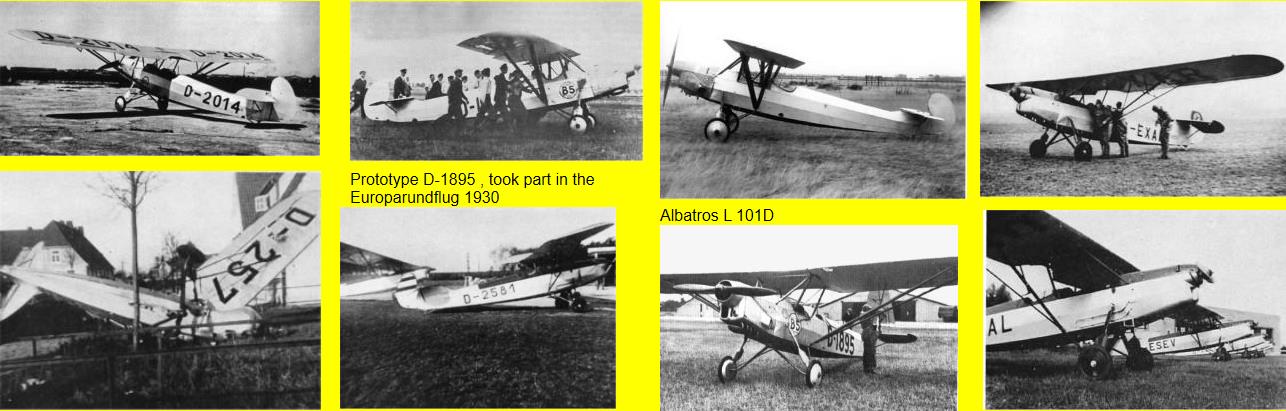
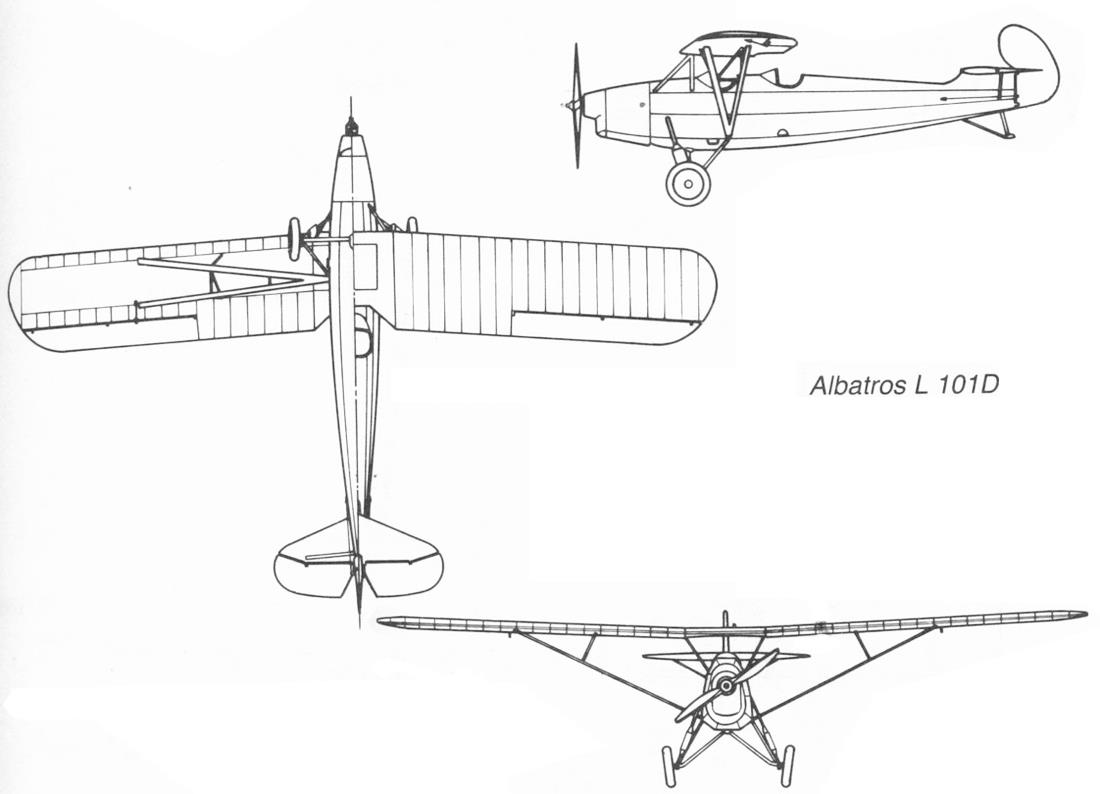
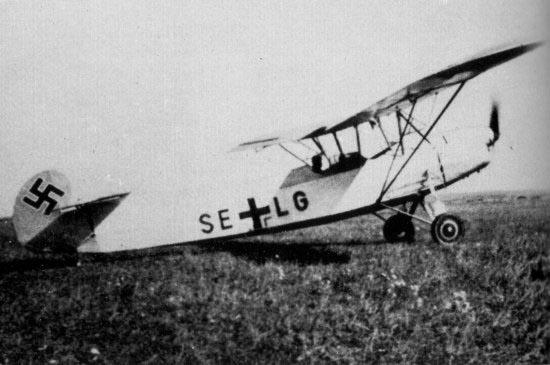
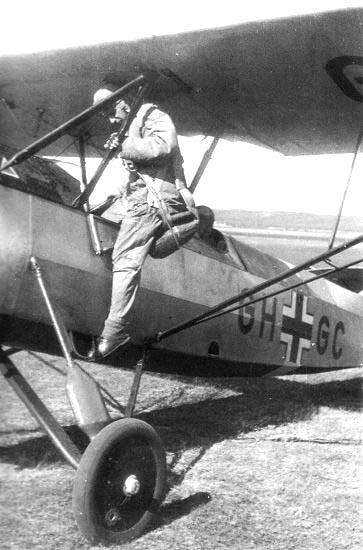
In 1930 the company Albatros-Flugzeugwerke GmbH developed in Berlin Johannisthal, secretly commissioned by the Defense Ministry, a two-seat trainer aircraft to train pilots for the commercial pilot schools. As it was forbidden for Germany to develop and build military aircraft  the orders came from the Ministry of Transport. The aircraft were then required  that it  should satisfy both civilian as well as military applications. Such an aircraft was the albatross Al-101, a relatively large strutted high-wing monoplane with fixed tailwheel undercarriage. The fuselage was a steel tube construction with a plywood panel. Only the rear fuselage was covered with fabric.. The wing was a three-piece plywood paneled wooden structure that was left out at the trailing edge so the student pilot course to better visibility for half-round. Wings, the entire wing structure of two strut pairs were additionally supported by the outer wing with large V-struts against the hull. For space-saving reasons, the two outer wings are retracted back. All control surfaces were fabric covered. The tail, also of  a wooden structure, was covered with fabric. The landing gear had split axles and had rubber springs . In spring 1932, the aircraft was completed. Quickly apparent massive problems, such as a tendency to flat spins,was discovered,   the aircraft was stable around all axes. The wing design proved to be too soft, there was vibration and deformation. After extensive renovations, the designs were changed to  Al 101C and D, who received a Argus As 8A / B engine with 135 hp takeoff power. The flight performance were now satisfactory, so that a small series of 30 units were built. A version with a Cirrus "Hermes" engine was reported for Europe Flight 1930 as L101A, but did not  start. In 1931, the Focke-Wulf Flugzeugbau GmbH in Bremen took over the Albatroswerke and the Al-101 and Al-102, which was a revised version  and equipped with the more powerful Argus As 10C.   Al-101, was  continued to be built. Only the model designation was changed.
m.
Type Two seat trainer Prototype Two seat trainer seaplane       W Two seat trainer                   C Two seat trainer                   D
Engine 1 Argus As 8 1 Argus As 8 1 Argus As 8a 1 Argus As 8a
Dimensions Length 8.45 m, span 12.35 m, height 2.70 m, wingarea 20.00 m2, aspect ratio 7.62 Length 8.45 m?, span 12.35 m, wingarea 20.00 m2, aspect ratio 7.62 Length 8.45 m, span 12.35 m, height 2.70 m, wingarea 20.00 m2, aspect ratio 7.62
Weights Empty 445 kg,  flying weight 795 kg, wingloading 39.75 kg/m2 Empty 600kg, fuel 90 kg, oil 10 kg, load (including pilot) 200 kg, flying weight 800 kg Empty 475 kg, fuel 90 kg, oil 10 kg, load (including pilot) 320 kg, flying weight 795 kg, wingloading 39.75 kg/m2
Performance Max. speed 160 km/h at sea level, cruising speed at sea level 140 km/h, climb 2.40 m/s, service ceiling 4000 m, range 930 km Max. speed 170 km/h at sea level, cruising speed at sea level 150 km/h, climb 2.40 m/s, service ceiling 3600 m, range 670 km, endurance 5 h
The L 101 aircraft type has been designed in an expanded form for the same purposes that the Albatros L 82 has proven successful in serving, namely training, sport, and touring. In this further development, two measures of particular importance have been taken in the overall design of the aircraft. In contrast to earlier versions of the same type, the metal frame construction was adopted completely for the first time, i.e., also for the wing structure, and thereby significantly simplified. A further significant simplification was achieved by switching to a monoplane design. For safety reasons (rollover) and safety requirements, the high-wing configuration was chosen. The operating range was extended to Group K 5 (highest aerobatic capability). Otherwise, the design was carried out according to the same principles as with the L 82. The aircraft type is equipped with an air-cooled 4-cylinder Argus engine. 8. The fuselage, welded from steel tubing, has a luggage compartment in front of and behind each of the two seats. The seats are equipped for carrying back cushions and parachutes. The high-mounted, strutted wing is constructed of duralumin box spars, duralumin ribs, and a duralumin tube framework. The fabric covering is tropicalized. The wings can be folded back, allowing for towing by car and storage in a small space. All essential operating parts are easily accessible, and the engine cowling can be folded down as a single unit. The landing gear has compression rubber suspension with oil damping (Albatros design) and Albatros brake wheels, controlled by oil pressure. The tail skid is adjustable. With a payload of 350 kg, the cruising speed is 160 km/h, the range is 750 km, the landing speed is 75 km/h, and the service ceiling is 5000 m.
Even before February 2, 1933, his appointment as Reich Commissioner for Aviation, Hermann Göring (1893-1946), as the second most powerful man in the NSDAP (National Socialist German Workers' Party), had repeatedly declared that he would ensure a comprehensive strengthening of German aviation in every respect should his party ever assume leadership. This happened on January 30, 1933. And with that, the large-scale planning and development of a military aviation sector began—still secret, but undeniably so. Accordingly, the Reich Air Ministry (RLM), which emerged from the Reich Commission on April 27, 1933, was initially divided into two major ministerial departments, one- a civilian and a military one.
Already under the Reichswehr of the Weimar Republic, a cadre of air force units was secretly created for military matters.Although it existed as an independent
part of the Wehrmacht, it had neither a tactical nor an operational deployment value; the units were, for the most part, purely training units. But precisely this groundwork in the training sector offered the air force planners a foundation often underestimated in retrospect, upon which they could immediately build to arrive at a rotating staffing plan for the far-sighted and very expansive planning of positions for flying personnel.
As early as 1934, under the supervision of an inspection of schools, the training program for Luftwaffe candidates had reached a considerable scale, albeit disguised under the cover names of civilian institutions. This included, for example, the German Air Transport School (DVS) with its various branches. For the enormous armament efforts of the time, the slogan aimed at foreign policy, "building a risky air fleet," became a risk in itself, as quantity took precedence over quality. On January 1, 1934, the then State Secretary for Aviation,
Erhard Milch (1892-1972), published his aircraft procurement program. According to this program, a total of 4,021 aircraft were to be manufactured by September 30 of that year,
more than half of which, namely 2,168, were to be training aircraft, including 1,760 aircraft for initial training alone. With these enormous production numbers, it is not surprising that initially, aircraft were included in the program that were considered purely stopgap solutions. Among the beginner training aircraft was the L 101 monoplane. It was in the midst of the transition (German Reunification). . He was in the transition from the 1920s to the 1930s under the technical direction of Dipl.-Ing. Walter Blume (1896-1964) at Albatros in Berlin-Johannisthal as a replacement prototype for the Albatros L 82 training biplane. 82 were created, although its series production had not yet even begun.
Aviation historian Egon Kruger (1914-1979), who worked at the Johannisthal plant during the construction of the L 101 and later trained on the prototype, recalls: “The aircraft was technically a conglomerate of various components in the style of French metal aircraft construction from the early 1920s. It handled well in the air, but in short-especially on final approach, the large wing obstructed the view. The As 8 engine was indeed mounted in rubber bushings, but so poorly suspended that the entire aircraft rattled. The vibrations were so strong that my handwriting was illegible.
Entering the take-off times after the flights became a shaky scribbling. Indeed, the somewhat idiosyncratic and protracted search for an Albatros-specific solution for metal aircraft construction also yielded results. Even the L 101 featured an astonishing variety of fabric-covered metal structures: the fuselage and tail assembly were welded together from steel tubes, the wing presented itself as a framework made of duralumin elements. Thus, the spars with rectangular cross-section were made of a frame was pulled and then fitted with
countless weight-saving drilled holes, the ribs were constructed from sheet metal, and the torsional structure was formed from tubes.
The long adherence to hybrid construction methods, which proved ineffective, was probably also one of the reasons why all the later Albatros designs were denied resounding success. Vibrations, on the other hand, were common features of many designs at that time. Their cause lay in the design of the engine mounts for the new, advanced engines, whose compact engine casings were intended to be used for power transmission. Such suspensions could be easily built with just a few rods, but were generally so flexible due to the small connection base and the acute angularity of the frames that, in the event of uneven engine operation, large imbalance energy occurred, which could act on the entire cell beyond the front section. In the  L 101, with its initially undamped engine, had ailerons that oscillated along their longitudinal axis. The bending stress on their lateral bearing levers was so severe that the center aileron bearing arm even broke; it had to be reinforced. An elastic engine mount reduced the vibration to a quarter of its original value, but it never disappeared completely.
Nevertheless, almost 100 L 101s were built. And this is how it happened: For participation in the second-running European tour “Challenge International”, which took place between July 18 and August 7, 1930, from Berlin, Albatros had entered the L101 and the low-wing L100. also powered by one of the new 120 hp Argus As 8 engines, but in its design with a closed cabin (even for three people) it corresponded much more closely to the basic idea of ​​the competition: the promotion of cross-country flying. The participation of the aircraft registered as D-1906 under competition number D 2, however, turned out to be quite tragic. Already in the first leg of the route, landing gear damage occurred during landing in Braunschweig. On the third day of the cross-country flight, Orter Dietrich von Redern, on his way to the registration in London, walked into the moving propeller and was fatally injured. Pilot H. E. von Oertzen subsequently gave up. With that, the great hope for the Johannisthal factory was out of the race.
Success now depended on the L 101, which was initially even listed twice in the registration list. But only the L 101 prototype with the  cross-country flight of a total of 7,560 km (from Berlin via Braunschweig, Frankfurt, Reims, Calais, Bristol, London, Calais, Paris, Poitiers, Pau, Zaragoza, Madrid, Seville, Madrid, Zaragoza, Barcelona, ​​Nîmes, Lyon, Lausanne, Bern, Munich, Vienna, Prague, Wrocław, Poznań, Warsaw, Königsberg and Gdansk back to Berlin) was easily completed by Stein and his team from Boltersdorf to Vienna with full marks. Then, damage to the propeller, which was probably due to a material defect and could not be repaired with onboard equipment (there was no spare propeller on board), ruined all chances of winning.
According to the regulations, the crew could only complete the remaining stages outside of the competition and were therefore excluded from the technical inspection and thus from the overall ranking. On August 30, 1930, they completed their flight as planned in Berlin.
The second aircraft of this type registered for the 1930 European Round Flight was the Albatros L 101 A with an ADC Cirrus Hermes engine producing 105/115 hp (77.2/84.6 kW), which was supposed to start under the competition number D 3, but did not appear. After checking for gaps in the serial number sequence, it appears that this version was never built, just like the Z 101 B, a variant with two floats. Therefore, the second L 101 produced must have been serial number (W-Nr.) 10183, the first of a total of three so-called series prototypes. They had been ordered by DVS after their good performance in the European Air Race and incorporated all the improvements that had proven useful based on the experience of the competition.
This included a slight enlargement of some tail surfaces, such as the rudder by a fuller shape and the horizontal stabilizer by a rounded leading edge instead of the previous straight one. The first of these series prototypes was launched under the designation L 101 S 1 in March. Approved in 1931 for the testing facility in Adlershof (DVL) as D-2014 for performance and characteristic tests. W.Nr. 10184 and 10185 were issued in the same month as L 101 S 2 with the registrations D-2001 and D-2002 directly to the DVS for practical testing in training operations. These three L 101s were to remain the only ones built under the management trio (Schubert, Wieland, Blume) of Albatros-Flugzeugwerke GmbH,
because in September 1931 the factory merged with Focke-Wulf Flugzeugbau AG in Bremen and was subsequently called Focke-Wulf Flugzeugbau, Werk Johannisthal. In aviation circles, it remained Albatros for years; The name Albatros was also incorporated into the new type designation: L 101 became AL 101.
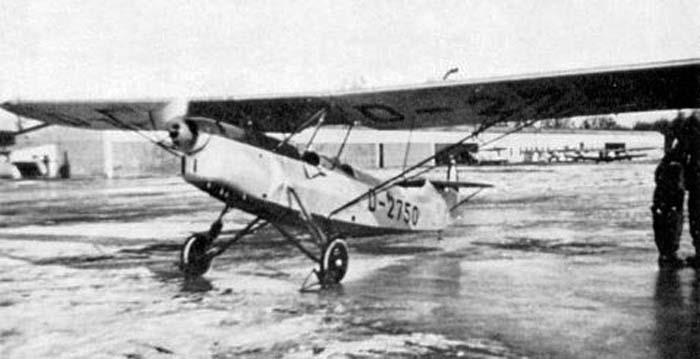
The first series order placed by the DVS comprised seven aircraft of the AL 101 C version. Externally, they differed little from the pre-production prototypes, but—like the S 2—they had additional struts integrated into the wing bracing. All were delivered in January 1933: the first (W.-Nr. Fw 141, D-2371) to the DVL, all others (W.-Nr. Fw 142 to 147, D-2372 to 2377) to the DVS. A subsequent order, according to the delivery schedule, differed only slightly from the predecessor model AL 101 C. The most important changes for practical operation were handholds in the canopy to facilitate entry and exit. Armrests and backrests for the seats with additional boxes for carrying reverse parachutes, as well as trim tabs adjustable in flight on the elevator.
Furthermore, the 610 x 85 spoked wheels were replaced with 600 x 100 electronic brake wheels, and a significantly reinforced tail skid, adopted from the heavier Al 75 and Al 102 aircraft, was fitted. With a takeoff weight of 520 kg, it could be used with different takeoff weights for a wide variety of purposes, for example as a sport and touring aircraft (use group P3) with a payload of 310 kg, which brought the takeoff weight to a maximum permissible weight of 830 kg, but also to a maximum range of 660 km, which corresponded to a flight duration of about 4.6 hours - and that with an aircraft whose breaking load factor is still at 6.6. This value increased to 7.2 for the primary use of the aircraft as a training aircraft (Group S4K), whose takeoff weight was reduced to 750 kg, which also reduced the range to 460 km (flight duration approximately 3.2 hours).
With this weight, the aircraft was approved for basic aerobatics. It became fully aerobatic (Group S5K) with a takeoff weight of up to 630 kg, which reduced the payload to a maximum of 110 kg and the flight duration to 1.1 hours (approximately 160 km range), but increased the breaking load factor to 10.8.
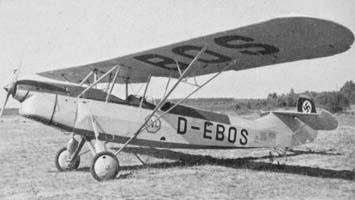
From 1934 onwards, all still operational AL 101 aircraft received letter markings D-E..., some from 1939 onwards received WL- instead of D- and subsequently a standard registration number, of which at least 18 can still be traced. This variety of markings allows conclusions to be drawn about a broad range of uses: Initially in service almost exclusively with the various branches of the DVS, it was the training aircraft par excellence for numerous pilots during the still secret training period. When the unveiling of the Luftwaffe (March 1, 1935) made the DVS cover superfluous, they were taken over from April 1, 1935 onwards by the newly established Command of Schools.
strengthens the German Air Sports Association for its flight training centers to form an Air Force reserve or is directly allocated to military flight schools. Even for purely sporting purposes, the Reich Air Sports Leader received three AL 101s on June 17, 1936.
When the DL.V was formally dissolved in 1937 and taken over by the National Socialist Flying Corps (NSFK), some of its aircraft became the property of the newly founded organization. However, the significant expansion of purely military pilot training schools necessitated by the restructuring, with their constant demand for materials, meant that even models like the AL 101 remained usable for a long time. But their numbers quickly declined; they became rare. Nevertheless, parts of an AL 101 D (W.-Nr. 245, D-EKYQ) even survived the war. From this aircraft, part of the German Aviation Collection, the fuselage frame with engine and propeller, the canopy, and the entire tail assembly are located in the Museum of Aviation and Space Travel in Krakow.

Technical Description
Wing: Three-piece with rigid baldachin over the fuselage. Folding wing sections. Two spar-like construction with drawn duralumin spars of rectangular cross-section, ribs made of duralumin sheet metal, and a torsion bracing of steel tubes, completely fabric-covered. Supported by V-struts to the fuselage lower chords. The ailerons are also fabric-covered, consisting of a steel tube axle and duralumin ribs.
Fuselage: Welded steel tube frame with a square cross-section and welded-on tubes for mounting the ribs for the polygonal cross-section, with diagonal tubes at the front and wire cross-bracing at the rear, completely fabric-covered. The fuselage spine consists of removable sheet metal panels. The open seats with dual controls are arranged one behind the other and have seat shells with recesses for back parachutes.
Tail unit: The horizontal stabilizer is a welded steel tube frame integrated with the fuselage as a raised attachment.
The horizontal stabilizer and rudder are also welded steel tube structures with fabric covering. The elevator has auxiliary control surfaces adjustable during flight. Control linkages with wire cables, primarily running in ball bearings, and deflections exclusively via levers.
Landing gear: Tripod design. The axles, which are connected to the fuselage lower chords by a strut and a spring strut each, The wingtips are guided to a special support under the fuselage centerline. Shock absorption is achieved through compression rubber with oil damping. Electronic disc wheels 600x100 mm with dual servo oil brakes. Tail skid with self-adjusting skid, also compression rubber sprung.
Engine: Argus As 8 Series 3 air-cooled, four-cylinder in-line engine with inverted cylinders and 120 hp (88.3 kW) takeoff power, suspended in a steel tube frame that is easily detachable from the fuselage. Oil cooling is provided by a tubular cooling coil on the right fuselage side. Manual starter. Rigid two-bladed lightweight wooden propeller with Rupp hub,
2.10 m diameter. Fuel in two gravity-fed tanks in the canopy; capacity 102 and 48 liters.
Paint scheme: Originally a standard production model in silver-celled with a dark olive-green back and civil registration applied in black, as well as the valid flag bands in black, white, and red on the vertical stabilizer; later partially in RLM grey 02 and partially with registration markings in black, as well as with bar crosses and swastikas in black and white (see drawing).