| Type |
Single seat high performance glider |
| Dimensions |
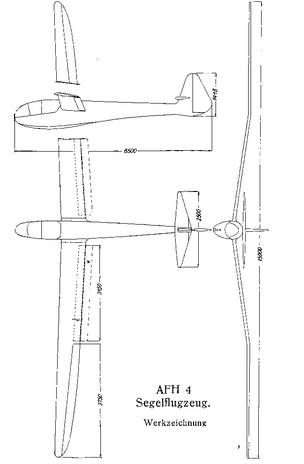
Length 6,55 m, height 1,82 m, span 15 ,0 m, wing area 10 m2, aspect ratio 22,5 |
| Weights |
Empty 180 kg, max.flying weight 270 kg, wing loading 27 kg/m2 |
| Performance |
Max. speed 300 km/h, landing speed 32 to 91 km/h, lowest sink 0,72 m/sec. at 69 km/h, glide ratio 1:33,6, min. speed with flaps 45 km/h |
| Type |
Werk.Nr |
Registration |
History |
|
|
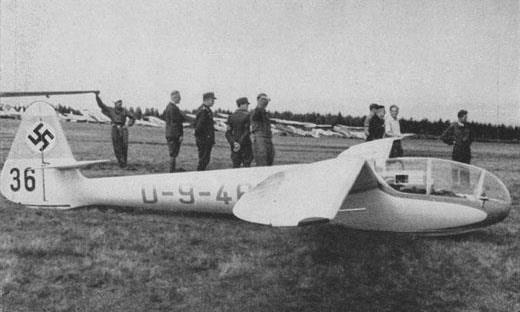
D-9-463 |
|
Profile at wingroot NACA 23014, mid NACA 23012, tip 23012
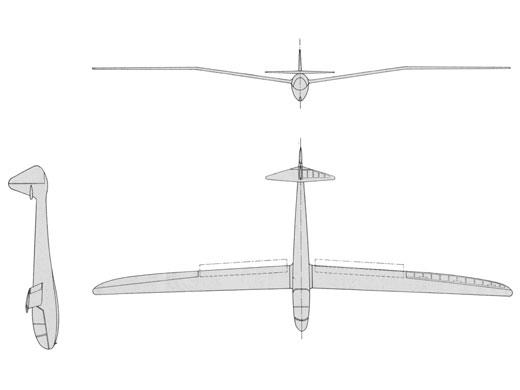
The AFH-4 sailplane was built by the Technical Flight Section of the Hanover Technical School. It was designed by Eppmann and Vollmer, and the idea behind it was to produce a glider with the greatest possible speed range. In its planning, special consideration was given to high cruising speed and good turning qualities. It is a full cantilever mid wing with remarkably thin wing depth and employing a modified Fowler auxiliary wing.
The elliptical wing is of gulled design with a sweep forward of 2.5° with the 23012 section thickened at the root by Lt'. The two wing panels are connected to the fuselage by five bolts apiece. A good stiffness (164 oscillations per minute) was achieved in spite of the thinning depth (10.6 em. max.).
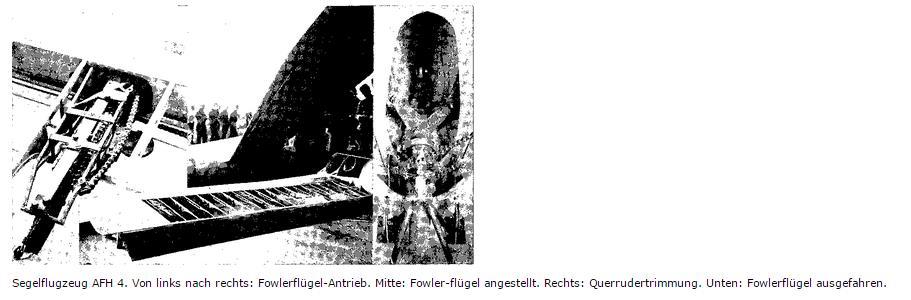
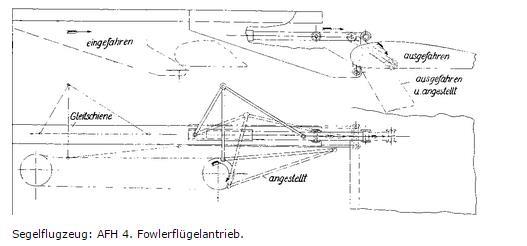
In order to increase the speed range even more than the best previous designs at the lower speeds, the ship was fitted with a landing flap which combines the advantages of the German Junker and the American Fowler auxiliary wings. This flap lies in an entering relationship to the wing section and can be pushed out like the Fowler flap, whereby the wing area is increased by 14.4%, but in contrast to the Fowler wing, in which a special supporting wing angle is fixed every time the flap comes out; in this construction the supporting arm can be placed so that the flap can be set anywhere be tween 5° and 40° down like the junker's wing when it is fully extended. In this way, it is possible to utilize the best position of this extra wing area for controlling the rate of descent and the minimum flying speed. Placed further down, it can be used as a brake flap to steepen the gliding ratio.
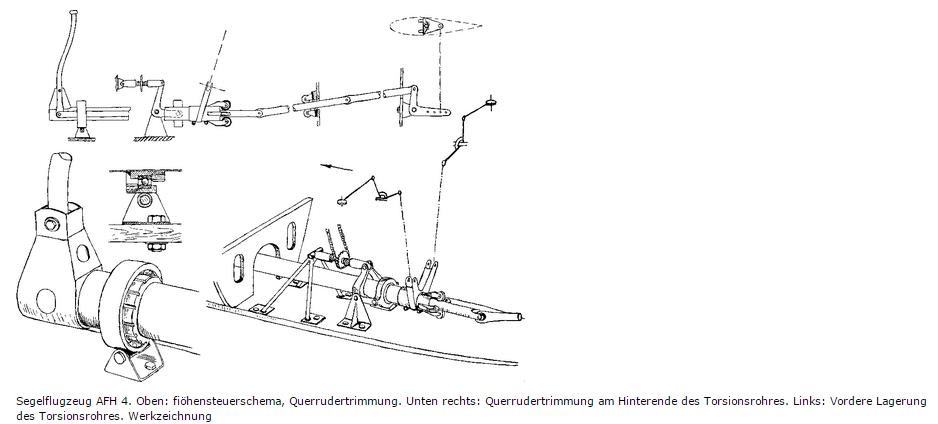
The whole movement of the flap (pushing out as well as down) is controlled with one lever. The ailerons can be trimmed down 10°, the trimming being done through lifting the rear end of the tortion tube with a spindle. Elevator and aileron controls are mounted in ball-bearings.
The fuselage is wood monocoque construction with landing skid mounted on tennis-balls. The large, Plexiglas cockpit cover gives unusually good vision for the pilot with practically no distortion or reflection. It was made by Kopperschmidt and Sons, Hamburg.
The high lying, pendulum elevator is fastened with a bolt to one of the girders at the side of the vertical fin. It is controlled through a push-pull rod and can be trimmed from the cockpit by an adjustable Flettner tab. The rudder construction is symmetrical with its turning axis ahead of the trailing edge of the fin.
SPECIFICATIONS
Span 15 m. Aspect Ratio 22.5 (19.7) Length 6.5 m. Weight Empty 203 kg. Wing Area 10 m' (11.4 m') Gross Weight 263 kg. Wing Loading 26.3 kg/m' (23 kg/m') Gliding Ratio 1:33.6








Academic flying groups (Akafliegs) at the technical universities were particularly hard hit by the Gleichschaltung (coordination) ideology of the new rulers in 1933. The National Socialist leadership not only objected to their name as a symbol of class darkness, but also criticized their independent status. On April 11, 1933, Hermann Göring, as Reich Commissioner of Aviation, informed the Akafliegs that he could no longer support them with aircraft or special means. Furthermore, he expected the members of the groups to make themselves available to the newly founded German Air Sports Association (DLV). Just ten days later, on orders from Berlin, there were theoretically no more Akafliegs. Their facilities and aircraft were transferred to Nazi organizations such as the SA Air Force.
What sounds like a farce was based on wishful thinking. In the Air Force Commissariat It had been decided to make particularly proven and fearless "old fighters" from the ranks of the now unemployed Nazi stormtroopers (SA) into pilots for the planned new Luftwaffe. Their special training began throughout the Reich, for example at The Württemberg Air Sports Association of the
DLV as the "Palmer Foundation." The charade was short-lived. The DLV established itself as the sole institution in the Third Reich and thus also became responsible for the Luftwaffe reserve.
Like most groups at other universities, the Academic Flying Group at the Technical University of Hanover e.V. lost not only its independence due to the Commissariat's decision.
In this group (as well as in the Hanover Aero Club), members of the SA Air Storm appeared as an "expert organization," who—although they could not yet fly—eagerly worked to take over the aircraft, the hangar, and especially the cars. However, the DLV soon gained control, establishing not only a local group in Hanover but also the state group. An eyewitness:
"Both organizations, in solving their tasks, drew upon the members of the Akaflieg as their flying pool, insofar as they were still connected to Hanover through interest or studies."
The 1933 Germany Flight was prepared by the Akaflieg and was ultimately won by five of its pilots in five of its former aircraft – for the DLV. Almost a year and a half of uncertainty followed, then new working groups could be formed at the technical universities.
Groups for aeronautical research were established. This was made possible by the former Darmstadt Akaflieg member Otto Fuchs (1897-1987) of the German Research Institute for Aviation (DVL), who was concerned about the next generation of engineers. He had the support of the Research Department Cl in the Technical Office of the Reich Air Ministry (RLM) under its head Adolf Bäumker and, with his help, Mathias "Bubi" Bös, a consultant who had emerged from the Aachen Akaflieg.
Under the depoliticized name of Aeronautical Technical Groups (FFG), they were able to develop rapidly with the financial contributions provided by the RLM and sensibly distributed by the DVL. Skilled workers and master craftsmen, often under wages, moved into frequently newly constructed halls and workshops. Aircraft were allocated for training and experimental purposes.
At the end of 1935, the DVL (German Aerospace Center) organized a motor aircraft training course in Hanover specifically for members of the specialist group to obtain the A2 license.
In Hanover, at the beginning of 1935, eight students, with the active support of their professor, Dr.-Ing. Arthur "Papa" Pröll, founded a specialist group. From the summer semester of 1935, Heinz Eppmann joined the group, who would play a leading role in the first in-house design, the AFH 4. Since all members already possessed a pilot's license, he was selected as the "group leader" for motor flight training within the framework of the DVL training. Initially, the group work was hampered by the university administration's decision to make electrical engineering the focus of the curriculum. The aircraft construction department had been relocated to Braunschweig. In Hanover, only an institute for aerodynamics remained, with a small air channel. And occasionally, Professor Pröll gave lectures on the subject of aviation.
In order for the group to become ready again for its own design work, he offered Hans Jacobs (1907-1994) – head of the design department of the German Research Institute for Gliding (DFS) and creator of most of the gliders built at that time granted Eppmann and his fellow student Herbert Vollmer, who had joined the FFG in 1936, a six-month internship in his office. They returned with detailed knowledge that enabled them to immediately begin the design process. and to begin the construction of the high-performance glider
AFH 4.
When the DVL provided funds for the construction of buildings for the specialist groups, they also approved funds for the Hanoverians. These Hanoverians then built on a plot of land provided by the city as compensation for the previous hangar at Vahrenwald airfield, very generously and actually exceeding the scope of the DVL's expectations. The complex comprised an aircraft hangar with two adjoining workshops for mechanical work and woodworking. Also on the ground floor, along one narrow side, were four rooms. Two of them served as common rooms, the other two as design offices. Upstairs there was a caretaker's apartment, two rooms for Prof. Pröll's institute, and eight small rooms for two students each. The financing of the well-furnished clubhouse (instead of a spartan, simple residence planned by the DVL) was successful because, in addition to the DVL grant


The same sum was raised again by friends of the former Akaflieg for a perfect group home, and because the architect's fees could be saved, as two senior civil engineers took over the planning and construction management. The topping-out ceremony took place in early summer 1937.
To ensure the workshop was well-equipped for the construction of a new aircraft, Hans Jacobs from the DFS (German Aircraft Society) provided the young master aircraft builder Hans Müller.
This proved to be a wise decision beforehand, as Eppmann and Vollmer designed a high-performance single-seater that was ahead of its time in terms of its design and construction details. The design goal was to achieve an unusually high cruising speed for the time, with good maneuverability, across a wide speed range. For this purpose, the thin wing, with a kink at half its wingspan, received extendable flaps similar to the Fowler wing, but with the difference that they could also be extended horizontally without any angle of attack to increase the wing area. Also novel was the semi-reclined position of the pilot, which allowed for a small fuselage cross-section and a large, all-around visibility canopy.
Why the new design was called AFH-4 is still not entirely clear, because in the sequence it should actually have been called AFH 9. Design assistance was provided by Willi Koops, subsequently, alongside Eppmann and Vollmer, the responsible designer for the further development of AFH 10. He had begun his studies in 1935, but had in the meantime gone to sea.
The constructive design of the complex mechanical system for control and flap operation was undertaken, as later also with the AFH 10, by fellow student Walter Schwering.
The AFH 4 was completed and test-flown as planned in the summer of 1938, shortly before the Rhön Competition – for which academic pilots and their designs had only been permitted again since 1937. There was no time for testing. But the glider could be flown to the Rhön Mountains with Eppmann at the controls in an FFG-owned Klemm Kl35. It was one of the earliest gliders equipped with a radio. Wolfgang Schulz was scheduled to fly the AFH 4 in the competition. He had been gliding and soaring since 1934 and, with the performance badge awarded to him in May 1938, was considered the most experienced glider pilot in the group. On July 26, the third day of the competition, Schulz crashed the AFH 4 shortly after completing an hour's flight and was so severely injured that he died on August 2. After a technical inspection, The AFH 4's safety could be easily restored during the winter (the new canopy was no longer blown, but consisted of bent Plexiglas segments). In July 1939, Vollmer, who presumably died in Dresden in 2002, demonstrated his design in flight as his diploma thesis – possibly for the first time in the history of gliding.
With a number of test flights, Flight characteristics and performance were determined. They certified the design as having excellent values, except for minor flaws (such as slight instability around the vertical axis due to the large forward fuselage section).
According to its design, the aircraft proved to be one of the fastest gliders for cross-country flight. It was finally lost when Vollmer had to bail out by parachute in 1940 because the wing-fuselage connection gave way. Therefore, the successor design, the AFH 10, received continuous spars on each wing half, which were connected in the fuselage center by two bolts. The group had developed this design The project was undertaken to determine how a motor glider could be derived from the AFH 4. Therefore, the AFH 10 largely corresponded to its predecessor in terms of design and appearance, but possessed A larger wing area by 20% greater depth to compensate for the engine weight. The AFH 10 flew as a glider at the Ida- flieg summer meeting in August 1941 in Prien and, requisitioned by the British, survived the war. It was taken to England, stored improperly, and had to be scrapped.
Technical Description
Wing: Cantilevered, gull-wing mid-wing glider, gull at half span. Two-piece, single-spar construction. Double-trapezoidal outline with rounded trailing edge on the outer trapezoidal section. Construction of a wide box spar with reinforced webs, ribs, and complete plywood covering. Profile with 12% thickness across the entire span (NACA 23012), thickened to 13% only in the immediate root area. Wing chord at the root 0.81 m. Angle of incidence at the (Floor area increased to 11.21 sq m) and then individually adjustable from 5 to 40 degrees.
Fuselage: One-piece, all-wood shell construction. Maximum fuselage width 0.60 m, maximum fuselage height 0.97 m, maximum cross-section 0.45 sq m. Pilot in a reclining seat under a blown (first version) or segmented, all-glass canopy.
Stabilizer : Cantilever cruciform tail. Side fin designed as a symmetrical twin wing. Plywood-covered vertical stabilizer (area 0.47 sq m) fixed to the fuselage. Fabric-covered rudder (area 0.54 sq m) with forward-mounted pivot point. Elevated, fabric-covered, one-piece flea rudder (area 0.75 sq m) undamped, with Flettner rudders operated from the driver's seat.
Landing gear: Ash wood skid integrated into the fuselage and sprung by tennis balls. For towing flights, a jettisonable single-axle two-wheel landing gear can be fitted. Tennis ball-sprung, integrated keel skid under the wingtip.
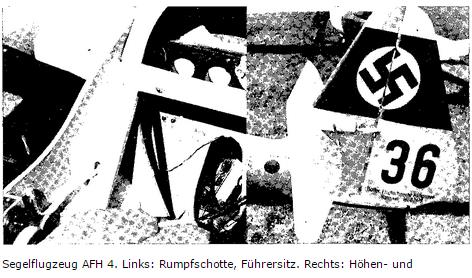
Paint: Completely in 05 Ivory. Band of the national insignia in red, swastikas in a white circle, and competition numbers (36) in black. Registration mark (D-9-463) and decoration on the nose and wing root area in a still unidentified decorative color, which is weaker in color than the red (possibly yellow?) that was already prohibited for aircraft at that time.