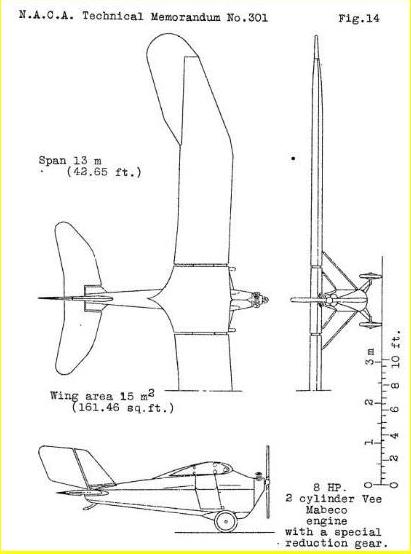
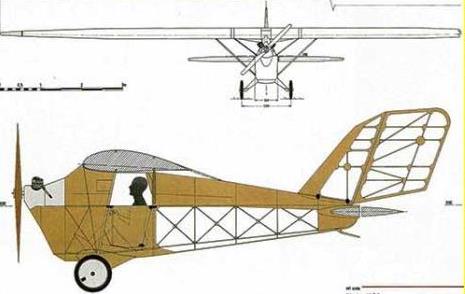
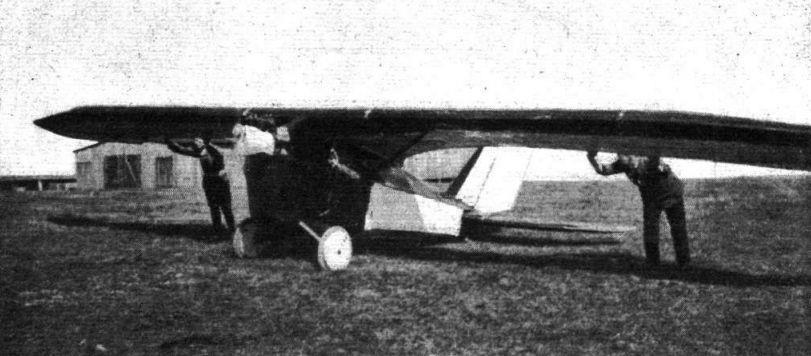
The Aachen "KF" light airplane (single-seat high-wing monoplane) designed by Kemperer and built by Aachener Segelflugzeugbau GmbH., is a thick-wing monoplane with a central wing length rigidly braced to the fuselage.   The outer lengths of the wings are entirely cantilever with a pronounced sweepback of the leading edge at the tips-
The fuselage is of rectangular section with an inverted vee-shaped deck.   The cockpit is situated under the wing, at which point the deck is omitted.
The landing gear consists of two streamlined outwardly inclined struts which project from the bottom of the fuselage with the wheels sprung from their ends-
The fin and rudder are unusual in their backwardly inclined position.
The airplane is credited with an initial climb rate of 60 m (200 ft.) per minute, and a maximum speed of 46 M-P-H-
Type Single seat sportplane
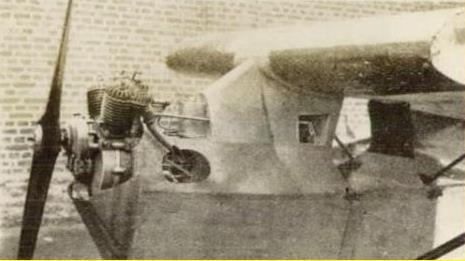
Engine 1 Mabeco 2-cyl. 8 hp with na reduction gear !:2,3  Two bladed propeller
Dimensions Length 5,4 m , height 1,74 m ,  span 13 m , wing area 15,2 m2  ,
Weights Empty 160 kg, loaded 240 kg , max. take off weight  
Performance Max.. speed 47 - 90 km/h , cruising speed 75 km/h , range , endurance  , service ceiling   , climb 1,0 m/sec at 950 m
Type Werk.Nr Registration History
Engine installed 1923 in Fulda. Crashed 1923
The K.F. was a true motor glider: its wings and tail assembly were derived from the FVA-5 (S-5) ‘Rheinland’ glider, which Klemperer had designed as Type E for the Rhön Gliding Competition in 1923. The ‘Rheinland’, not to be confused with the later FVA-10b of the same name from 1939, was a cantilever high-wing monoplane with a wingspan of 12.7 meters and gull wings. Impressive, but also a contributing factor to the type’s lack of success in the air, was the huge pendulum elevator.
New and elegant, but perhaps a little short, the closed wooden fuselage presented itself, from which only the pilot's head protruded. It made the ‘Rheinland’ one of the most modern aircraft at the 4th Rhön competition, however, longitudinal oscillations (elevator flutter) appeared in flight at certain speeds, which led to at least one minor breakage upon landing.
The construction of the motor glider fuselage for the ‘Rheinland’ wing had to be kept strictly secret in Aachen: The occupying powers still present in the Rhineland from World War I tolerated no motorized flight activities.
Fitting for wing and tail assembly The glider was built as an almost cantilevered high-wing monoplane with two short struts and a biplane landing gear. Looking at the photos of the glider and motor glider construction, one must not only admire designer Klemperer, but even more so the workshop foreman Köhler for his delicate woodwork! The pilot sat under the wing; he could enter comfortably through a half-height door. The engine was a 7.5 hp Siemens & Halske ‘Mabeko’ V2 motorcycle engine with a self-built 1:2.3 reduction gearbox. The ability to start the engine from the pilot's seat with a pull-starter was new – only the ability to restart in the air makes the motor glider truly independent! The engine and aircraft were transported separately, in strict secrecy, to the Rhön region and only fully assembled in Fulda at the local rubber works. Just as in 1920 with the Rhön winner, the "Schwatzer Duvel," the courageous Aachen students had once again succeeded in a risky transport of forbidden goods through occupied territories! During the flight tests in 1923
on the 950-meter-high Wasserkuppe, the Darmstadt pilot Hoppe achieved quite usable results (see data sheet). Unfortunately, the Aacheners' joy in their new aircraft was short-lived: According to captions in an old album belonging to FVA member Schulz, the K.F. suffered a total crash in 1923, even before the 'competition' from the other Akafliegs with their designs later immortalized in specialist literature appeared, and the pilot was seriously injured. Looking at the photos, it's hard to believe he survived! The cause was probably a break in the left wing due to aileron flutter.
Whether the aircraft was then rebuilt or whether a second prototype was used (which I suspect is most likely), or whether the photographed breakage only occurred in 1924, is unfortunately not verifiable. In any case,