| Type |
Werk.Nr |
Registration |
History |
| a |
1 |
D-2585, D-YMAZ |
|
| a |
2 |
D-2836, D-YDAR |
|
| a |
3 |
D-3045, D-YKIP |
|
| a |
|
D-2378 |
|
|
14 |
D-YBIT, D-ENAL, HB-SEX |
Julius Hawlik, Chemnitz. Cancelled Nov. 1938 |
|
|
D-YFAR |
Overhauled by Avia ,Kurovice Dec. 1939 |
|
|
D-YHAF |
|
|
|
D-YKAS |
Otto Hofman/Diez |
|
|
D-YBIK |
DLV , NSFK. Cancelled Nov. 1938 |
|
|
D-YDUS |
Herbert A.E. Bohme/Fuhlsbüttel |
|
|
D-YGUR |
|
|
7 |
D-YSUR, OO-DKW, OO-ASW |
|
Einsitzer Erla Me 5a, Motor 20 PS DKW.
[Nach den in dieser Zeitschrift-bekanntgegebenen Versuchs bauten von Mehr hat die Firma Nestler & Breitfeld A.-G., Erla i. Erzgeb., die Serienherstellung dieses
Tiefdeckers begonnen. Die Flügel sind freitragend, abnehmbar für den Straßentransport, zweiholmig mit Sperrholz beplankt. Rumpf ganz in Holzbauweise, mit Sperrholz
[beplankt, geht nach hinten in eine senkrechte Schneide aus. Führersitz mit Kopfabfluß, hinter dem Führersitz Kasten für Fallschirm und
geräumiger Gepäckraum von ca. 0,15 m3 Rauminhalt. Fahrgestell mit geteilten Halbachsen, Räder mit Nied erdrück-Bai Ion reifen. Am Boden verstellbare Höhenflosse und
Kielfläche, Holzbauweise mit Sperrholz-Beplankung, sämtliche Ruder sind stoffbespannt.
Wassergekühlter DKW-Motor, elastisch gelagert, Zweitakt, 2 Zylinder, 600 cm3 mit Umkehrspülung, leistet bei n 3500 ca. 20 PS. Die Kühlerjalousie kann vom
Führersitz aus verstellt werden.
Die Maschine ist an Instrumenten und Zubehör ausgerüstet mit Hand an laß-Vorrichtung für den Motor, Aluminium-Betriebsstoff behälter, in Gummipuffern gelagert, mit
35 1 Fassungsvermögen für ca. 600 Flug-km ausreichend, Einzel- oder SMmmelauspuffrohr, Holzschraube mit Nabe, Luftschrauben dreh zahl 1 : -2,55 untersetzt für
max. 1400 Touren. Sämtliche Wasserleitungen für den Kühler sowie sämtliche Betriebsstoffleitungen aus elastischen Schläuchen.
Die Maschine hat zwecks Zulassung von Zelle und Motor beim Reichsamt für Flugsicherung den notwendigen 50-Std.-Flug mit plombiertem Motor durchgeführt. Der
Betriebsstoffverbrauch errechnet sich auf 3.50 RM pro Flugstunde. Preis der Maschine 3875.— RM.
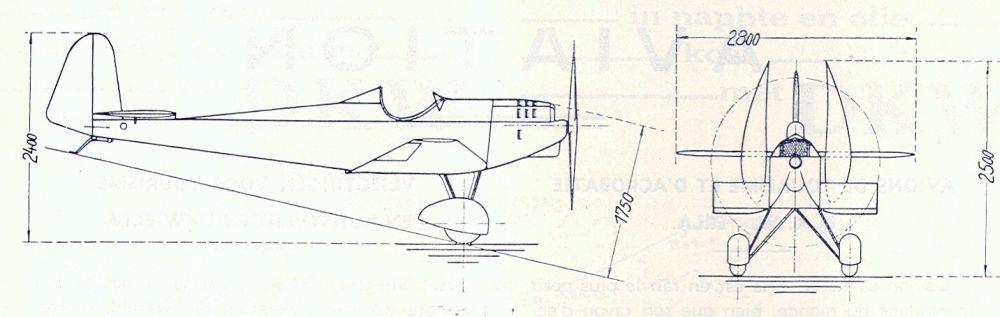
Spannweite 11 m, Länge 6,20 m, Höhe 1,75 m, Flächeninhalt 13,70 m2, Seitenverh. 1 : 8,8, Leergew. 220 kg, Zuladung Beanspr. P3 150 kg, Zulad. Beanspr. S4 120
kg, Fluggew. Beanspr. P3 370 kg, Fluggew. Beanspr. S4 340 kg, Flächenbelastung Beanspr. P3 27 kg/m2, Flächenbel. Beanspr. S4 25 kg/m2, Leistungsbel. 17 kg/PS,
Höchst-geschwindigkeit 125 km/h, Reisegeschw. 110 km/h, Landegeschw. 48 km/h, Steigzeit auf 1000 m ca. 9 Min., Gipfelhöhe ca. 3500 m, Aktionsradius ca. 600 km.
| Type |
Single seat sportplane |
| Engine |
1 DKW FL 600 20 hp |
| Dimensions |
Length 6,20 m , height 1,75 m , span 11,0 m , wing area 13,70 m2 , aspect ratio 8,8 |
| Weights |
Empty 220 kg, loaded 370 kg, S4 340 kg , max. take off weight |
| Performance |
Max.. speed 125 km/h, cruising speed 110 km/h , range 600 km, endurance , service ceiling 3500 m , climb 9 min- to 1000 m, to 2000 m 24 min., to 3000 m 48 min., landing speed 50 km/h, lstart run 100 m, landing run 70 m |
DKW Erla Me
A "people's airplane" is ready for series production
It is astonishing how unknown the industrialist Jörg Skafte Rasmussen (1879-1964), born in Nakskov, Denmark, remained in Germany, even though Saxon motor vehicle manufacturing owed a great deal of its size and reputation to him before the war. For this, he received an honorary doctorate from the Dresden University of Technology in 1938. Although the automotive industry of the then GDR also benefited from the two-stroke technology and front-wheel drive that he had innovatively promoted, the press of the communist state judged him quite differently: For them, Rasmussen was "...one of the leading monopolists of Germany who had placed his trust in the leaders of the fascist party because he saw in these forces the most useful tools for suppressing the workers' movement and for preparation for the war they planned for the redivision of the world in favor of German imperialism."
This literally quoted, one-sided, and undoubtedly purely ideological view does not do justice to the Dane's life's work. The record, in which the small Erla aircraft factory, founded by Rasmussen but no longer managed by him, ranked 7th in air armament towards the end of the war, and the fact that among its workforce of just under 23,000 people were 2,100 concentration camp prisoners, is undoubtedly terrible. But it cannot be solely blamed on one man who, despite all his entrepreneurial zeal, always produced for the masses with limited means, i.e., primarily the workers.
A large part of what later became East Germany was, at the time, geographically a strategically advantageous location for air traffic. This was the main reason why the concentrated expansion, particularly of aircraft factories, in Central Germany, specifically in the Saale-Elbe-Erzgebirge industrial region, affected the workforce of the entire mechanical engineering sector (which also included the aircraft manufacturing) already grew by 222 percent from 1933 to
1939 – as strongly as in no other industrial region in Germany. At the same time, the wage level in this region was the second lowest in the entire Reich.
When the undoubtedly very commercially ambitious Rasmussen completed his mechanical engineering studies at the Mittweida Technical College in 1900, which he had begun two years earlier, he decided to stay in Germany. In 1906, he acquired an old textile factory in the Zschopau Dischautal valley, where he began manufacturing his first two-stroke engines in 1919 and, from 1921, motorcycles equipped with them under the brand name DKW. The DKW products, which covered the lower price range, were henceforth considered simple, functional, reliable, powerful, and durable. In the summer of 1922, the Zschopau Motor Works – simply called DKW Works because of its products – had already delivered its 2,000th motorcycle, and by 1928, 300 DKW mopeds, unbeatable in terms of price, were leaving the halls of what was now the world's largest motorcycle manufacturer every day. In the same year, Rasmussen realized the first affordable DKW automobile with a frameless wooden body and a two-cylinder, two-stroke gasoline engine as front-wheel drive.
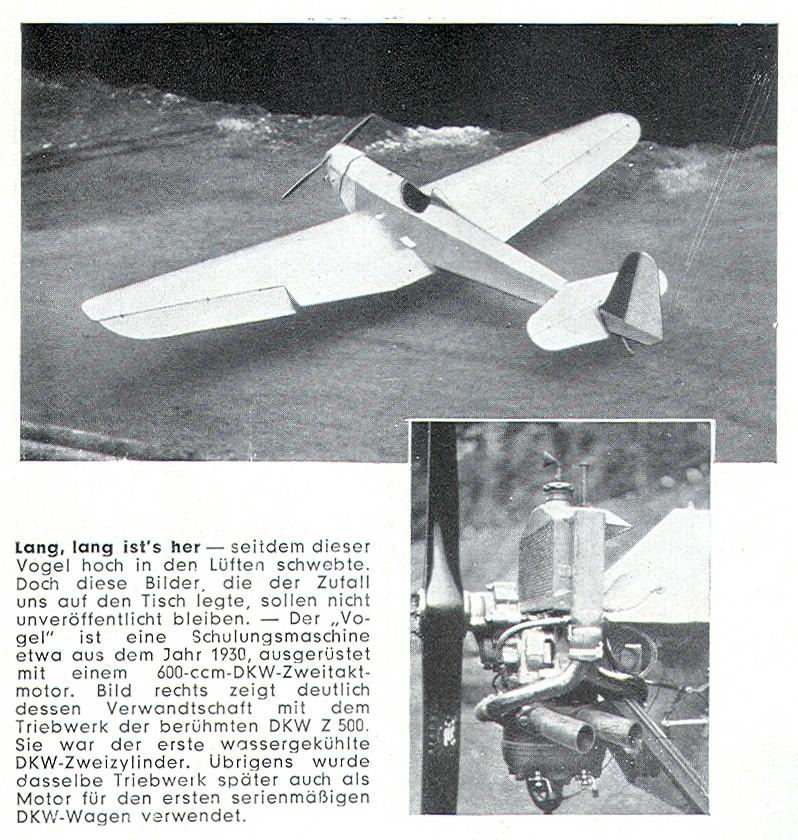
As early as 1929, Rasmussen had this liquid-cooled engine with a 584 cc displacement and 18 hp (13.24 kW) peak output at 3,500 rpm modified into a geared-down light aircraft engine, Model P, which could be installed vertically or vertically and in its series production version with approximately 20 hp (14.71 kW) takeoff power, DKW FL 600. It was, since its basic components were taken from mass production. to be acquired for 600 Reichsmarks and thus
the most affordable aircraft engine in its class. For this engine, the engineer Franz Xaver Mehr (1896-1981), born in Bettensweiler and a graduateof the Konstanz Technical College, designed the single-seat Me 5 (Me V) from 1931 onwards as a further development of his single-seat Me 1 built in Lindau (see scale documentation Mehr Me 1 in MF11/2009). Apart from the engine, it differed mainly in its wing with a modified airfoil and a pilot's seat set back with a head drain. Compared to the Me 3 project as an intermediate stage, the wingspan increased from 10.0 to 11.0 meters. The continuous landing gear axle, instead of the half-axles of its predecessor, was considered a step backward.
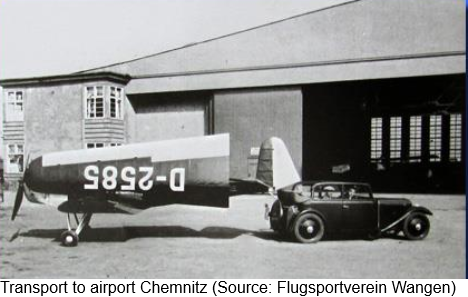
The motorcycle manufacturer LuB- mann GmbH in Meckenbeuren near Friedrichshafen The prototype, built in the port, was transported to the Constance airfield in July 1932 – with its outer wings removed and attached, and under its own power – and maiden-flown there on July 18 by Dornier pilot Alfons Luber, who had already made the first flight of the Me 1. The "Konstanzer Zeitung" reported on July 19, 1932: "Pilot Luber, the aerobatic pilot still known from the last Constance airshow, took off with the small aircraft (weighing 202 kg empty). Despite the tailwind, the aircraft was already airborne in just 60 meters and spiraled up to 300 meters during the 10-minute flight. Its sleek contours and flight characteristics were magnificently demonstrated." It circled the square many times, also glided for a while with its engine throttled back, and landed smoothly again. At the airshow in Dübendorf next week, the aircraft will undergo further test flights.


"To give off some airworthiness. Good luck." On August 17, Luber conducted a 4-hour and 30-minute flight at an altitude of 2,000 meters over Constance without any problems, for the endurance flight testing of the bright and penetrating-sounding engine.
Around the same time, the Saxon automotive industry was undergoing a radical restructuring. In 1928, the Zschopau-based J.S. Rasmussen AG (DKW) had acquired a majority stake in Audiwerke AG in Zwickau, founded by Horch in 1909, using loans from the newly established Saxon State Bank. Due to the global economic crisis, the bank resisted further loan requests and initiated a merger of the Audi, DKW, Horch, and Wanderer brands under the name Auto Union AG. The plants were to retain their identity, but each cover a specific production segment.
This largest Saxon industrial company and the second-largest car manufacturer in Germany (after Opel) was founded on June 29, 1932. When the bank, and thus the state of Saxony, finally held 90% of the shares, it dismissed Rasmussen as one of the three chairmen of the board without notice on December 31, 1934. He was thus de facto expropriated. Auto Union's entry into the aerospace business through the founding of Mitteldeutsche Motorenwerke (Middle German Motor Works) came later, in 1936. One of his companies, which Rasmussen had not allowed to be integrated into Auto Union. The ironworks, which had been established around the year 1250 as the second oldest foundry in Germany in the Ore Mountains village of Erla - since 1999 a district of Schwarzenberg -
were founded. He expanded it in 1932/33 into the Erla Iron and Aircraft Works GmbH and began the construction of light aircraft there "...at my own risk and as my own private
enterprise". He used it as a base to found an Erla Maschinenwerk GmbH in Leipzig on July 18, 1934, undoubtedly out of profitability expectations, which was to carry out the construction of aircraft from other companies under license. It was only established 15 months after the decision of the Reich Commissioner's Office to allow only already established companies with"entry tickets" - which Rasmussen would have had with his light aircraft - to enter aircraft manufacture. However, as early as 1936, the state-funded Luftfahrt-Kontor GmbH Rasmussen was forced out of the business again.
The industrialist's early expressed interest in the "people's aircraft" grew when Mehr and his pilot arrived at his private residence with the folded Me
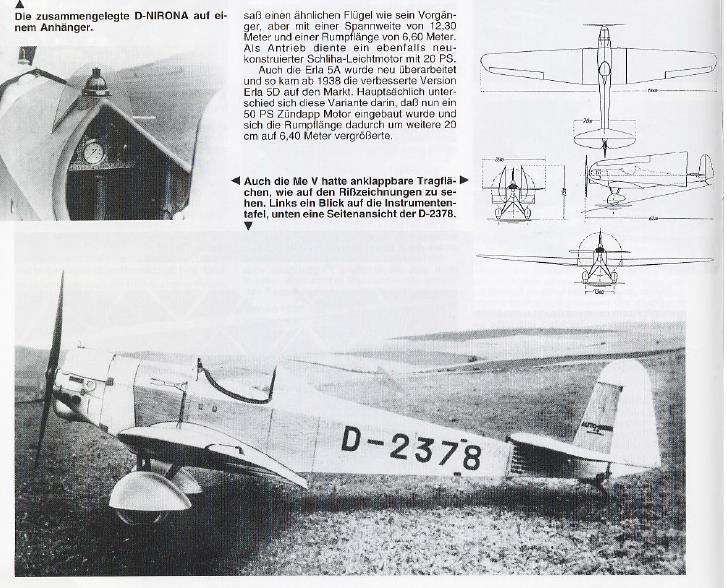
5 as a trailer behind a small DKW car, assembled the aircraft in a nearby meadow, and flew it for him. The result was a development contract and Mehr's appointment as chief designer. This Me 5 prototype, by then improved with half-axles, wheel fairings, and an optimized engine installation,
The first prototype, the DKW Erla Me 5a, received its type approval in Erla in January 1933 as D-2378.
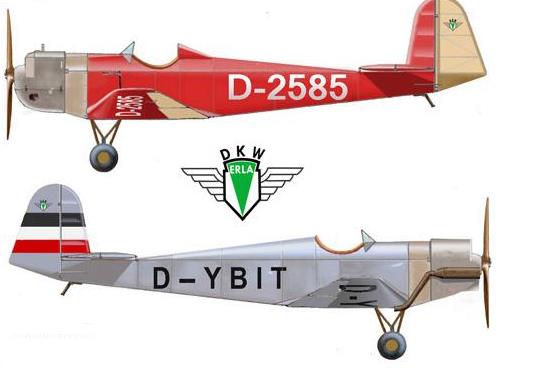
Meanwhile, three further prototypes with serial numbers 1, 2, and 3 had been launched as DKW Erla Me 5a aircraft. Their structure was reinforced to such an extent that, with reduced payload, they achieved aerobatic suitability according to stress group S4K. They were approved for factory use between September 1933 and February 1934 as D-2585, D-2836, and D-3045 (later D-YMAZ, D-YDAR, and D-YKIP) and served to prepare the aircraft for series production. For example, the landing gear was fitted with balloon tires and later with an additional rubber damping element. The fuselage spine, initially triangular and pointed with a head vent for the pilot, was raised and rounded.
These were later modified. The first production DKW Erla Me 5a motorcycles, with serial numbers 4 to 14, were completed by August 1934.
One of these went to Belgium (OO-DKW). From the second series, designated Erla 5a (serial numbers 15 to 24), built in the first half of 1936, a possessing a slightly modified vertical stabilizer, the D-YPAN with serial number 17 was tested by the German Air Sports Association.
However, the aircraft were difficult to sell due to their single-seat design. Although only a few production aircraft could be sold, eight advertisements for resale appeared in the magazine "Flugsport" alone between August 1937 and August 1939 – some for only 800 RM. Rasmussen, when asked whether a proper means of transport must have at least two seats: "That's right. I saw the validity of this theory with my motorcycles, whose production figures skyrocketed when the passenger seat was introduced. That's why the design of a two-seat aircraft fuselage is almost complete." But the fr/a two-seater never materialized. Apparently, it wasn't possible to develop one of the simple built-up, but underpowered DKW engines could be modified inexpensively enough to meet the power requirements of this aircraft class.
Technical Description
Wing: Three-section wing, center section fixed to the fuselage. Modified Göttingen 289 airfoil, slightly cambered, 17.2% thick. Root chord 1.65 m, tail chord 0.79 m. Sweep 2.14 degrees, dihedral (underside) 5 degrees. Construction with main and auxiliary spar in box construction, truss ribs and plywood skinning up to the auxiliary spar, fabric-covered behind. Balanced ailerons with a total area of 1.20 sq m made of wood with fabric covering.
Fuselage: Pentagonal cross-section (later, rounded fuselage spine). Constructed with wooden frame bulkheads and five stringers and completely plywood-planked. Maximum fuselage width 0.60 m. Open pilot's seat with Seat cushion, suitable for mounting a back and seat parachute. Behind it, an externally accessible baggage compartment with a volume of 0.15 cubic meters.
Tail assembly: Wooden superstructure, fins plywood-covered, rudder fabric-covered. Vertical fin fixed to the fuselage. Rudder on the prototype 1.20 m high and 0.50 m deep, on the first series 0.65 m deep, and on the second series 1.05 m high and 0.70 m deep. Adjustable horizontal stabilizer and elevator, each a single piece with a 2.75 m wingspan, 2.80 m on the production models.
Landing gear: The prototype had 510 x 65 mm wheels on a continuous axle, then low-pressure balloon wheels 380 x 150 mm, unbrakable (internal shoe brakes optional), on V-struts and half-axles made of profiled steel tubing, later with additional rubber dampers. Track width 1.30 m. Rubber-sprung and fully rotatable tail skid.
Engine: A water-cooled, suspended two-cylinder, two-stroke in-line engine DKW FL 600 with 20 hp (14.71 kW) starting power at 3,500 rpm, geared 1:2.55 for a propeller speed of max. 1,400 rpm. Fuel consumption 9 liters/hour. Fixed wooden propeller with a 2.0 m diameter. 30-liter tank for fuel-oil mixture (mixture 20:1) behind the firewall. Collective exhaust with silencer optional.
Paint: Plywood natural or green painted, fabric aluminum bronze or white. Special paintwork available.