

| Type | Single seat flying boat glider |
| Dimensions | Length , height , span , wing area , |
| Weights | Empty , loaded , max. take off weight |
| Performance | Max.. speed , cruising speed , range , endurance , service ceiling , climb |






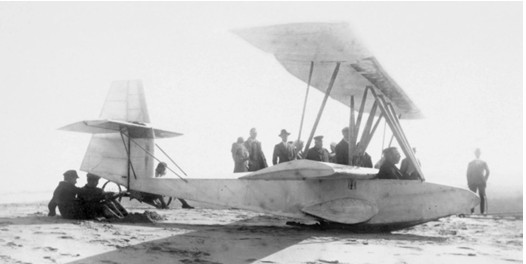
Flying boat 'Königsberg'
The design of the aircraft is adapted to the local conditions on the Curonian Spit. The spit has its steep slopes, which are up to 60 m high, towards the
lagoon side. If you want to fly there with a glider, you always have to reckon with the possibility of going down on the water, unless you have an extremely
manoeuvrable aircraft to be able to stay in the narrow call wind field. Consequently, an aircraft had to be created that could take off from the dunes und_both land and
water. The most expedient for this purpose seemed to be a high-decker with a wide hull. The idea was to install a large stage
to enable the aircraft to take off from the water. However, this had to be discarded, as the stage would have been
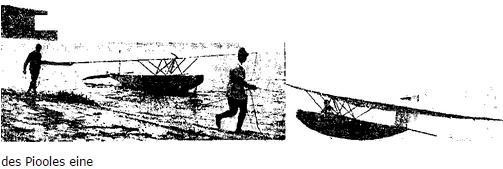
damaged too easily during landings and take-offs in the dunes. A small step has resulted of its own accord from the fact that, to facilitate the start from land, the front part has received a slight curvature of the bottom, to the highest point of which a central runner is attached. The boat is single on the sides and top, double covered with canvas and cellonated at the bottom. The aircraft was sometimes on the water for an hour without drawing much water. To protect the canvas, the floor is nailed with strips.
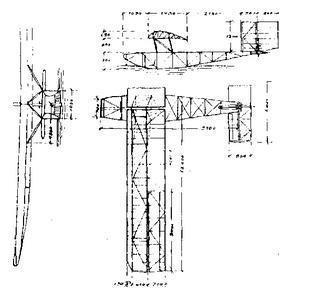
Incidentally, the aircraft is built as a normal tension-free monoplane. The dimensions are shown in the attached drawing. The wing has
18 m2. The weight of the aircraft is 100 kg, resulting in a wing load of 10 kg/m2. The surface has two spars, which are braced together in the usual way to prevent twisting. The controls are normal. The profile used is Göttingen 441.The
aircraft was built by me alone after work within 6 months for the most part in my apartment. The flight switches were quite good. After the
competition in Rossitten, the plane unfortunately stood in the rain for 3 weeks. Nevertheless, 6 times the safety in the Rhön could still be proven. Unfortunately, due to lack of money, the experiments in the Rhön had to be stopped after the first three flights.
Kurt Peyean