Type 1 + 3 sportplane
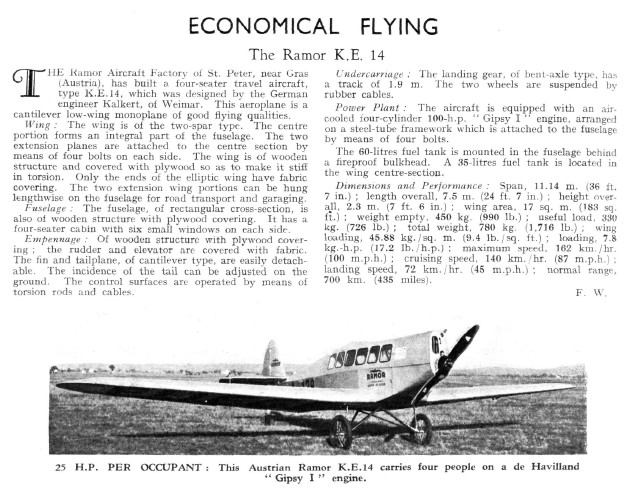
Engine 1 de Havilland Gipsy 1
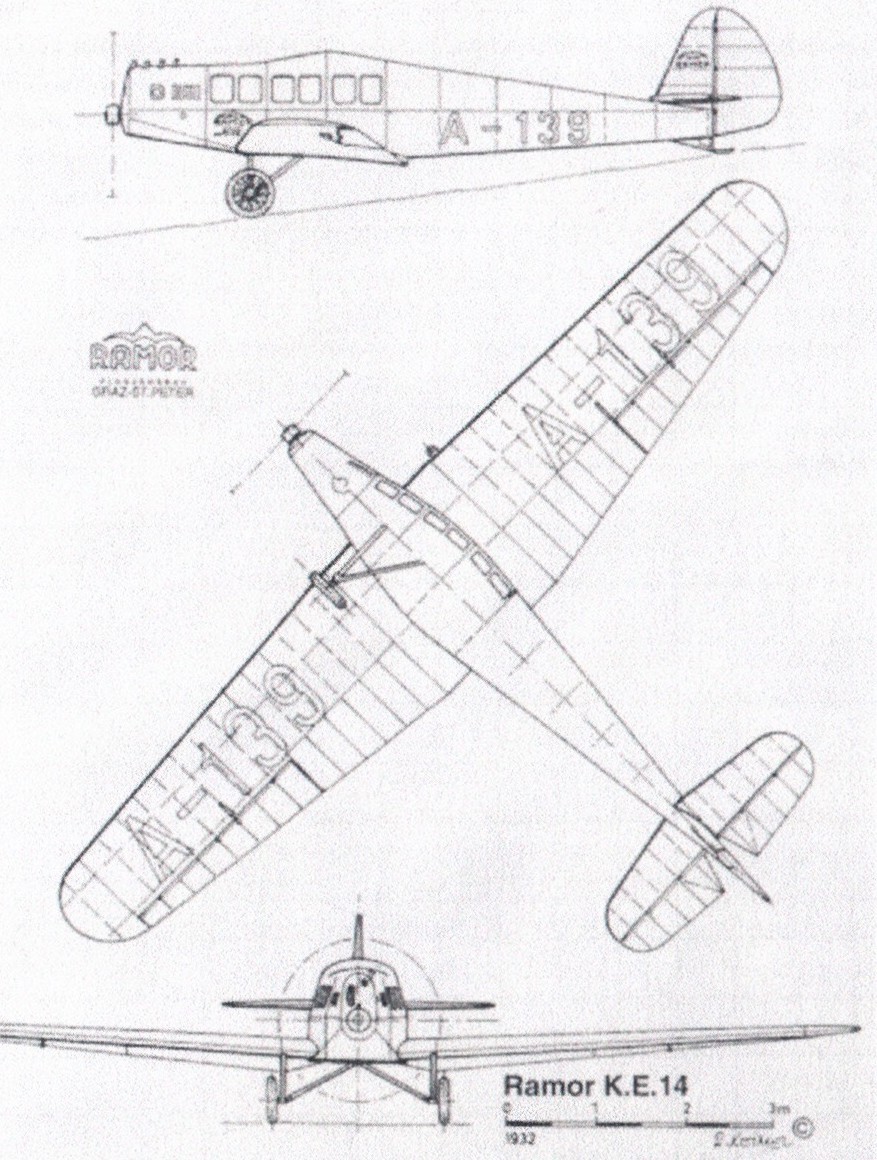
Dimensions Length 7,5 m , height 2,3 m ,  span 11,14 m , wing area  17 m2 ,
Weights Empty 450 kg, loaded 780 kg , max. take off weight  , wing loading 45,88 kg/m2, power loading  7,8 kg/hp
Performance Max.. speed 162 km/h , cruising speed 140 km/h , range 700 km, endurance  , service ceiling   , climb, landing speed 72 km/h
Type Werk.Nr Registration History
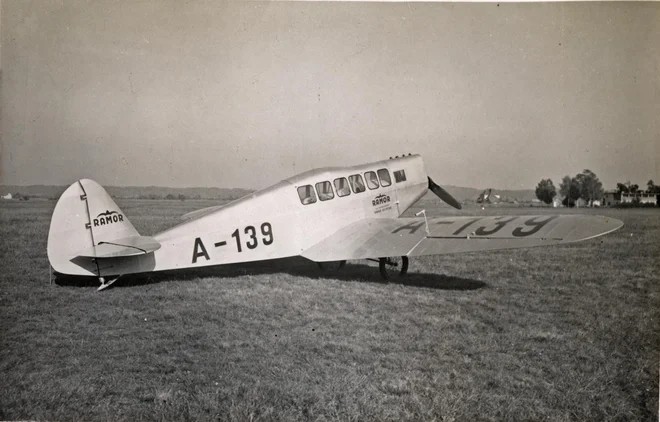
A-139 Built by the Ramor Flugzeugwerke
This passenger and commercial aircraft, designed by Obering. A. Kalkert of the Weimar Engineering School for Ramor-Flugzeugbau St. Peter near Graz, is designed for a pilot and three passengers. Performance at a range of 700 km with a 100 hp engine is good.

The fuselage is a standard box girder, with two longitudinal spars at the top and two at the bottom connected by frames. The fuselage cross-section is rectangular with an upper arch. Streamlined in the side view. The spans between the frames are crossed by longitudinal and transverse diagonals. Birch plywood planking. Frames 3 and 4 form
part of the wing spars. The wing stubs extend out from the fuselage. Frame 1 is a firewall, with fittings for the engine mount at the four corners. The space
between frames 3 and 4, or 4 and 5, provides seating for two people each.
The wings are connected to the 1.7 m wide center section with four bolts each. The air forces are transferred to the spars by shaped and box-shaped ribs.
The wing is covered with birch plywood from the lower edge of the rear spar over the wing nose to the upper edge of the rear spar. This creates a torsionally rigid box-shaped structure. The rib ends of the rear spar are covered with fabric.
The horizontal and vertical stabilizers are removable. They are mounted on the rear edge of the fuselage. The control spars consist of a box-shaped spar, which is formed into a semicircular tube by covering it with plywood.