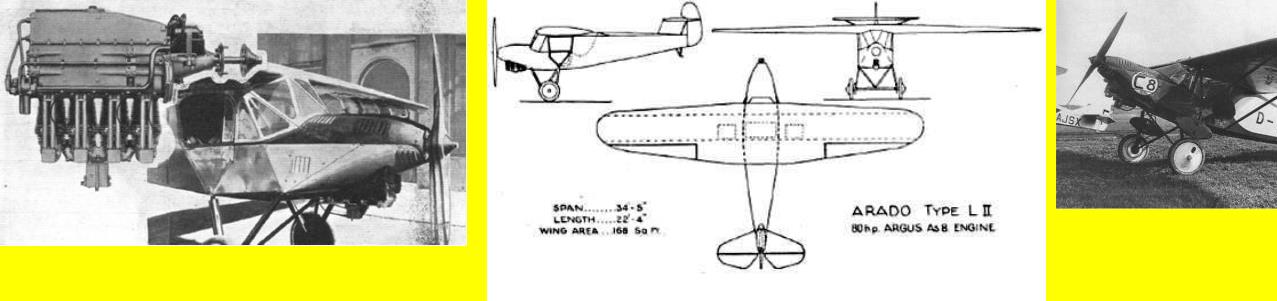
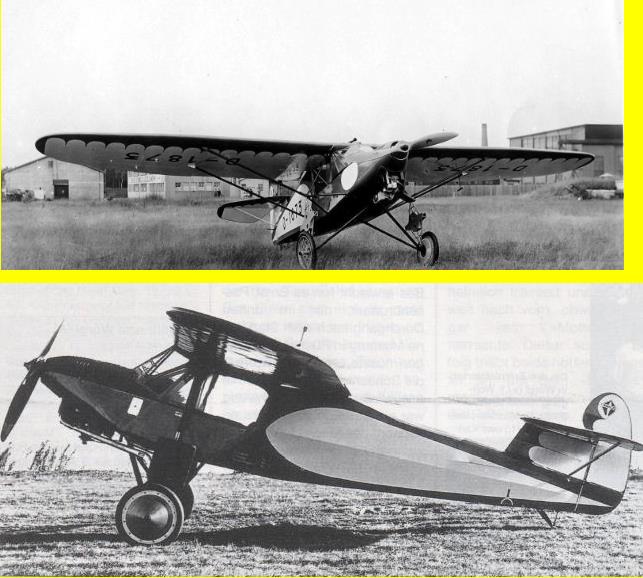
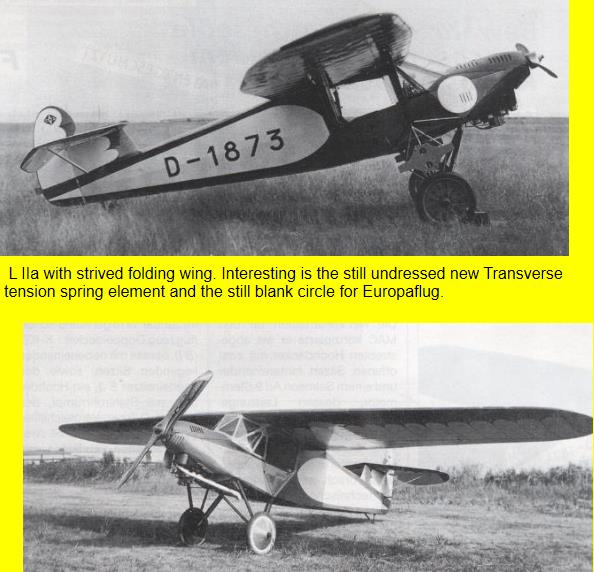
THE ARADO "TREFF AS" from Flight
First German Light Aeroplane to be designed for Inverted Argus.
A LTHOUGH the inverted aero engine is no novelty, a German firm having produced engines of this type long before the war 1914-18, the type has never hitherto become really popular. It is probably no secret that the makers of British light aeroplane engines have been experimenting with the inverted type of engine, and could, did the demand exist, put such engines into production at very short notice. We believe we are right in stating that the chief argument used against the inverted " in-line " engine is that with its cylinders hanging down from the nose of the fuselage, there is considerable likelihood of damage if the aircraft turns over on the ground, or even if it merely " stands on its nose." Probably this criticism is quite justified. There are many cases on record in which the machine turned up on its nose, or the undercarriage collapsed and let the machine down on to the ground, the only damage being, perhaps, a broken or bent propeller. The engine was undamaged because the machine " slithered " along on the crankcase, which was strong enough to stand this treatment. A cylinder head, particularly that of the front cylinder, would doubtless have been rather badly damaged. On the other hand, the radial type of engine has two or more of its cylinders projecting below the level of the fuselage, and the number of " casualties " to lower cvlinders does not appear to be excessive. While thus the inverted in-line engine may be at a slight disadvantage as compared with the upright engine of the same type, it is no worse off than the radial engine in this particular respect, possibly a little better, and there is no denying the fact that a very fine forward view is attained when the engine is " turned upside down." It is held by some authorities that there is some difficulty in getting as good carburation with the engine inverted, although why this should be so is a little obscure.
Bearing in mind that a British aero engine firm was the first to produce the four-cylinder, in-line, air-cooled light aeroplane engine which is so popular at the present time, and that at least two firms could without doubt produce inverted versions very quickly, it has remained for the German " Argus " firm of Berlin-Reinickendorff to place on the market the first inverted four-cylinder, in-line air-cooled engine of 80 h.p. One of these engines was, it may be recollected, exhibited at the Olympia Aero Show last July. And the first German aircraft firm to design a machine specially for the inverted " Argus " engine is the Arado Handels-Gesellschaft, of Berlin, whose works are situated at Warnemiinde.
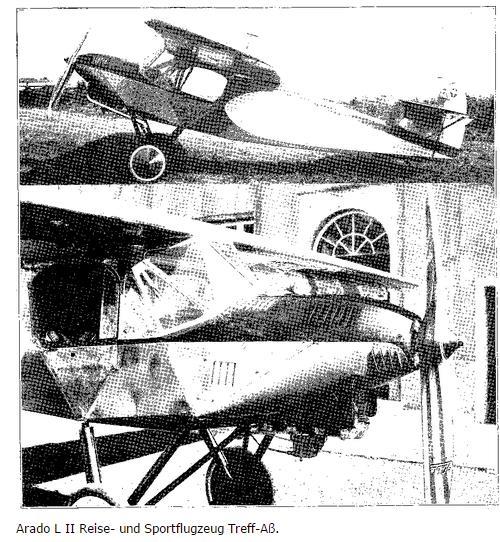
The Arado L.II, or " Treff As," is a cantilever monoplane two-seater cabin machine, in which the pilot and passenger are placed side-by-side. In aerodynamic design, the machine is fairly orthodox, although the high placing of the horizontal tail surfaces is unusual. It may be recollected that the original Koolhoven monoplane, now produced in this country by Mr. Desoutter, had its tail surfaces placed high. Although this placing made the machine delightfully indifferent to engine-on and engine-off conditions, it was, we believe., found that in starting it took some considerable time to get the tail up, thereby increasing the length of run required to " unstick." In the production type Mr. Desoutter has dropped the tail plane on to the top longerons. It would be interesting to know whether the same has been found in the Arado " Treff As." The ground angle is large, and one would expect the high tail position to reduce the effett of the slip stream.
Constructionally the Arado " Treff As " is of " mixed " type, with a wooden, ply-covered, one-piece wing, and welded steel tube fuselage. The wing structure consists of two main box spars and the usual lattice girder ribs, the plywood covering or planking extending to the rear spar only. The trailing edge portion is covered with fabric, with the exception of the ailerons, which are ply-wood planked. The tail surfaces are all of welded steel tube construction, fabric covered.
The photographs of the machine, and the notes sent to us by the Arado firm, indicate a " split " undercarriage, although the general arrangement drawings show the axle type. It is assumed that the machine was originally designed with the older type of undercarriage, but that before completion of the machine this was altered to the divided type. Springing is by rubber rings.
The Argus As 8 type engine is, as already stated, of the inverted type, and is neatly cowled in, covered with an aluminium cowling. A fireproof bulkhead separates the engine from the cabin, and the two petrol tanks, each of 55 litres (12-1 gallons) capacity, are mounted one on each side of the fuselage, inside the wings, between the main spars. This position, coupled with the inverted form of engine gives a large head of petrol, ample for direct gravity feed.
The seats inside the cabin are placed side by side, and in view of this fact the control stick is placed in the centre, where it can be reached by either occupant. There is a separate foot bar for each, so that school work can be carried out. It is claimed that this arrangement has many advantages for instructional flying in that it enables the pupil to see more clearly what the instructor is doing, and vice versa. Conversations, it is stated, can be quite easily carried out without telephones, and of course, no special flying clothes are necessary, owing to the enclosed cockpit. A cellon windscreen composed of several panels protects the occupants against the slipstream. The sides are left open above the doors, so that in case of the forward screen becoming fogged, the pilot can lean out for landing. At the front corners of the openings in the sides there are small adjustable screens, which can be set to give a minimum of draught inside the cabin.
Behind the seats there is a luggage compartment in the form of a canvas satchel, while net racks in the cabin itself may be used for attache cases, maps, etc.
The main characteristics of the Arado " Treff As " are :—
Length overall, 6-81 m. (22 ft. 4 in.). Wing span, 10-5 m. (34 ft. 5 in.). Wing area, including ailerons, 15-62 sq. m. (168 sq. ft.). Height, 2-28 m. (7 ft. 6 in.). The tare weight of the machine is 405 kgs. (890 lbs.). The load is made up as follows :—Pilot, 75 kgs. (165 lbs.) ; passenger, 75 kgs. (165 lbs.) ; fuel, 70 kgs. (155 lbs.) ; oil. 10 kgs. (22 lbs.) ; luggage, 35 kgs. (77 lbs.). Total load, 265 kgs. (584 lbs). Total loaded weight, 670 kgs. (1,474 lbs.). Jving loading, 41-87 kgs./sq. m. (8-78 lbs./sq. ft.). Power loading, 8-37 kgs./h.p. (18-4 lbs./h.p.). The top speed at 3,300 ft. is given as 162 kms.'h. (100 m.p.h), and the climb to 3,300 ft. in 8 mins.
The Argus As 8 engine develops its rated power of 80 b.h.pat the low speed of 1,400 r.p.m., so that the propeller efficiency should be very good.
| Type |
L II Two seat sportplane |
L IIa Two seat sportplane |
| Engine |
1 Argus As 8a |
1 Argus As 8R |
| Dimensions |
Length 6.72 m, height 2.28 m, span 10.50 m, wingarea 16.00 m2 Length 6.72 m, height 2.28 m, span 11.00 m, wingarea 16.00 m2 |
Length 6.72 m, height 2.28 m, span 11.00 m, wingarea 16.00 m2 Length 6.72 m, height 2.28 m, span 11.00 m, wingarea 17.00 m2 |
| Weights |
Empty 405 kg, , crew 150 kg, fuel tanks 2 x 55 l, flying weight 670 kg |
Empty 460 kg, crew 150 kg, fuel tanks 2 x 65 l, flying weight 780 kg |
| Performance |
Max.speed 162 km/h, climb to 1000 m 7.00 min. |
Max.speed 166 km/h, climb to 1000 m 7.80 min,t 2000 m 18,1 min. service ceiling 4000 m, range 700 km |
| Type |
Werk.Nr |
Registration |
History |
| L II |
57 |
D-1771 |
Named "Treff-Ass". Testflights in November 1929.Used for joy-rides around Warnemünde until Nov. 1936 when it crashed. |
| L IIa |
58 |
D-1873 |
Took part in the Europa-Rundflug 1930, DVS Braunschweig (Pilot Stutz),crashed at Pau on the 23d of July. |
| L IIa |
59 |
D-1874 |
Took part in the Europa-Rundflug 1930, Arado (Pilot von Dungern) |
| L IIa |
60 |
D-1875 |
Took part in the Europa-Rundflug 1930, Arado (Pilot Peschke). Took part in the Deutschlandflug 1931 |
| L IIa |
61 |
D-1876 |
Took part in the Europa-Rundflug 1930, Arado (Pilot Dr. Pasewaldt). Took part in the Deutschlandflug 1931 |









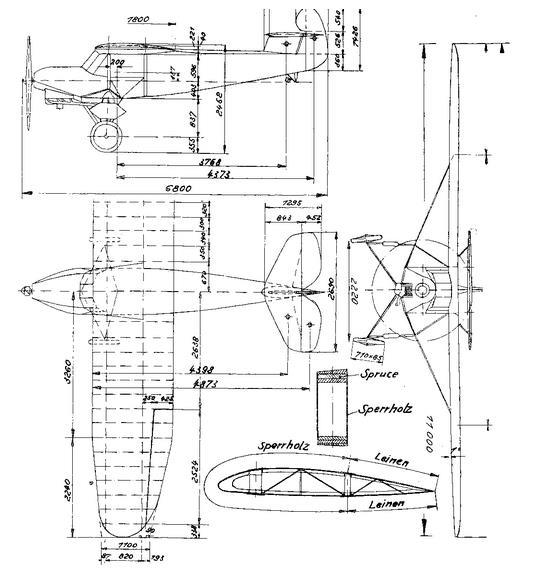
Arado L II Touring and Sport Aircraft Treff-Aß.
Page 442
, Flugsport
No. 23
The keel fin is a component of the fuselage and is permanently welded to its upper surface. The rudder projects above the keel fin and has a compensator on top. All tail and control surfaces are welded from steel tubing (except the ailerons) and covered with canvas. The horizontal stabilizer sits on top of the fin and is supported on each side by a strut to the fuselage upper chord. All control surfaces are equipped with precision ball bearings. The joints are Meyrol high-pressure lubricated.
The wing is cantilevered and undivided. It has two box spars and ribs and is plywood-clad from the underside of the rear spar to the top of the rear spar.
The wing outline is trapezoidal, with rounded tips.
The ailerons are made entirely of wood. Its skin is made of plywood.
There is a retaining ring on each side of the wing tip, allowing the aircraft to be easily anchored when spending the night outdoors.
The Arado L II model is equipped with the air-cooled Argus As-8 engine, whose four cylinders are arranged in a suspended arrangement. The engine's continuous and maximum power is 80 hp at an engine speed of 1,400 rpm. Two fuel tanks, each with a capacity of 55 liters, are located in the wing to the left and right of the fuselage, between the wing spars, where they are specially protected in the event of a crash landing. The fuel flows to the engine as a drop fuel. A firewall is installed behind the engine. The engine's covering panels are made of aluminum.
Equipped weight: 405 kg; pilot: 75 kg, passenger: 75 kg, fuel: 70 kg, lubricant: 10 kg, baggage: 35 kg, total: 265 kg; take-off weight: 670 kg. Wingspan 10.5 m, length
6.72 m, height 2.28 m, area 16 m², wing loading G/F 41,870 kg/m², power loading G/N 8.37 kg/hp, speed at 1 km altitude V = 162 km/h.
Climb time to 1 km altitude = 8 min.
Arado sportplane Ar. Llla.
The Araclo L lla model is equipped with the air-cooled Argus As-8 engine, whose four cylinders are arranged in a suspended position. The engine's continuous and maximum power is 80 hp at an engine speed of 1400 rpm. Two older fuel tanks, each of 65 hp, are located in the wing to the left and right of the fuselage, between the wing spars, where they are particularly protected in the event of a crash landing. The fuel flows to the engine as a drop fuel. A firewall is located behind the engine, and the engine's cladding is made of aluminum. The passenger compartment is protected from the wind and propeller jet by large cellon windows at the front and top. Two small side doors allow for very convenient entry and exit. Since the two seats are next to each other, the control stick could be positioned suspended in the middle of the cockpit, which further contributes to the comfortable layout of this space. The doors extend to approximately elbow height, leaving the cabin open at the sides. This guarantees clear visibility in rainy weather and foggy windows. Two small, adjustable side windshields,
similar to those found in cars, prevent any drafts caused by the propeller jet. The aircraft can therefore be used without any special clothing;
even a cap and goggles are not required. The use of an overhead engine and the inclusion of a firewall between the engine and the cockpit,
prevents even the slightest oil splash from entering the interior. Behind the seats is a luggage bag that occupies the entire width of the fuselage, allowing even larger items of luggage to be carried. It is accessible from the cockpit; it is closed off by a zippered canvas partition. Two small nets, mounted above the seats, for storing maps, handbags, etc., complete the interior.
The fuselage is made of welded steel tubes covered with canvas.
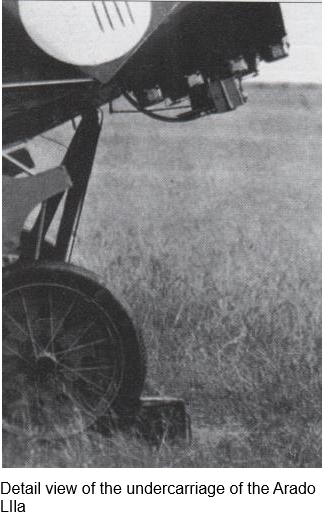
The axleless chassis consists of two halves, each with a spring strut. The skid, designed similarly to the landing gear struts, also has a spring strut. A small roller, which can be folded down from the pilot's seat, allows for easy rolling on cement tracks without abrading the skid plate.
All spring struts are of the simplest design. The softness of the suspension can be adjusted by adding or removing individual rubber rings. Brakeable wheels are available upon request.
The keel fin is a component of the fuselage and is permanently welded to its upper surface. The rudder extends beyond the keel fin and has a compensator on top. All tail and control surfaces are welded from steel tubing (except for the ailerons) and covered with canvas. The horizontal stabilizer sits on top of the fin and is supported on each side by a strut to the upper fuselage flange. This design also creates ample ground clearance at the fuselage end, which is very advantageous during emergency landings on terrain covered with tall grass, reducing the risk of damage to the fuselage end. All control surfaces are equipped with precision ball bearings, and the joints are lubricated with Meyrol high-pressure lubrication. The wing is braced and split. It has two box spars and ribs and is covered with plywood from the underside of the rear spar to the top of the rear spar. The wing outline is trapezoidal, with rounded tips. The wing shape was chosen to be as optimal as possible according to aerodynamic principles. The wing is foldable. To do this, the front stem is released at the fuselage node, folded onto the wing, and strapped in place. The aileron pushrods are then released using a quick-release fastener. If the front spar connection on the fuselage is now released, the wing can be pivoted rearward about an axis parallel to the rear spar and simultaneously about a vertical axis.
And attached to the tail fin tip by a connecting fitting. The weight of the wing is supported by the rear stalk.
The fuel lines at the fuselage connection consist of metal hoses and do not need to be removed.
The wooden ailerons are covered with plywood.
Wingspan 11 m, length 6.72 m, height 2.28 m, wing area 17 m², space required with folded wings 2.75 x 3.26 x 7.52 m.
Empty weight 115 kg, pilot and passenger 150 kg, fuel 85 kg, oil 10 kg, baggage 40 kg, total weight 700 kg.
Speed at 83 HP 158 km, at 110 HP 173 km, climb time to 1000 m 7.5 min.
THE FIRST LIGHT AIRCRAFT FROM WARNEMÜNDE SHIPYARD
Arado L II "Treff As"
Paper is patient. Especially the paper of advertising materials. Because the new two-seater sport aircraft from Arado, as an early novelty, with its windshields, air deflectors, and half-doors, possessed something like a draft-free and weatherproof cabin for the two side-by-side occupants, the advertising manager went so far as to claim: "The enclosed cockpit makes special clothing and goggles unnecessary.
Comfort and freedom of movement are thereby increased. The companion has enough space to arrange his cards without having to worry that they will be blown away by the draft."
brought together or completely torn apart." But that's exactly what happened at the International Air Race - the Challenge International 1930. It had taken off on July 20th from Berlin started with a 7,560 km long European circuit flight of the 60 participating aircraft. From takeoff, it led through partly very bad weather. For the German Commercial Pilot School (DVS), the flight instructor of the Braunschweig branch, Hermann Stutz, flew together with his companion König in the Arado L Ila (serial number 58) with the competition number B4, which was registered later that same month under the registration D-1873 for DVS GmbH had been approved.
Stutz – a trained architect who had survived the war as a retired lieutenant and former fighter pilot (in Fighter Squadrons 20 and 71) with four recognized kills – landed in Reims after prescribed stops in Braunschweig and Frankfurt/Main with the main group. The small naval airfield St. Inglevert near Calais – where 15 aircraft had already landed on the first day –They had come up with something - he reached it on the morning of the second day. The start for the canal flight to England was only cleared around noon due to the weather.
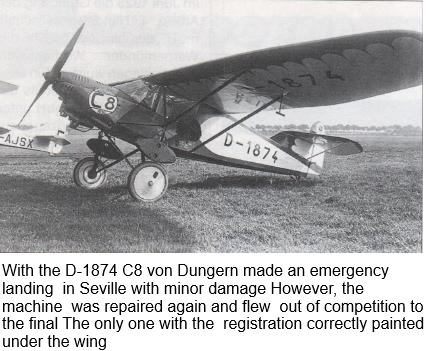
Stutz and his companion reported in as planned in Bristol and London, but were overdue on the return flight, which led again to St. Inglevert: The crew of an escort aircraft had crashed the Arado with lost sight of Boulogne on its course. Despite a considerable delay, it eventually made its way to the overnight stop. Late in the evening of the third day, when the first nine competitors, after forced landings in Paris, Poitiers, Pau, and Zaragoza, had already reached Madrid, the crew of Stutz/König was delayed by landing gear damage.On the morning of July 23, the fourth day of the competition, the unforeseen happened: The crew was en route from Poitiers to Pau when, in poor visibility, all their charts were blown away. They navigated 150 km without aids, eventually reaching Pau, only to crash during landing. Since it was impossible to repair the damage using onboard resources, B 4 was eliminated. On the same day, a second, factory-built Arado L Ila with the competition number C8 (serial number 74, registration D-1974) reached Pau.
It was flown by Wolf Freiherr von Dungern, an experienced competition pilot and also a technical advisor at the DVS in Braunschweig. However, during the onward flight, von Dungern and his companion Blickle crashed in Seville. Despite the ace's invocation, the newly designed Arado seemed to have poor prospects.It hadn't exactly started off very encouragingly. At the beginning of the whole story is actually the previous year's International Air Race – the one from 1929. It was initiated by the Aéro-Club de France with the aim of developing usable light aircraft for private use.
Various national aero-clubs in Europe jointly raised prize money totaling 300,000 francs (almost 50,000 Reichsmarks), and the French organizers also donated a challenge cup called the Coup Challenge. The Mecklenburg Aero Club (MAC), Rostock, founded in 1913, which from autumn 1926 onwards sought to establish its own aviation activities in Warnemünde, wanted to participate in this competition with an aircraft belonging to the club. It was to be manufactured in the Warnemünde factory facilities, dating from the First World War, of the former Flugzeugbau Friedrichshafen GmbH. were taken over by Hugo Stinnes in 1920 and operated as "Dinos" Automobilwerke AG (which ceased operations in November 1925). In February 1925, they came under the umbrella of AG Hugo Stinnes in Hamburg.
Also in Hamburg, In June 1925, the Arado Handelsgesellschaft mbH was founded, to which the Warnemund shipyard facilities were assigned as a branch. A year earlier, the »Aquila«-Verkehrs GmbH had already been established in Berlin with the participation of the aircraft manufacturer Ernst Heinkel, whose purpose was the construction and sale of aircraft manufactured at the Warnemund shipyard.All these commercial interlocking arrangements were influenced by the military.
It saw the shipyard facilities as an ideal production site for the products from the aircraft factory of Ernst Heinkel, which was also located in Warnemünde which as a predominantly development company was not well suited for series production.
However, military orders remained scarce, and in-house developments were subordinate to those of the more experienced competition.
In 1929, the economic situation of the Arado shipyard in Warnemünde became critical. Every order was welcome, even one as modest as that of the MAC. However, their suggestion to involve Hermann Hofmann in the development had complicated negotiations. Arado finally agreed on the condition that this graduate engineer, who had emerged from the Akaflieg Darmstadt, would assume sole responsibility for calculation and design, but gave the aircraft the internal designation L/. Hofmann had previously designed the high-performance glider D 15 Westpreutien, which was considered a classic . Representatives of the "Darmstadt School" had many imitators, and with its first version, Ferdinand Schulz held all world records for a time. Hofmann was also responsible for the designs of the GMG light aircraft I and II, which were built by the Griesheim furniture workshop of the Müller brothers.
He conceived the new design for the MAC as a strutted high-wing aircraft with two open seats in tandem and a Salmson Ad 9 radial engine, whose power weakness (40 hp, 29.4 kW) he compensated for through optimal aerodynamic design of the airframe. Unfortunately, the wing broke down during the technical testing for the 1929 European tour in Paris. Hofmann crashed and was killed.
In the same year, Arado began designing its own light aircraft. Because the shift towards touring flight was clearly underway among sport pilots, a market niche was anticipated. Despite using the same high-wing monoplane design, the Arado development and design team developed a concept that differed completely from Hofmann's. It was adapted to the latest insights into touring flight and purposefully geared towards the market. The extensive experience of Chief Engineer Walther Rethel (1892-1977) was incorporated here. Born in Wesel as the son of an officer, he attended the then Royal Higher School of Mechanical Engineering in Dortmund until 1914, graduating successfully, and then joined the Kondor aircraft factory, headquartered in Essen, as an apprentice.
After the outbreak of war, he was hired as a designer, but soon began working independently. Of his designs at Kondor, two innovative patterns stand out in particular: The In January 1918, the K-100 (B I) training biplane, already with side-by-side seating, and the E 3 single-seat fighter, a high-wing
wing with a steel tube fuselage, were tested. The E 3 was very well received at the 3rd D-Type Comparative Flight in October 1918 with two different makes of rotary engines.
After the war – initially working as a demonstration aircraft pilot – he designed and built aircraft for the Dutch Air Force in 1920.
The Dutch company NAVO designed a four-seat high-wing passenger aircraft, then various flying boats at Fokker. In mid-1925, he took over the position of chief designer at Arado in Warnemünde – through Hugo Stinnes' personal mediation. He retained this position, at least nominally, until 1938. Then he moved to Messerschmitt as head of the design office.
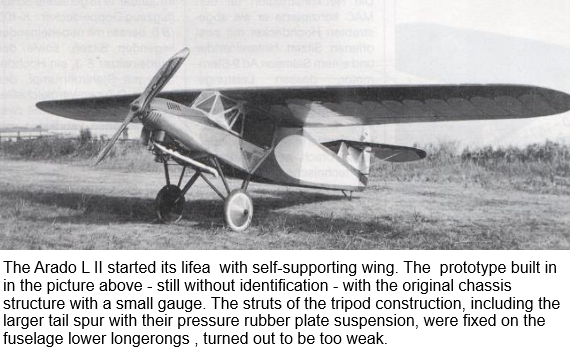
Under Rethel's supervision, a whole series of differently designed prototypes had been developed at Arado before the new light touring aircraft, designated LIII, was finally on his design board. For this aircraft, he chose the cantilever high-wing design with a continuous trapezoidal wooden wing that rested on the cabin. In the wide fuselage, constructed as a welded steel tube frame and generously glazed, the two occupants sat side by side. With a supposed demand from the pilots for open cockpits, only half-turns were provided, so that in bad weather or with an oily windshield, the unglazed cabin sides would offer a clear view. The prototype with serial number 57, which received registration D-1771 in February 1930, was already able to be flown in November 1929. However, the delicate tricycle landing gear, articulated only at the lower chords, with pressure-rubber spring discs in the rear struts and a track width of only one meter, proved to be too weak and had to be redesigned. To allow flight testing to continue, the prototype was provisionally fitted with a continuous, rubber-cable-sprung axle.
Two half-axles in the best Fokker style. Finally, struts leading to the upper fuselage chord with a spring box for the V-shaped suspended rubber rings were chosen as the final solution, increasing the track width to 2.20 meters. While the flight performance was rated well, the flight characteristics remained improved despite a change in the aileron wingspan. in need of modification. When a folding wing promised more points in the 1930 Challenge International competition announcement, this prompted a redesign of the wing.
With a slight increase in wingspan from 10.5 to 11.0 meters, it acquired a double-trapezoidal planform with an area of 17.52 instead of 16 square meters, was made in two sections, and braced by two parallel struts on each side towards the lower fuselage chord. The wing halves could-rubber suspension was another innovation, whose saucer-shaped fairing gave the L Ila its unmistakable appearance. However, it too was not entirely satisfactory. The redesigned instrument panel received a vibration-free mounting.
Back to the European tour: The two Arados still participating regularly (Peschke's repaired aircraft also flew the remaining route as the third, out of competition) were also registered to Arado Handelsgesellschaft mbH. One of these L Ila aircraft, with the registration D-1876 and the competition number D1 (serial number 61), was flown by Dr. Georg Pasewaldt (1900-1989[?]). The Berlin native had studied economics, received his doctorate in 1922, and in 1925 completed his flight training at the Magdeburg airship company, before joining the DVS via Sportflug GmbH in 1927 and obtaining all available licenses there.At the time of the International Air Race in 1930, he served as flight and training manager at the DVS Warnemünde. Subsequently, he was to become head of flight operations at the Norderney Air Service Station and finally director of the DVS Stettin, before being transferred to the Luftwaffe as a captain in 1936. He served with the General Staff and front-line units. And as head of the Development Department in the Technical Office of the RLM (Reich Air Ministry), he rose to the rank of Obersell (First Lieutenant) until suspicions of collaboration with the resistance movement cost him his position in 1944. In 1956, Dr. Pasewaldt renewed his pilot's license.
During the 1930 airshow, he and his companion Eydt had taken off in the leading group, but on the second day, worried about the failure of Stutz's aircraft, they were unable to leave St. Inglevert. The next day, a chase began, which the crew successfully completed, as they were the last aircraft to receive takeoff clearance in Pau despite the rapidly deteriorating weather conditions over the Pyrenees and reached Zaragoza after a thunderstorm flight.
While on the fourth day the nine-plane leading group, including the Germans Morzik and PoB, flew from Madrid via Seville back to Madrid and Zaragoza towards Barcelona, Spain, the large
group was still in Pau or at the airfields before it, because the Pyrenees were now completely congested. But Pasewaldt and his companion also only made it as far as Vadrid due to an engine problem. However, they did not miss the connection, as the leading group was delayed in Barcelona due to bad weather and reached Lyon via Nîmes.
The onward flight to Lausanne on the sixth day was, according to Pasewaldt's account, one of the most difficult cross-country flights of his flying career.
Despite fog with visibility of only a few meters, thanks to precise dead reckoning navigation, he safely reached his destination on Lake Geneva in low-level flight through the Rhône Valley,
| in order to reach Vienna via Bern and Munich on the same day. (Editor's note: Dead reckoning is a method in which the position of an aircraft is calculated from airspeed, heading, time, and wind influence. "Dead reckoning" means that the current position is determined by aligning the already flown route with the departure point or the last known position. The flight path is calculated from the ground speed, the direction of flight, and the flight time. On the seventh day of the competition, the Pasewaldt/Eydt crew reached their overnight destination of Poznań via Prague and Wrocław. They were now in the leading group, as only four aircraft ahead of them had reached the next stage destination, Warsaw. The onward flight on the eighth day went via Königsberg and Danzig back to Berlin. On this Sunday, July 27th, all nine aircraft of the leading group were on track to reach their destination, as they had taken off from Danzig almost simultaneously. At 5:13 p.m., Fritz Morzik and his companion Schiel landed in fourth place with their- MFW M 23c. They were later declared the overall winner. At 4:33 p.m., Englishman Broad arrived first with his De Havi Island Moth. Exactly one hour later, Dr. Pasewaldt landed his Arado in sixth place on the Tempelhof airfield. The second Arado L Ila, with registration D-1875 and competition number C 9 (factory number 60), arrived in Berlin only two days later.
Nevertheless, their crew, the aerobatic pilot and head of the Rhine-Ruhr flying school in Düsseldorf, Otto Peschke, as pilot, and his coxswain Eschbacher, scored 207 points, 27 more for the cross-country flight than the Pasewaldt/Eydt crew: They had covered the total distance in a pure flight time of 56 hours and 17 minutes at an average speed of 134 km/h, compared to the 60 hours and 22 minutes that their competitors had needed. The two rated aircraft thus took 13th and 14th place. In the subsequent technical examination, however, they fell back to places 18 and 22, but with 336 and 318 total points respectively, they were only a quarter behind the top-scoring participants.The L Ila was a successful approach to the touring aircraft of the future – but only an approach. The hesitancy with which the cabin design was approached could only be half the solution. The complete solution was shown by the American two-seater.
Monocoupe 95A, also with side-by-side seats, was also designed as a braced high-wing aircraft and likewise with a steel tube fuselage and a wooden wing. It was designed in 1929 by C. Folkerts (who designed several successful racing aircraft with retractable landing gear for the National Air Races in the late 1930s) and went into production in 1930 at the Monocoupe Corporation at Lambert Field in Robertson, Missouri.
This aircraft, with which the Canadian Carberry, as the only non-European model, also participated in the 1930 International Air Race and achieved a remarkable 6th place, had a fully enclosed cabin according to American automotive standards – well-equipped and easy to board. It thus embodied a configuration that has remained successful in the market to this day. The Model 95A, with only minor improvements from time to time, remained in production until 1950. It could ultimately be offered for just $3,800. In order to sell the remaining L Ila aircraft at all, Arado had to give its customers a discount of 4,000 marks in 1931.
Two of the L Ila, D-1875 and D- 1876, went to the The Travemünde test site of the RDL (Reich Association of the German Aviation Industry) named "Tedje" and "Fiedje," received aerodynamic improvements such as a more comprehensive engine shell, drag-reducing fairings for the spring elements and strut connections, and better covers for the wing-fuselage
junction and the horizontal stabilizer gap.
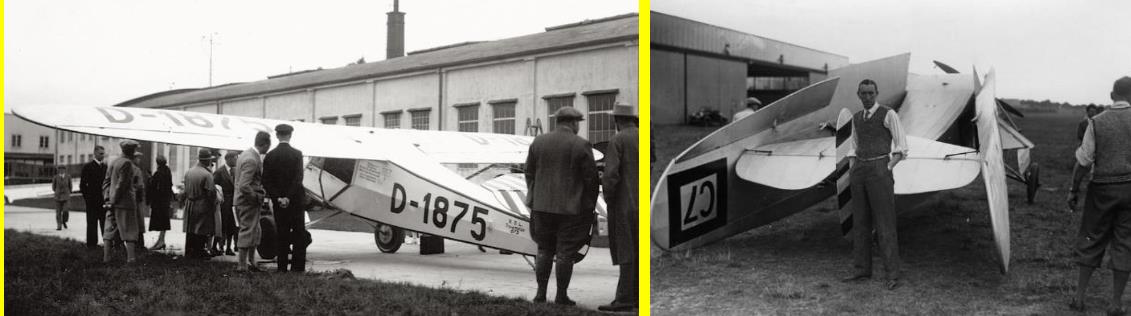
Under the command of the Holtenau Seaplane Station's head, Theo Osterkamp (flying D-1876 with registration number C 7), and the Travemünde test pilot Walter Hagen (flying D-1875, registration number C 8), they participated unsuccessfully in the 1931 Deutschlandflug (Germany Flight). The participation of the D-1873, registered by the Düsseldorf flying club in the DLV (German Aviation Association) under competition number C1, in the 1933 Germany Flight was equally fruitless. The last Arado L Ila was only removed from the register in 1936, but not a single aircraft had flown with one of the registration markings newly introduced in 1934. The As had not triumphed.
Technical Description
Flat-wing aircraft: Braced high-wing with parallel struts; two-part, two-spar wooden wing with box spars and truss ribs, plywood-covered to the trailingspar, fabric-covered behind; 1 degree dihedral. Ailerons made of wood, completely covered with plywood; wing halves manually via fittings on the rear spar and rear struts, foldable and fixable on the horizontal stabilizers.
Fuselage: Truss structure made of welded steel tubes, fabric-covered; external triangular braces for the landing gear linkage and the vertical stabilizer support are integrated components of the fuselage structure. Cabin with half doors and side-by-side seats; baggage compartment behind the seats separated by a zippered partition; Y-shaped control stick, instrument panel suspended by rubber bands.
Tailplane: Frame made of welded steel tubes, fabric-covered; vertical stabilizer with equalizer horn, horizontal stabilizer braced to the fuselage lower chords.
Wheels: Split axles on shock absorbers with transverse tension rubber springs; wheels 710 x 85 mm, braked. Skid platewith rubber spring strut.
Engine: An air-cooled Argus As 8 four-cylinder in-line engine with overhead cylinders and 95 hp (70 kW) takeoff power at 1,600 rpm. Rigid two-blade wooden propeller with a diameter of 2.25 meters. Two 55-liter fuel tanks in the wing roots.
Paint: Cream-white with extensive red trim; registration markings in black.