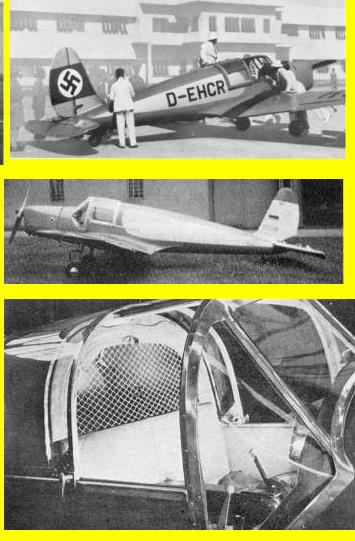
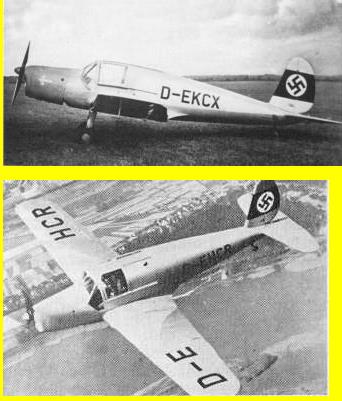
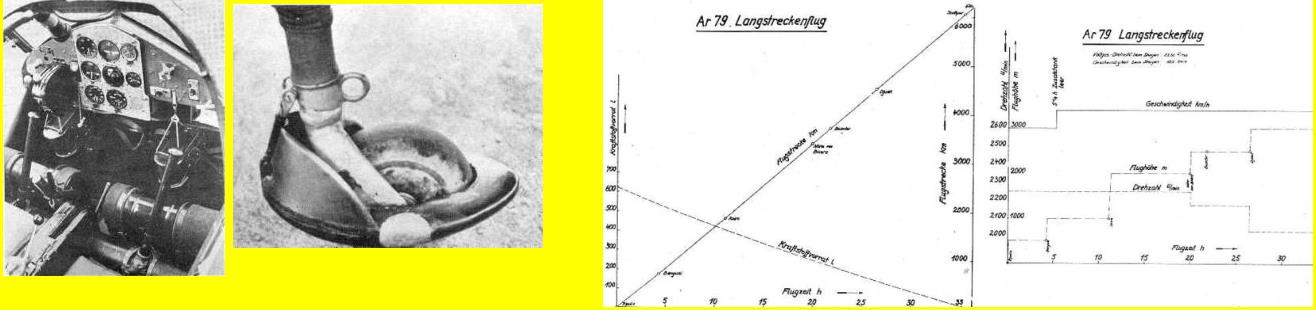
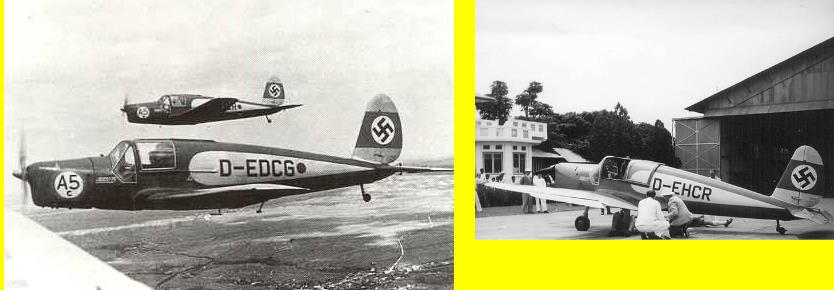
The Arado Ar 79 high-performance side-by-side two-seat cabin tourer was designed by Dipl.Ing Walter Blume in 1937, and made its debut in 1938, promptly establishing a number of international class records. On 15 July 1938, the first example, the Ar 79A V1 D-EKCX flown by Herr Lüber set a new 1 000km record in its class with an average speed of 229,04 km/h, and two weeks later, on 29 July, the Ar 79A V2 D-EHCR flown by Seelbach, established a 2 000-km record with an average speed of 227,029 km/h. A more ambitious flight began on 29 December 1938, when D-EHCR, piloted by Oblt Pulkowski and Ltn Jennett, was flown non-stop from Benghazi, Libya, to Gaya, India, a distance of 6903 km at an average speed of 160 km/h. For this flight, the aircraft was fitted with a 520 l fuel tank in the fuselage and a 106 1 auxiliary tank beneath the fuselage.
The Ar 79 was of mixed construction, the fuselage being a welded steel tube structure and an Elektron monocoque aft, and the single-spar wing being a wooden structure with plywood and fabric skinning. Power was provided by a 105 hp Hirth HM 504A-2 four-cylinder inverted inline engine and all three undercarriage members were retractable.
A total of 48 Ar 79s was built in B, D and E versions, the sub-types differing in only minor respects of equipment, etc, production terminating in 1941, and a number being utilised for liaison duties by the Luftwaffe. At least one example - the 47th built - survived WWII and is still flying with the Lufthansa Historical Flight. An Ar 79B-l, this aircraft was registered D-ECUV.
Schul- und Reiseflugzeug Arado„Ar 79u»
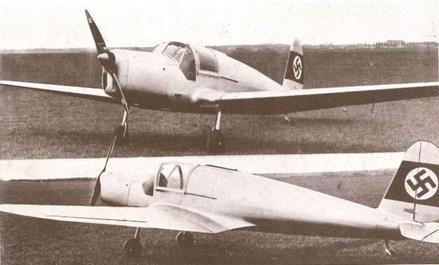
Das neue, von den Arado-Flugzeugwerken herausgebrachte Baumuster, von dem drei Maschinen am Deutschlandflug teilnehmen, ist als freitragender Tiefdecker mit
zwei nebeneinanderliegenden Sitzen ausgeführt.
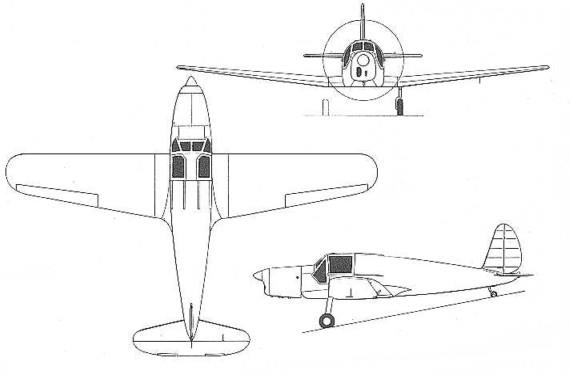
Der dreiteilige Flügel besitzt trapezförmigen Umriß und weist leichte V-Form auf. Das fest mit dem Rumpf verbundene Mittelstück ist mit Blech beplankt, während die
Außenteile stoffbespannt sind. Ausgekleideter Flügel-Rumpf-Uebergang.
Der Rumpf weist vorn rechteckigen Querschnitt mit gerundeten Kanten auf und wird weiter hinten annähernd kreisförmig. Glattblech-Schalenbau mit leichten Querversteifungen. Geschlossene Kabine mit zwei nebeneinanderliegenden Sitzen, die von einer Schiebehaube überdacht sind. Der vordere Teil der seitlichen Fenster ist besonders weit heruntergezogen, um die Sicht nach vorn unten zu verbessern.
Freitragendes Leitwerk in der von anderen Arado-Bau mustern her bekannten Form. Durchgehendes Höhenleitwerk am Rumpfende, davor die fest mit dem Rumpf
verbundene Kielflosse mit dem zweimal gelagerten Seitenruder. Höhenruder mit Trimmklappe.
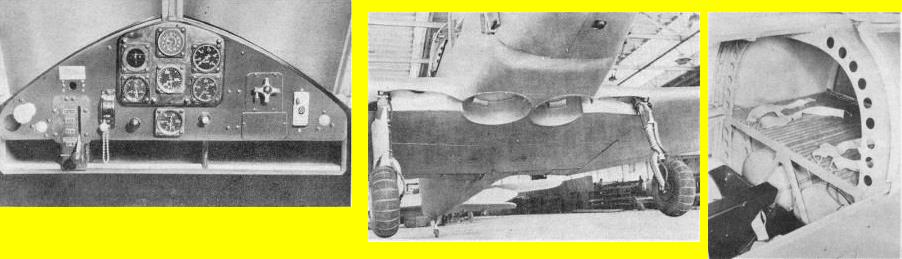
Einzieh fahrwerk an den äußeren Enden des Flügelmittelstückes. Die Räder sitzen an freitragenden Federstreben, die am unteren Ende seitlich abgekröpft sind und nach
innen hochgezogen werden. Die Streben kommen dabei in die Flügelnase, die Räder in den Rumpfboden zu liegen. Schwenkbares Spornrad.
Triebwerk: Luftgekühlter Reihenmotor Hirth „HM 504" von 105 PS Höchstleistung.
Die Maschine wird normal mit dem Vierzylinder Hirth „HM 504" ausgerüstet. Auf Wunsch kann auch der leichtere „HM 60 R" von 80 PS Verwendung finden. Mit den
beiden je 60 l fassenden Tanks beträgt die normale Reichweite mehr als 1000 km. Bemerkenswert ist die große Spurweite des Fahrwerkes (2 m), die zusammen mit
dem feststellbaren Spornrad gute Rolleigenschäften ergibt.
Der Flügel ist in Holzbau ausgeführt, zur Aufnahme der Kräfte dient ein Holm mit angesetzter Sperrholznase. Die Beplankung besteht teilweise aus Sperrholz, z. T. aus
Stoff.
Spannweite 10 m, Länge 7,6 m, Höhe 2,1 m, Fläche 14 m2, Leergewicht 460 kg, Fluggewicht 760 kg, Flächenbelastung 54 kg/m2, Leistungsbelastung 7,25 kg/PS,
Höchstgeschwindigkeit (erflogen) 230 km/h, Reisegeschw. 205 km/h, Steigzeit auf 1000 m 3,7 min, auf 2000 m 8,2 min, praktische Gipfelhöhe 5500 m, Landegeschw.
74 km/h, Reichweite 1025 km, Brennstoffverbauch 11 1/100 km.
| Type |
Two seat sportplane |
| Engine |
1 Hirth HM 504A-2 |
| Dimensions |
Length 7.60 m, span 10.00 m, height 2.10 m, wingarea 14.00 m2 |
| Weights |
Empty 460 kg, loaded 760 kg , max. take off weight |
| Performance |
Max. speed 230 km/h at sea level, cruising speed 205 km/h , range 1025 km, climb 5.55 m/sec, service ceiling 5500 m, required start run 180 m, landing speed 68 - 77 km/h, range 1025 km |