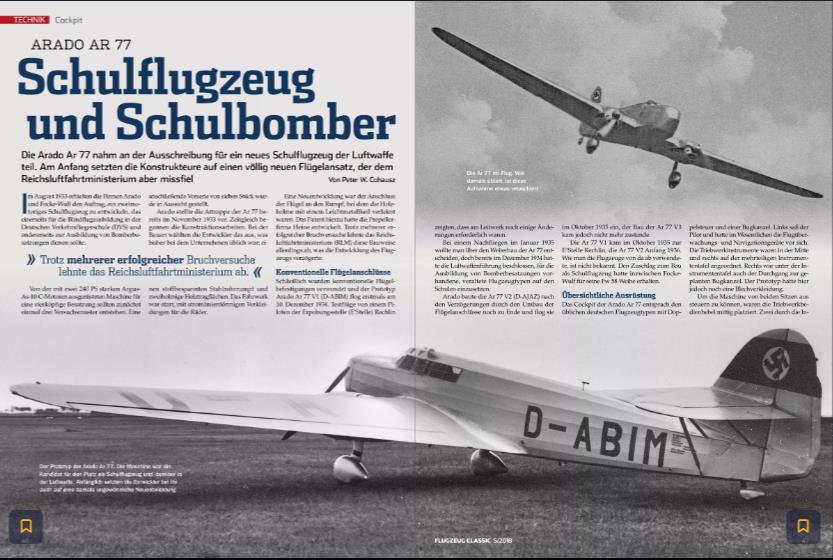
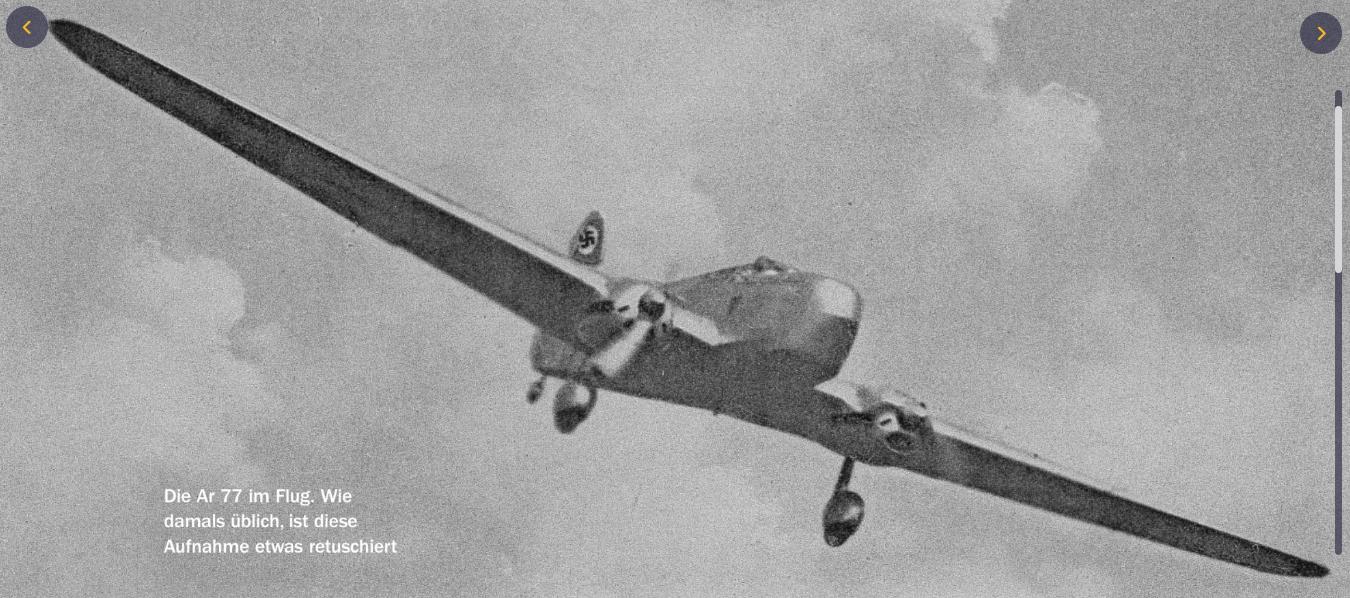
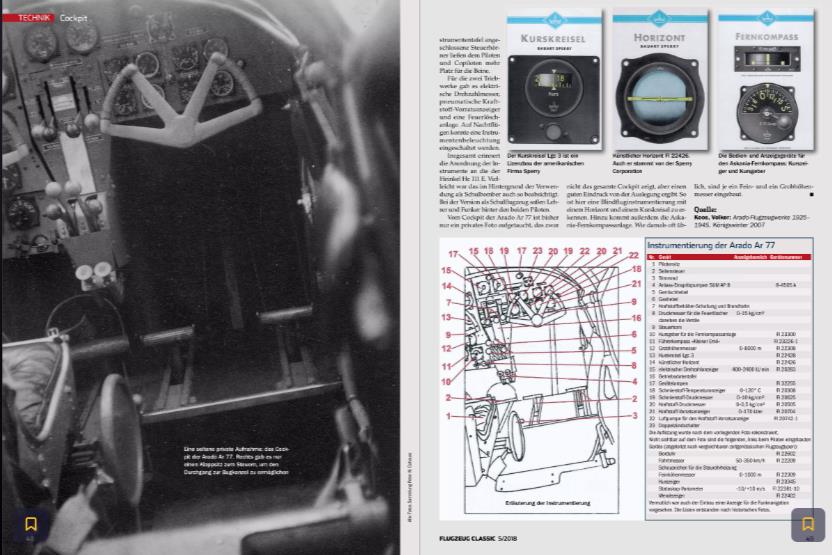
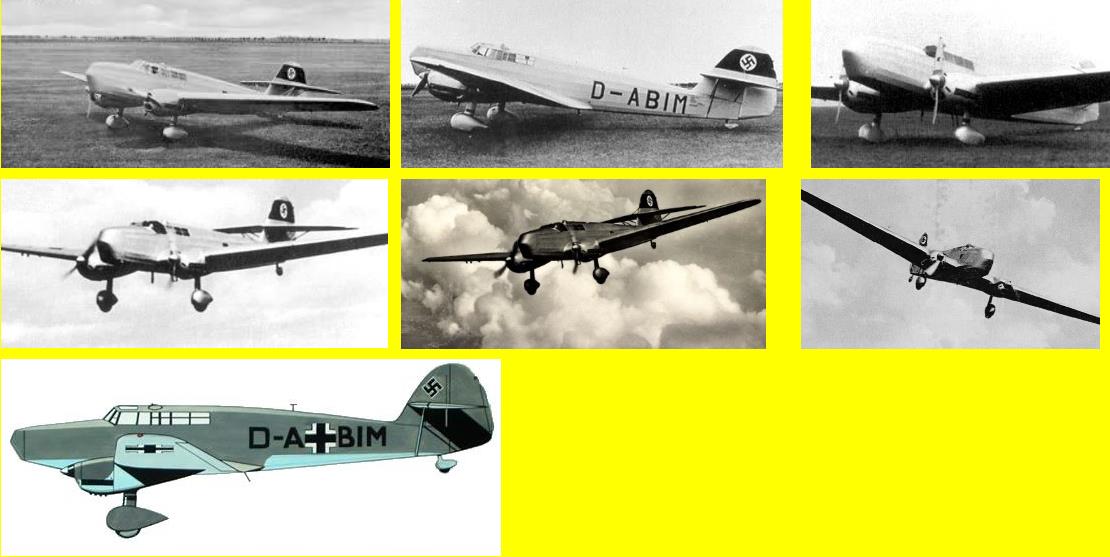
The Ar 77 had a thick cantilevered wooden wing which was skinned with plywood on the under-surfaces and covered with fabric on the upper surfaces. The fuselage was built up from welded steel tubing covered with fabric. Tail surfaces were built up from steel tubing and were also fabric covered,not following Arado's trademark layout of a fin and rudder forward of the tailplane;instead the tailplane was high mounted on the fin and supported by steel tube 'N' struts. Elevators and rudder were covered with fabric, aerodynamically balanced in the Ar 77A and without aerodynamic balance horns in the Ar 77B. The fixed tailwheel undercarriage consisted of cantilevered oleo-pneumatic main-leg struts fitted with brakes and a tail-wheel under the rear fuselage. The four crew members, being Pilot, Navigator or Instructor, and two Students, were accommodated in a cabin with full length windows along the fuselage sides.
The Arado Ar 77 was characterised by the relatively low placement of its engines in relationship to the wings. There was room for two people in the cockpit, and four other people, such as radio operators, in the fuselage. However, the Luftwaffe criticized the aircraft, instead, preferring the Focke-Wulf Fw 58.
Schul- und Uebungsflugzeug Arado »Ar 77".
Zur Umschulung auf mehrmotorige Flugzeuge haben die Arado-Flugzeugv/erke einen freitragenden Tiefdecker mit zwei Argus-As-10-Motoren herausgebracht, der für vier
Mann Besatzung Raum bietet und mit vollständiger Nachtflug ei nrichtung einschließlich FT- und Peilgerät ausgestattet ist.
Flügel in Holzbau, zweiholmig, mit vier Kugelverschraubungen an die Hauptspanten des Rumpfes angeschlossen. Flügelnase und Unterseite bis zum Hinterholm
sperrholzbeplankt, der übrige Teil mit Stoff bespannt. Zwischen den Obergurten der beiden Holme Innenauskreu-zung. Zwischen Rumpf und Motorverkleidung ist die
Nase in Blech ausgeführt und leicht abnehmbar. Landeklappen zwischen den Querrudern und dem Rumpf.
Rumpf aus Stahlrohren geschweißt, hölzernes Verkleidungsgerüst für die Befestigung der Stoff Bespannung. Bug mit Blech bedeckt. Zwei Führersitze nebeneinander,
nach Hochklappen des rechten Sitzes ist der Zugang zur geschlossenen Kabine mit zv/ei bzw. drei Sitzen frei. Haube des Führerraumes abwerfbar. Die Ueberdachung der
Kabine kann aufgeklappt und in dieser Stellung arretiert werden.
Leitwerk in Metall bau weise, Flossen meta II beplankt, Ruder stoff-bespannt. Beide Ruder besitzen Torsionsnasen, Höhenflosse an der Kielflosse befestigt und nach dem
Rumpf auf jeder Seite durch einen N-Stiel abgestrebt. Ruder mit Gewichtsausgleich und Trimmklappen versehen.
Fahrv/erk freitragend in Einbeinbau v/eise. Jedes Rad sitzt an einer Federstrebe, die hinter dem Motor am Vorderholm befestigt ist. Druck gummifederung mit
Oeldämpfung. Bremsbare Räder 690X200, stromlinienförmig verkleidet. Schv/enkbares, durch Gummizüge in Mittelstellung gehaltenes Spornrad. Abmessungen 290X110.
Triebwerk: zv/ei Arg us-As-IO-Motoren von je 240 PS im Flügel. Anlassen durch Handandrehkurbel oder Druckluft. Für jeden Motor ist zwischen den Holmen in Rumpfnähe
ein Brennstofftank von 170 1 Inhalt vorhanden. Oelbehälter aus" Stahlblech vor dem Brandspant, Röhrchenkühler für die Rückkühlung des Schmieröles an den
Zylinderköpfen befestigt.
Spannv/eite 19,2 m, Länge 12,6 m, Höhe 3,25 m, Fläche mit Rumpfanteil 50,5 m2, Leergewicht 2010 kg, Fluggev/icht 2885 kg, Flächenbelastung 57,2 kg/m2,
Leistungsbelastung 6 kg/PS, Höchstgeschwindigkeit am Boden 243 km/h, Reisegeschw-. 202 km/h, Lande-geschw. 84 km/h, Steigzeit auf 1000 m 3,9 min, auf 2000 m 8,8
min, Dienstgipfelhöhe 4900 m, Reichv/eite 720 km, Flugdauer 3,5 StdU Brennstoffverbrauch 71 kg/h, entsprechend 45-50 1/100 km.
| Type |
2 + 2 trainer |
| Engine |
2 × Argus As 10C 2-bladed wooden propeller, 2.3 m diameter |
| Dimensions |
Length 12.6 m span: 19.2 m height: 3.25 m wing area: 50.5 m2 |
| Weights |
Empty weight: 1,930 kg max takeoff weight: 2,940 kg fuel capacity: fuel 340 l + oil 25 l |
| Performance |
Max. speed: 240 km/h at sea level cruising speed: 200 km/h stall speed: 84 km/h range: 720 km service ceiling: 5,000 m rate of climb: 4.76 m/s time to altitude: 1,000 m in 3.5 minutes |
| Type |
Werk.Nr |
Registration |
History |
| V1 |
845 |
D-ABIM |
First flight 10 December 1934. Tested at Rechlin 1935. |
| V2 |
846 |
D-AJAZ |
First flight in ctber 1935. Tested at Rechlin 1935. Used to test different gun positions and light bombs |
| V3 |
847 |
|
Cancelled |