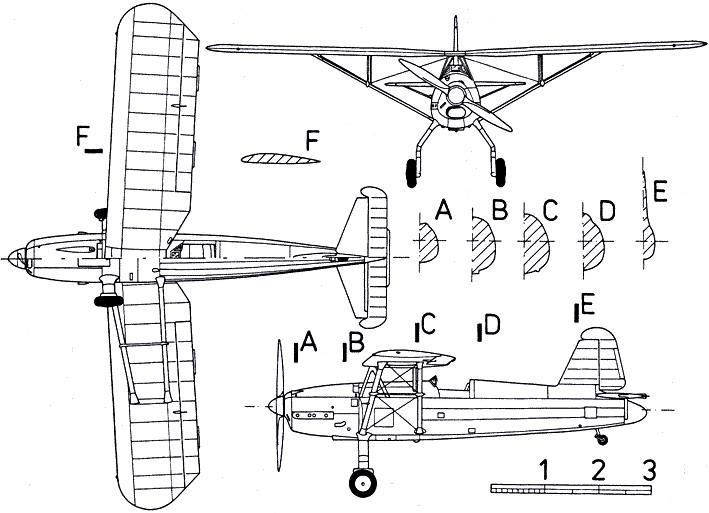
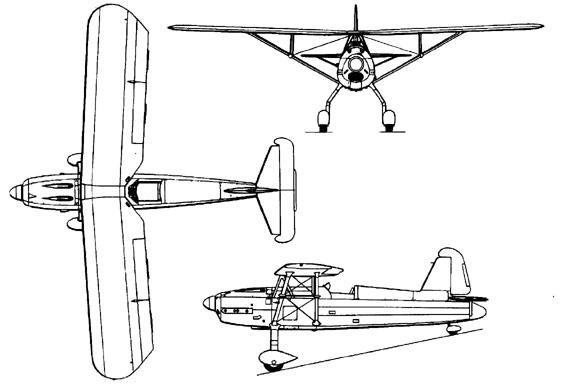
The Arado Ar 76 was a German aircraft of the 1930s, designed as a light fighter with a secondary role as an advanced trainer in mind. It was Arado's response to a requirement by the Reichsluftfahrtministerium (RLM) for such an aircraft, and in 1935 was evaluated against the Heinkel He 74, Focke-Wulf Fw 56, and the Henschel Hs 121 and Hs 125. Although the Fw 56 was selected for the main production contract, the RLM was sufficiently impressed by the Ar 76 to order a small number of these as well. The Ar 76 was a parasol-wing monoplane with fixed, tailwheel undercarriage. The wings were fabricovered wood, and the fuselage was fabric over steel tube.
Source Flugsport No 5 1935
Die Arado- Flugzeugwerke G.m.b.H, Warnemünde haben unter der Bezeichnung Arado Ar 76 einen abgestrebten Hochdecker als Uebungseinsitzer in Gemischtbauweise herausgebracht der zur Schulung fortgeschrittener Flugschüler bestimmt ist.
Die statiche Festigkeit genügt den stärksten Anforderungen, volle Kunstflugtauglichkeit. Das Verhalten im Kunstflug ist sehr angenehm, vor allem sind die geringen Trudelzeiten bemerkenswert.
Mit Rücksicht auf den Schulbetrieb wurde bei der Konstruktion auf leichte Reparaturfähigkeit und die Möglichkeit schneller Aus wechslung der einzelnen Teile großer Wert gelegt.
Rumpf geschweißtes Stahlrohrgerüst. Der vordere Teil des Rump fes sowie der Rumpfrücken sind mit Blech beplankt. der übrige Teil hat Stoffbespannung. Flügel abgestrebt, mit 3? Pfeilform. hat rechteckigen Umriß mit abgerundeten Enden. Holme mit Kiefergurten und Sperrholzstegen, Rippen aus Linde. Der Spannturm ist mit dem Rumpf verschweißt die Stiele sind ausgekreuzt. Durch die gewählte Ausführung wird ein fachstes Auf- und Abrüsten gewährleistet.
Flossen und Ruder sind in Metall aufgebaut und mit Stoff bespannt. Die Austrimmung in der Luft erfolgt durch eine verstellbare Hinterkante des Höhenruders. Höhen- und Querruder haben Gewichts ausgleich.
Federbein geknickt mit Oeldämpfung and Druckgummfederung. Die Räder haben Niederdruckbereifung und Oeldruckbremsen. Sporn rad mit Druckgummifederung. Alle Räder besitzen Tropfenverklei dung.
Triebwerk Argus-As-10-C-Motor, 240 PS Leistung. Der Motor-träger ist an 4 Punkten am Rumpf aufgehängt und leicht abnehmbar: die Motorhaube ist aufklappbar. Der im Vorderteil untergebrachte Kraßstoffbehälter faßt 105 Liter. Der Oelbehälter liegt unmittelbar vor dem Brandspant und hat einen Inhalt von 12 Litern. Der Brandspant besteht aus Dural-Asbest-Dural.
Der Motor wird durch Handandrehvorrichtung angelassen; außerdem ist eine Druckluftanlage eingebaut .
Normale Knüppelsteuerung. Fußhebel verstellbar. Sämtliche La gerstellen haben Kugellager und sind leicht zu überwachen.
Führerraum sehr geräumig, gute Ein- und Ausstiegmöglichkeit mit Fallschirm wurde bei der Konstruktion besonders beachtet. Sitz im Flug verstellbar. Gute Sicht. auch nach hinten. Alle wichtigen Teile sind durch abnehmbare Verkleidungsbleche leicht zu kontrollieren.
Source : William Green "Warplanes of the third Reich"
Among the earliest specifications drawn up by the C-Amt of Göring's Luftfahrtkommissariat was one calling for a lightweight single-seater for use as an emergency Heimatschutzjäger, a"home defence fighter". It had also to be suited for the role of advanced fighter trainer, and the importance attached to this specification by the Luftfahrtkommissariat may be gauged from the fact that no fewer than four aircraft manufacturers, Arado, Focke-Wulf, Heinkel and Henschel, were asked to submit proposals. The Heimatschutzjäger idea was not novel in Germany, as the Reichswehrtninisterium had prepared a similar specification in the 'twenties, and as now envisaged by the C-Amt, the aircraft was to be a high-wing monoplane designed around the Argus As 10C eight-cylinder inverted-Vee air-cooled engine, and capable of mounting either one or two 7.9-mm. MG 17 machine guns. The specification was later (in the autumn of 1934) to be amended to stipulate the twin-gun mounting plus the ability to carry three 22-lb. bombs for the Heimatschutzjliger role, armament being restricted to one MG 17 for the fighter training role.
Arado's contribution to the programme, the Ar 76 designed to the same strength factor as the Ar 67 and 68 fighters, was a parasol monoplane with a simple tubular steel fuselage with wooden formers, light alloy skinning forward and along the upper decking, and fabric covering for the aft sides and under-side. The wings were of wooden construction with fabric covering and attached on each side to the fuselage mainframes by parallel bracing struts. Provision was made in the upper decking of the forward fuselage for two MG 17 machine guns, and a bay was provided immediately aft of the fireproof bulkhead to house a magazine containing three vertically-hung 22-lb. bombs.
The first prototype, the Ar 76a (D-ISEN), was completed late in 1934, this being followed in the spring of 1935 by a second prototype, the Ar 76 V2 (D-IRAS). The Ar 76 V2, like the Ar 76 V3 completed shortly after the second prototype, differed from the original Ar 76a, which had been lost in an accident at an early stage in the flight test programme, in having some tail assembly modifications, these including the elimination of all dihedral on the horizontal surfaces. The general characteristics of the Ar 76 were adjudged excellent, but in the final evaluation of the contending designs, the Arado competitor was placed second to the Focke-Wulf Fw 56 Stösser. Nevertheless, a small production series of Ar 76A aircraft was ordered as a back-up for the Fw 56 programme, and these, delivered to the Luftwaffe in the spring of 1936, were used by the Jagdfliegerschulen. As a result of some minor structural strengthening and certain equipment changes, the empty and loaded weights of the Ar 76A were increased by 99 lb. and 176 lb. respectively over those of the V2 and V3, these increases being accompanied by a small reduction in performance.
| Type |
V1 - V3 Single seat advanced trainer |
A Single seat advanced trainer |
| Engine |
1 Argus As 10 C |
| Dimensions |
Length 7,2 m , height 2,55 m (tailskid on the ground) , span 9,5 m , wing area 13,34 m2 , |
| Weights |
Empty , loaded , max. take off weight |
Empty 750 kg, load 320 kg flying weight 1070 kg wing loading 80,15 kg/m2 powerloading 4,46 kg/hp, fuel 105 l |
| Performance |
Max.. speed , cruising speed , range , endurance , service ceiling , climb |
Max. speed at sealevel 272 km/h landingspeed 100 km/h climb to 1000 m 2,5 min. to 5000 m 21 min. service ceiling 6400 m . cruising speed at sea level 220 km/h landingspeed 100 km/h, endurance 2,14 h max. range 470 km |
| Armament |
|
Fighter) Two 7.9-mm. MG 17 with 250 r.p.g. plus three 10 kg bombs (trainer) one 7.9-mm. MG 17 with 250 rounds. |